


 Universiti Malaysia Sabah
UMS Sustainable Investment Policy
UMS Investment Policy for Sustainability Initiatives
At Universiti Malaysia Sabah (UMS), we are committed to advancing sustainability in all aspects of our operations, including how we manage investments. Our Investment Policy for Sustainability Initiatives outlines our approach to responsibly investing in projects, research, and infrastructure that align with environmental, social, and governance (ESG) principles. As part of our dedication to fostering a sustainable future, UMS integrates sustainability into its investment decisions by focusing on key areas such as renewable energy, health innovations, and socially responsible practices. In support of this mission, UMS has established the Centre for Sustainable Society Engagement, which serves as a platform to promote inclusive, community-driven sustainability initiatives and to strengthen our collaboration with stakeholders at the local, national, and international levels. Through this policy and the Centre, UMS ensures that its educational and research goals are achieved while actively contributing to broader global sustainability objectives.
Key Areas of Focus:
1. Renewable Energy Investments
Universiti Malaysia Sabah (UMS) is steadfast in its commitment to becoming a sustainable university by championing climate action and embedding sustainable practices across all dimensions of its operations, academic activities, research, and community engagement. This commitment reflects UMS’s active contribution toward achieving the United Nations Sustainable Development Goals (SDGs), particularly SDG 7 (Affordable and Clean Energy), SDG 12 (Responsible Consumption and Production), and SDG 13 (Climate Action).
In line with this vision, UMS prioritises investments in renewable energy technologies to support sustainable campus operations and reduce its overall carbon footprint. These efforts are consistent with national and global agendas to accelerate the transition toward clean and efficient energy systems.
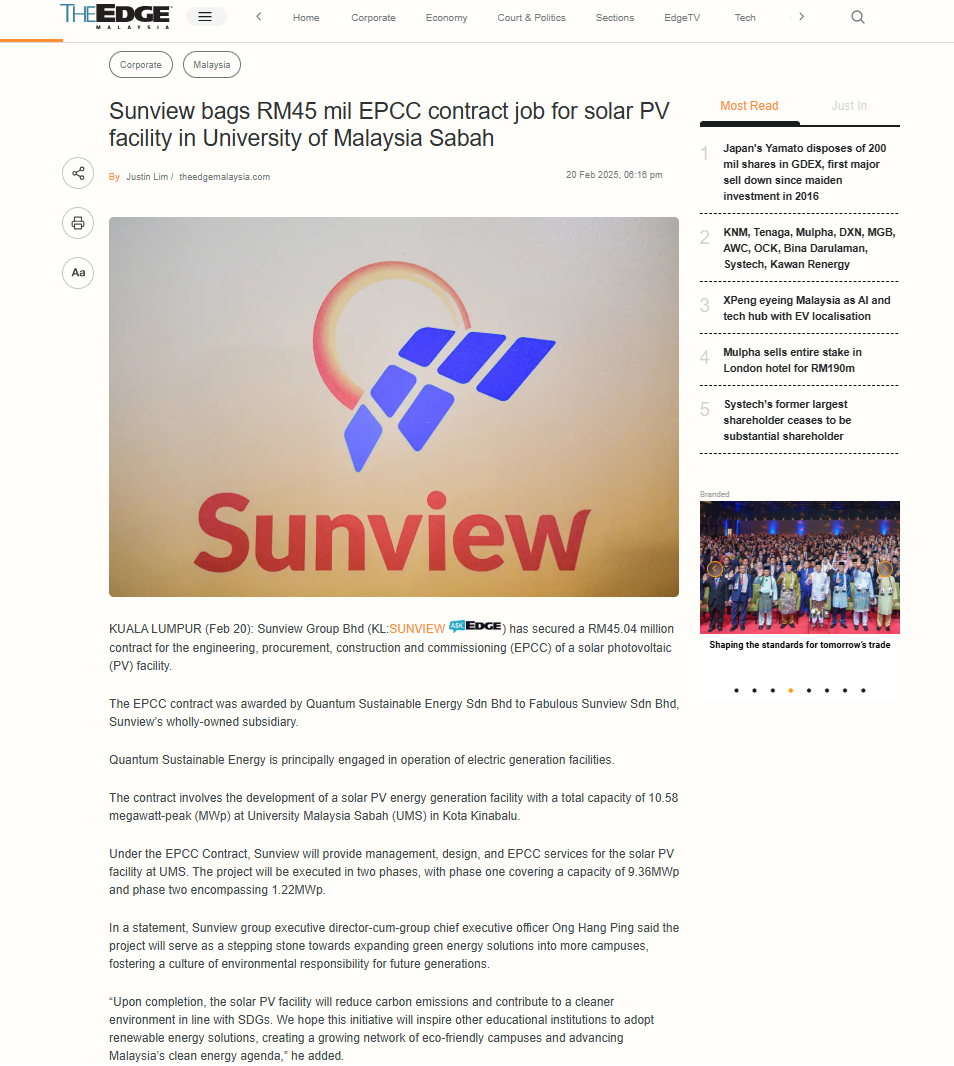
A key milestone in this initiative is the development of a 10.58-megawatt-peak (MWp) solar photovoltaic (PV) energy generation facility at UMS, undertaken by Fabulous Sunview Sdn. Bhd., a wholly-owned subsidiary of Sunview Group Berhad, under an Engineering, Procurement, Construction, and Commissioning (EPCC) contract valued at RM45.04 million. The project, awarded by Quantum Sustainable Energy Sdn. Bhd., will be executed in two phases — the first with 9.36MWp capacity and the second with 1.22MWp — marking one of the largest university-based solar initiatives in Malaysia.
Upon completion, this solar PV facility will significantly reduce greenhouse gas emissions, lower campus electricity dependency on non-renewable sources, and set a benchmark for green campus development in Borneo and beyond. It will also serve as a living laboratory for research, innovation, and education in renewable energy, empowering future generations to drive sustainable change.Through these strategic investments, UMS reaffirms its role as the “Brain of Borneo” in leading sustainable transformation and inspiring other institutions to embrace renewable energy solutions for a cleaner and greener future.
2. Health and Well-Being Investments Policy and Initiatives
As part of its commitment to the United Nations Sustainable Development Goals (SDGs), particularly SDG 3 (Good Health and Well-Being), Universiti Malaysia Sabah (UMS) integrates health-related research, services, and education into its broader sustainability and investment strategy. UMS recognises that equitable access to healthcare and the promotion of community well-being are fundamental pillars of sustainable development.
Through the Hospital Universiti Malaysia Sabah (HUMS), UMS provides comprehensive healthcare services to the university community and the wider public, including underserved and rural populations. HUMS embodies UMS’s commitment to advancing public health, social equity, and sustainable medical education. Its operations are strengthened through strategic investments and a network of satellite and community-based healthcare facilities that expand healthcare accessibility across Sabah.
Major Health-Related Investments:
- i. Hospital Universiti Malaysia Sabah (HUMS) The Hospital Universiti Malaysia Sabah (HUMS) represents a cornerstone investment in the university’s healthcare and education infrastructure. Valued at RM652 million, this 400-bed tertiary teaching and referral hospital offers medical, surgical, and specialist services while housing advanced facilities for teaching, research, and clinical training in medicine and health sciences.
- ii. Access Road to HUMS To ensure seamless connectivity between HUMS and the main campus, UMS invested RM18.94 million in the construction of a 1.25-kilometre access road complete with drainage, utilities, and supporting infrastructure. This initiative improves patient and logistics access, complementing HUMS’s operational efficiency.
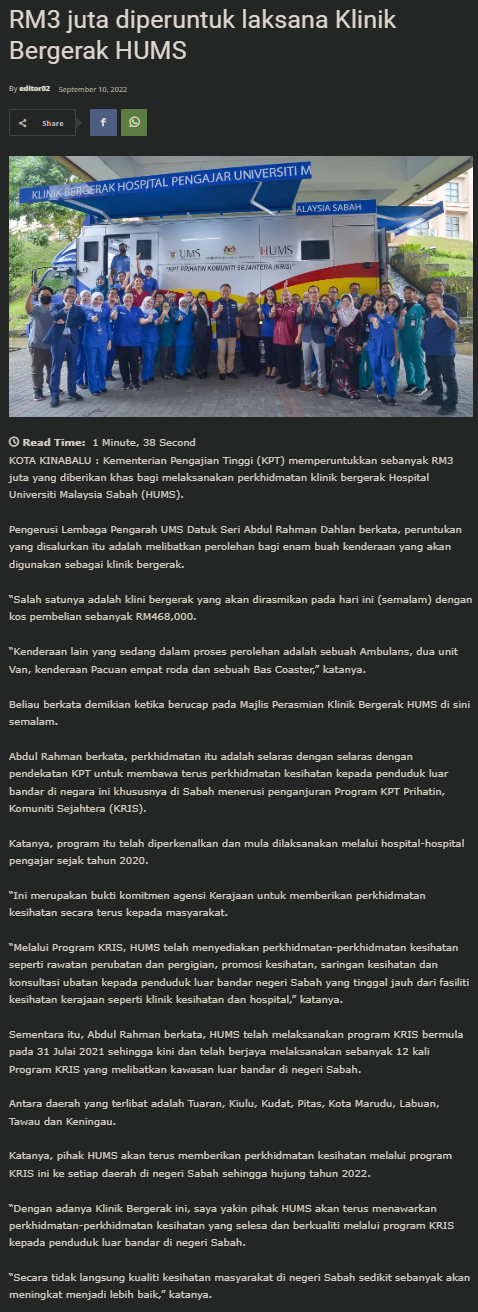
- iii. HUMS Bergerak (Mobile Clinic) The HUMS Bergerak initiative expands healthcare access to rural and remote Sabah communities. With a total investment of RM3 million, including RM468,000 for the acquisition of a specialised mobile clinic vehicle, the programme delivers diagnostic and preventive care directly to underserved populations. It exemplifies UMS’s outreach-based sustainability model.
- iv. Pusat Rawatan Warga (PRW) The Pusat Rawatan Warga provides preventive, curative, and mental-health services to UMS staff and students, ensuring a healthy learning and working environment. While specific capital expenditure data are not publicly disclosed, PRW is recognised as a vital component of UMS’s internal health ecosystem.
- v. Rural Medical Education Centre (Pusat Rendidikan Perubatan Desa), Kudat Established in 2009, the Rural Medical Education Centre (RMEC) in Sikuati, Kudat functions as both a community health facility and a living laboratory for rural medical education. It supports experiential learning, research, and healthcare delivery in remote areas, reinforcing UMS’s dedication to rural health equity.
- vi. Klinik HUMS (Poliklinik UMS) The Klinik HUMS, also referred to as Poliklinik UMS, operates as an outpatient and specialist consultation centre supporting the broader HUMS system. It offers accessible primary and specialist healthcare to the campus and nearby communities, though no official investment amount has been publicly reported.
3. Centre for Sustainable Society Engagement (CSSE)
The Centre for Sustainable Society Engagement (Pusat Kelestarian Libatsama Masyarakat) at Universiti Malaysia Sabah (UMS) is a dedicated platform for advancing sustainable development through education, community partnership, and knowledge transfer. The Centre acts as a vital bridge between the university and society, focusing on empowering local communities with the knowledge, skills, and tools necessary to address pressing environmental, social, and economic challenges.
Through collaborative outreach programmes, educational workshops, and community-based projects, CSSE facilitates the practical application of sustainability principles at the grassroots level. It translates academic research into accessible, actionable knowledge, supporting lifelong learning, inclusive growth, and the development of resilient communities that align with national and global sustainability aspirations, particularly the United Nations Sustainable Development Goals (SDGs).
CSSE reflects UMS’s deep commitment to ensuring that sustainability is a shared and inclusive responsibility—one that engages citizens, institutions, and industries alike. By fostering participatory learning and community empowerment, CSSE contributes to a future where no one is left behind in the journey toward a sustainable and equitable Borneo.
4. Sustainability-Driven Research Investments
Universiti Malaysia Sabah (UMS) places sustainability at the heart of its research and innovation ecosystem. Guided by the principles of the United Nations Sustainable Development Goals (SDGs), UMS prioritises research that promotes environmental stewardship, social inclusion, and sustainable economic growth as integral dimensions of its academic mission.
Through the UMS Research Management Centre (RMC) and the Innovation & Commercialisation Management Centre (ICMC), UMS actively supports research and innovation projects that address critical global and regional challenges. These include climate change adaptation, biodiversity and ecosystem conservation, renewable energy transition, sustainable resource management, and community resilience. Such initiatives not only generate impactful scientific knowledge but also deliver practical, evidence-based solutions that directly benefit society and the environment.
UMS continues to channel strategic investments into interdisciplinary research centres, living labs, and sustainability-driven collaborations, fostering a research culture that unites science, technology, and indigenous community wisdom. Funding priorities are directed toward projects with measurable sustainability outcomes, ensuring that university-led research contributes meaningfully to policy innovation, industry transformation, and local community empowerment.
By embedding sustainability within its research agenda, UMS reinforces its identity as the Brain of Borneo—a knowledge hub that drives innovation and advances the shared vision of a sustainable, equitable, and resilient future for Borneo and beyond.
5. Sustainable Infrastructure Development
Universiti Malaysia Sabah (UMS) is committed to developing and maintaining sustainable, inclusive, and future-ready infrastructure across its campus. Guided by the EcoCampus philosophy and the principles of the United Nations Sustainable Development Goals (SDGs)—particularly SDG 9 (Industry, Innovation and Infrastructure), SDG 11 (Sustainable Cities and Communities), and SDG 13 (Climate Action)—UMS ensures that all infrastructure investments are environmentally responsible, digitally adaptive, and socially inclusive.
UMS prioritises the development of eco-friendly buildings, energy-efficient technologies, and green open spaces that collectively reduce the university’s carbon footprint and promote environmental well-being. Initiatives such as the installation of solar photovoltaic (PV) systems, the implementation of rainwater harvesting, and the enhancement of waste segregation facilities reflect UMS’s ongoing efforts toward achieving a low-carbon and resource-efficient campus.
In line with the Digital UMS agenda, the university integrates smart campus technologies—including energy monitoring systems, digital governance tools, and online platforms that streamline operations—to improve sustainability performance and data-driven decision-making.
UMS also places great importance on inclusivity in infrastructure design, ensuring accessibility for all through OKU-friendly (Persons with Disabilities) facilities, universal design pathways, and assistive technologies that promote equitable participation in campus life.
Through continuous investment in green and inclusive infrastructure, UMS aspires to create a living model of sustainability—a campus that embodies environmental stewardship, digital innovation, and social responsibility, setting an inspiring example for universities and communities throughout Borneo and beyond.
6. Green Procurement and Sustainable Purchasing
UMS adheres to the Government Green Procurement (GGP) Policy, ensuring that sustainability is integrated into the university’s purchasing decisions. Through responsible procurement practices, UMS invests in products and services that support environmental sustainability and promote social responsibility.
The UMS Investment Policy for Sustainability Initiatives is a key component of our commitment to being a responsible and forward-thinking institution. Through these investments, we aim to contribute to the global transition towards a more sustainable, resilient, and equitable future. Our approach not only reduces environmental impact but also supports social equity, health innovation, and economic prosperity.
As we continue to evolve, UMS remains committed to making strategic investments that align with our values of environmental stewardship, social responsibility, and sustainable development. By integrating sustainability into our investment decisions, we are creating a positive impact on our community, our campus, and the world.