


Inclusive Growth for a Poverty-Free Future

UMS - SDG 1 No Poverty
Through financial aid, equitable access, and community innovation, UMS ensures that every student and family can rise above poverty and contribute to sustainable development.

 HOW WE WORK
Breaking the Cycle of Poverty Through Education and Empowerment
The United Nations Sustainable Development Goal 1 (SDG 1) calls for an end to poverty in all its forms everywhere — ensuring that all people, particularly the most vulnerable, have equal rights to economic resources, access to basic services, and the resilience to recover from social, economic, and environmental shocks. Universiti Malaysia Sabah (UMS) is deeply committed to advancing SDG 1 through inclusive education, financial empowerment, and community resilience. UMS recognises that poverty is not merely a lack of income but a multidimensional deprivation encompassing limited access to education, essential services, and sustainable livelihoods. Through integrated programmes that combine financial assistance, academic access, social outreach, and entrepreneurship, UMS breaks the cycle of poverty by empowering individuals, households, and underserved communities across Sabah to achieve dignity, self-reliance, and long-term well-being.
Universiti Malaysia Sabah
Education Access & Financial Empowerment
Since its establishment, Universiti Malaysia Sabah (UMS) has championed the belief that education is the most powerful instrument to break the cycle of poverty. Guided by the principles of inclusivity, equality, and opportunity, UMS ensures that no qualified student is left behind due to financial limitations. Through a holistic support ecosystem encompassing tuition aid, food security, transportation, and mentorship, the university empowers B40 families, first-generation learners, and rural youth to pursue tertiary education with dignity and confidence. These initiatives, many of which began as early as 2018, have progressively expanded in scope and reach, demonstrating UMS’s unwavering commitment to SDG 1 — ending poverty in all forms and ensuring equal access to economic resources and education. Together, they create a sustainable pathway for vulnerable groups in Sabah to uplift themselves through higher education and social mobility.
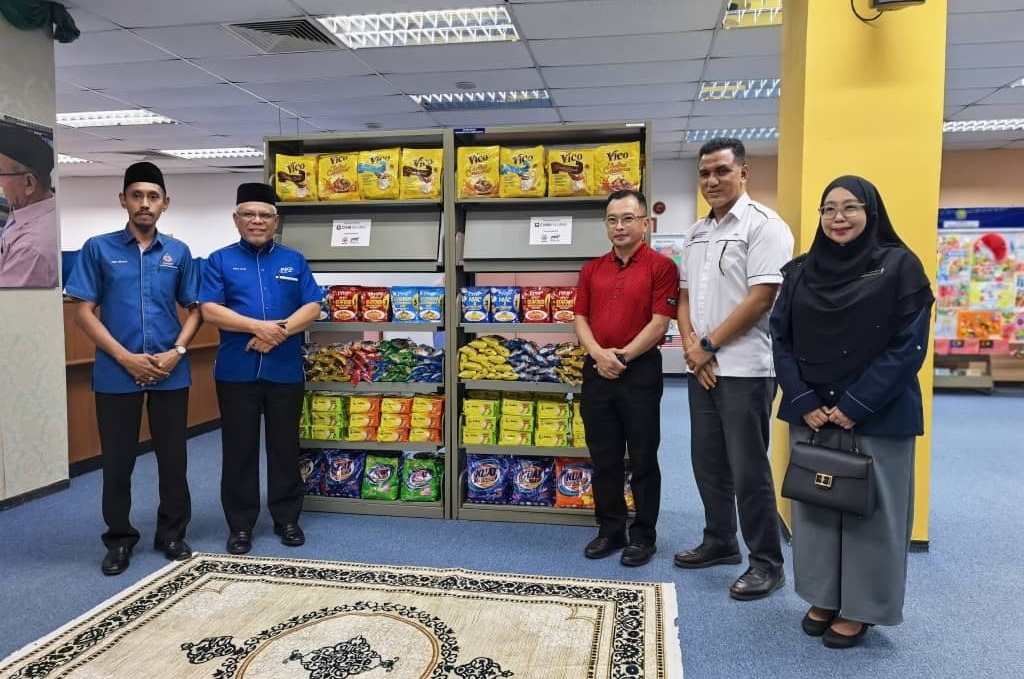
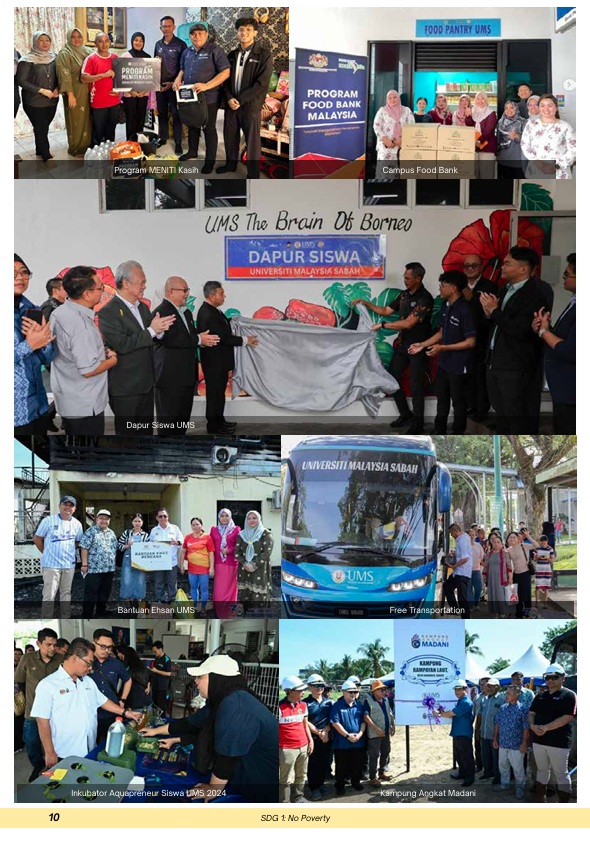
- — Dapur Siswa UMS – the central campus kitchen providing freshly prepared meals, especially during examination periods and critical times of need.
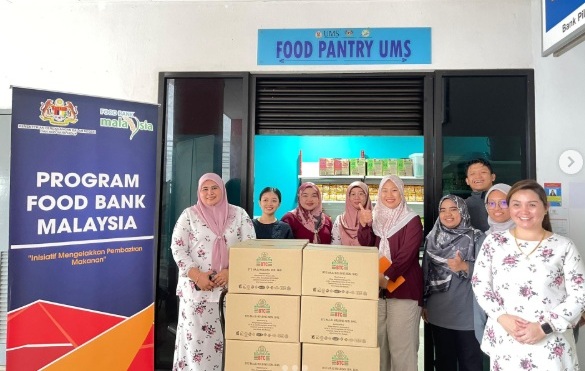
- — Dapur Pantry UMS – a self-service pantry offering dry food and daily essentials for students experiencing financial hardship.
- — Faculty-Level Food Stations – established at various faculties and research institutes to increase convenience and coverage across campus.
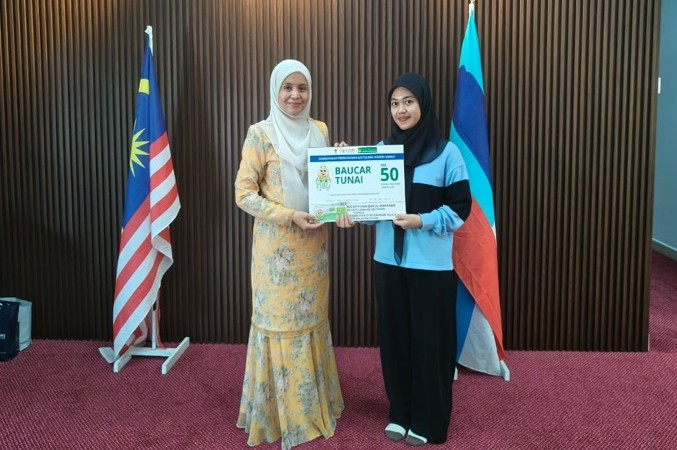
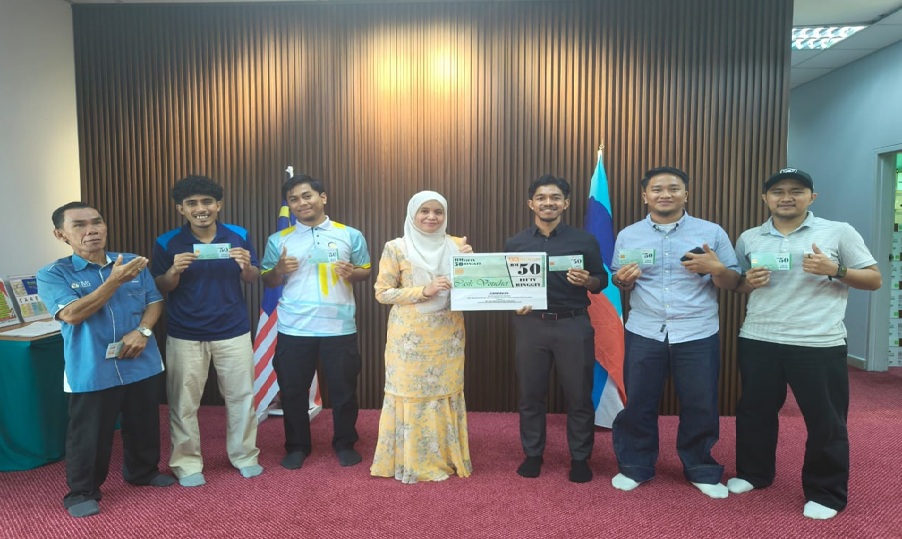
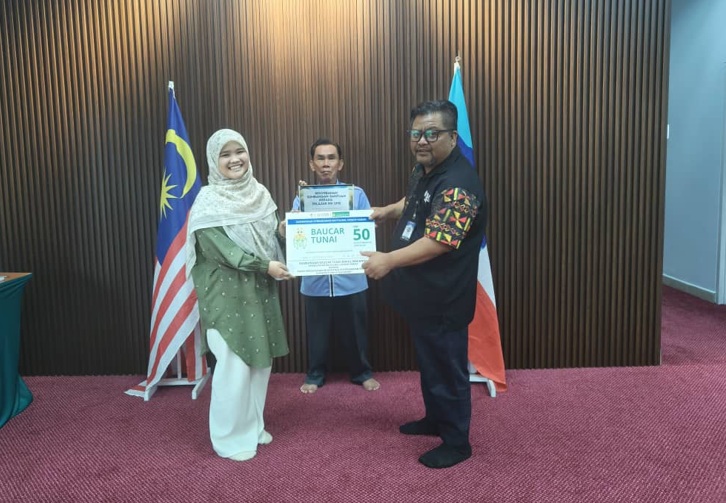
- — Food Voucher Scheme – provides redeemable meal vouchers for students in urgent or short-term hardship situations, allowing them to access food at participating cafeterias discreetly and with dignity.
- — Program Jom Breakfast UMS – a proactive initiative promoting healthy breakfast habits among students. Free or subsidised morning meals are provided through Dapur Siswa and selected faculty canteens, especially during examination periods or registration weeks. The programme is supported by staff associations, alumni, NGOs, and local sponsors, ensuring students begin their day with energy and focus.
- - Bantuan Sara Hidup (Living Allowance Assistance): provides basic financial support for daily expenses to students in hardship.
- - Bantuan Khairat Kematian (Bereavement Fund): offers compassionate financial assistance to affected students or their families.
- - Bantuan Kesihatan (Health Aid): supports students in covering medical or hospitalization costs.
- - Bantuan Kecemasan (Emergency Aid): provides rapid financial relief for unforeseen crises.
- - Insurans Pelajar (Student Insurance): ensures all students are covered under the university’s collective protection scheme.
i. UMS Financial Assistance and Cost-Sharing Scheme
Universiti Malaysia Sabah (UMS) upholds its commitment to inclusive and affordable education through a robust financial assistance and cost-sharing scheme designed to ease the financial burden on students from low-income and disadvantaged backgrounds. This initiative ensures that no qualified student is denied higher education due to economic hardship, aligning directly with SDG 4: Quality Education and SDG 10: Reduced Inequalities.
At the undergraduate level, the Malaysian Government subsidises between 86% and 95% of total programme costs, depending on the field of study. Students in Science and Information Technology programmes pay an average of RM 8,580, while the government covers RM 61,232 (87.7% of total cost). Similarly, Arts students contribute RM 6,930, with 86.2% of expenses funded by the government. More intensive programmes such as Engineering, Medicine, and Nursing receive even higher levels of support, where the government bears between 86% and 95% of total educational costs—covering tuition, laboratory usage, clinical training, and research supervision fees.
At the postgraduate level, UMS maintains strong financial accessibility. For Master’s students, the government subsidises between 79% and 90% of programme costs, while PhD candidates receive between 75% and 91% support. For example, a PhD student in Science and Information Technology contributes only RM 10,802, compared to RM 77,310 borne by the government.
This extensive subsidy framework—combined with additional support mechanisms such as the Program Siswa Sulung UMS, Bantuan Sara Hidup Mahasiswa, and Tabung Prihatin UMS—ensures equitable academic opportunity and progression. Through continuous collaboration with national agencies and private sponsors, UMS reinforces its mission to democratise education and foster upward social mobility. The scheme not only reduces financial inequality but also strengthens retention and graduation rates, particularly among students from B20 and B40 households.
UMS Undergraduate Program Cost Distribution (RM)
| Program | Cost Borne By Low-Income Student (RM) | Cost Borne By Government (RM) | Total Cost (RM) | Percentage of Cost Borne by Government (%) |
|---|---|---|---|---|
| Science and Information Technology | 8,580.00 | 61,232.00 | 69,812.00 | 87.7% |
| Arts | 6,930.00 | 43,348.00 | 50,278.00 | 86.2% |
| Engineering | 9,680.00 | 60,132.00 | 69,812.00 | 86.1% |
| Medicine | 13,330.00 | 233,590.00 | 246,920.00 | 94.6% |
| Nurse | 11,380.00 | 235,540.00 | 246,920.00 | 95.4% |
UMS Postgraduate (Master – Full Time, 2 Semesters) Cost Distribution (RM)
| Program | Cost Borne By Low-Income Student (RM) | Cost Borne By Government (RM) | Total Cost (RM) | Percentage of Cost Borne by Government (%) |
|---|---|---|---|---|
| Science and Information Technology | 5,771.00 | 38,285.00 | 44,056.00 | 86.9% |
| Arts | 5,221.00 | 19,744.00 | 24,965.00 | 79.1% |
| Engineering | 5,771.00 | 38,285.00 | 44,056.00 | 86.9% |
| Medicine | 5,771.00 | 52,096.00 | 57,867.00 | 90.0% |
UMS Postgraduate (PhD – Full Time, 4 Semesters) Cost Distribution (RM)
| Program | Cost Borne By Low-Income Student (RM) | Cost Borne By Government (RM) | Total Cost (RM) | Percentage of Cost Borne by Government (%) |
|---|---|---|---|---|
| Science and Information Technology | 10,802.00 | 77,310.00 | 88,112.00 | 87.7% |
| Arts | 9,702.00 | 40,228.00 | 49,930.00 | 80.6% |
| Engineering | 10,802.00 | 77,310.00 | 88,112.00 | 75.5% |
| Medicine | 10,802.00 | 104,932.00 | 115,734.00 | 90.7% |
ii. UMS Program MENITI Kasih
Launched in 2013, Program MENITI Kasih is one of Universiti Malaysia Sabah’s (UMS) flagship initiatives dedicated to expanding access to higher education for students from B40 (Bottom 40%)households income groups and underprivileged families. The programme provides a second-chance pathway for deserving Sabah students who were not initially offered admission into public universities — ensuring that financial hardship or lack of opportunity never becomes a barrier to higher education. Through academic bridging, preparatory guidance, and socio-emotional support, the initiative empowers students to enter, adapt, and succeed in university life.
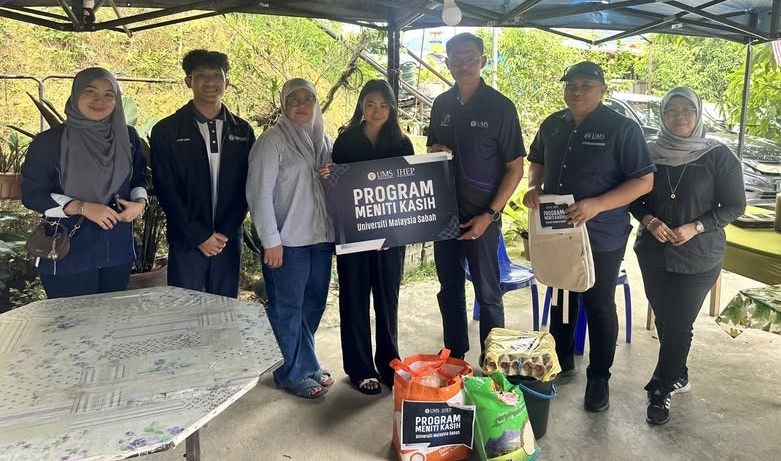
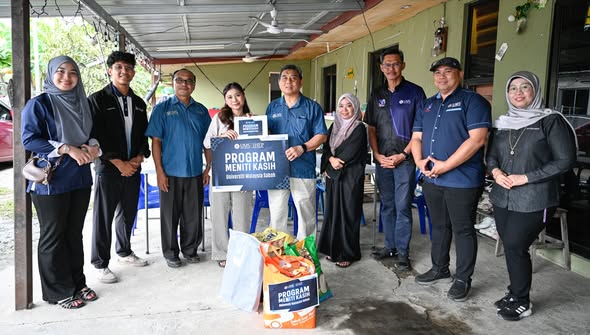
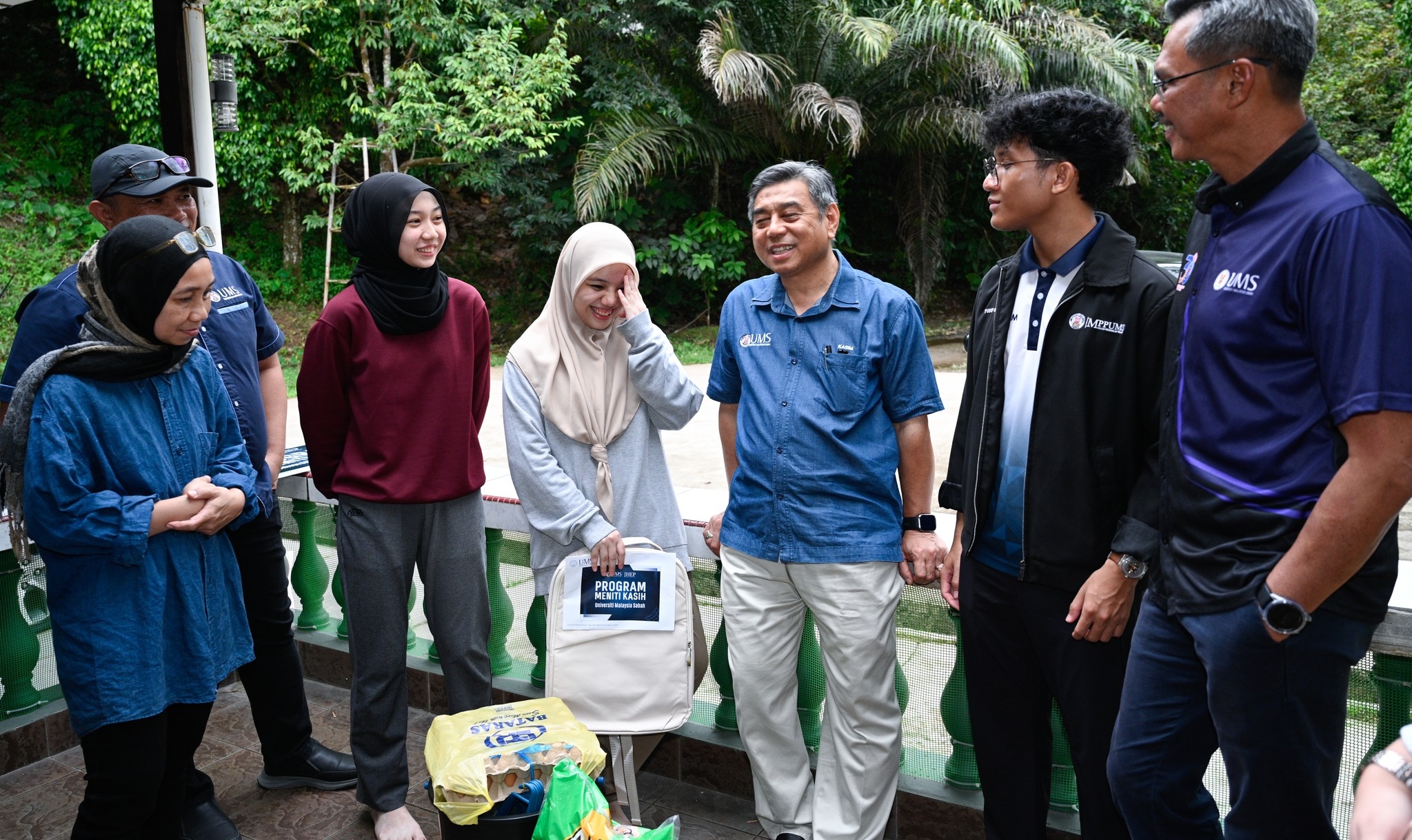
For more than a decade, Program MENITI Kasih has been implemented through the strong collaboration of UMS’s Student Affairs Division (HEPA) and Admissions Office, reflecting the university’s long-term institutional commitment to equitable access. The programme actively engages with rural schools and local communities across Sabah to identify potential students who show academic promise but face socioeconomic limitations. Since its inception, over 1,300 students have been successfully admitted through this programme — many as first-generation university entrants. To date, UMS has allocated and facilitated more than RM250 million in tuition sponsorships, living allowances, and educational support under MENITI Kasih and related access programmes. This sustained investment represents one of the largest university-led financial commitments to inclusive education in East Malaysia.
Program MENITI Kasih has evolved into a transformative vehicle for social mobility, directly addressing the structural roots of poverty through education. By converting missed opportunities into new beginnings, the programme uplifts entire families from B40 and rural communities, demonstrating the power of education as a sustainable poverty-reduction tool. Its long-term impact includes higher graduate employability, stronger community participation in higher education, and improved household income stability. The programme’s continuity over 12 years reflects UMS’s enduring leadership in turning educational access into real-world empowerment, and ensuring that every Sabahan youth, regardless of background, has the opportunity to learn, grow, and contribute to a more equitable and sustainable future.
iii. Siswa Sulung 3.0
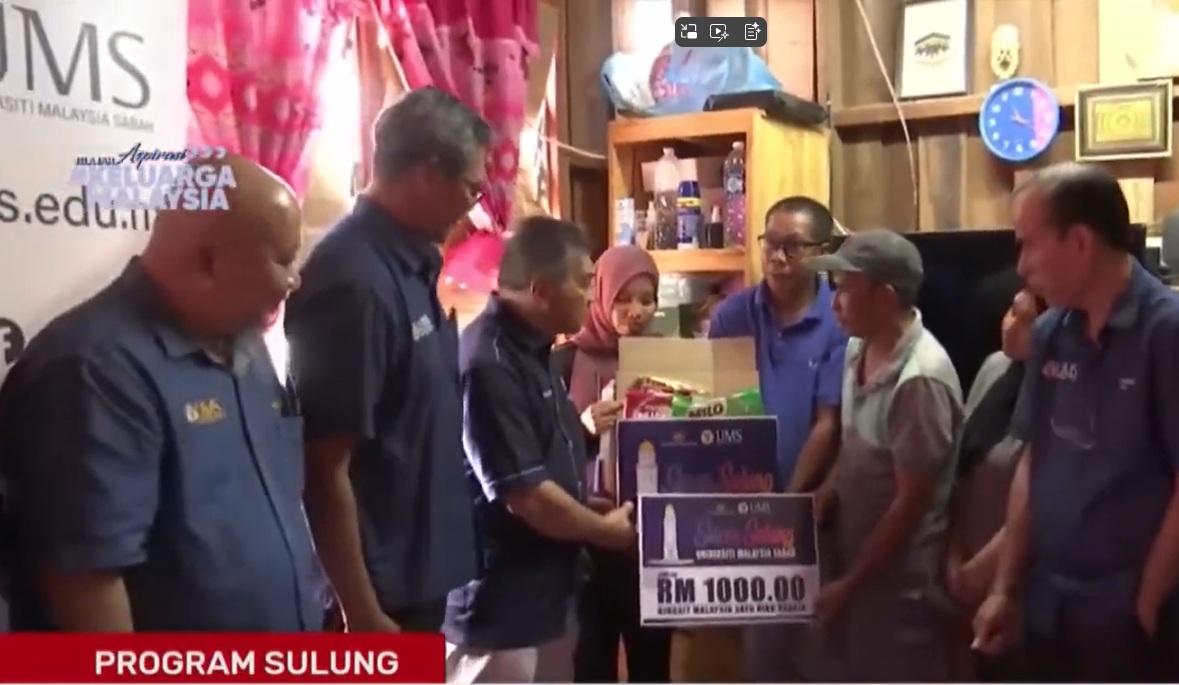
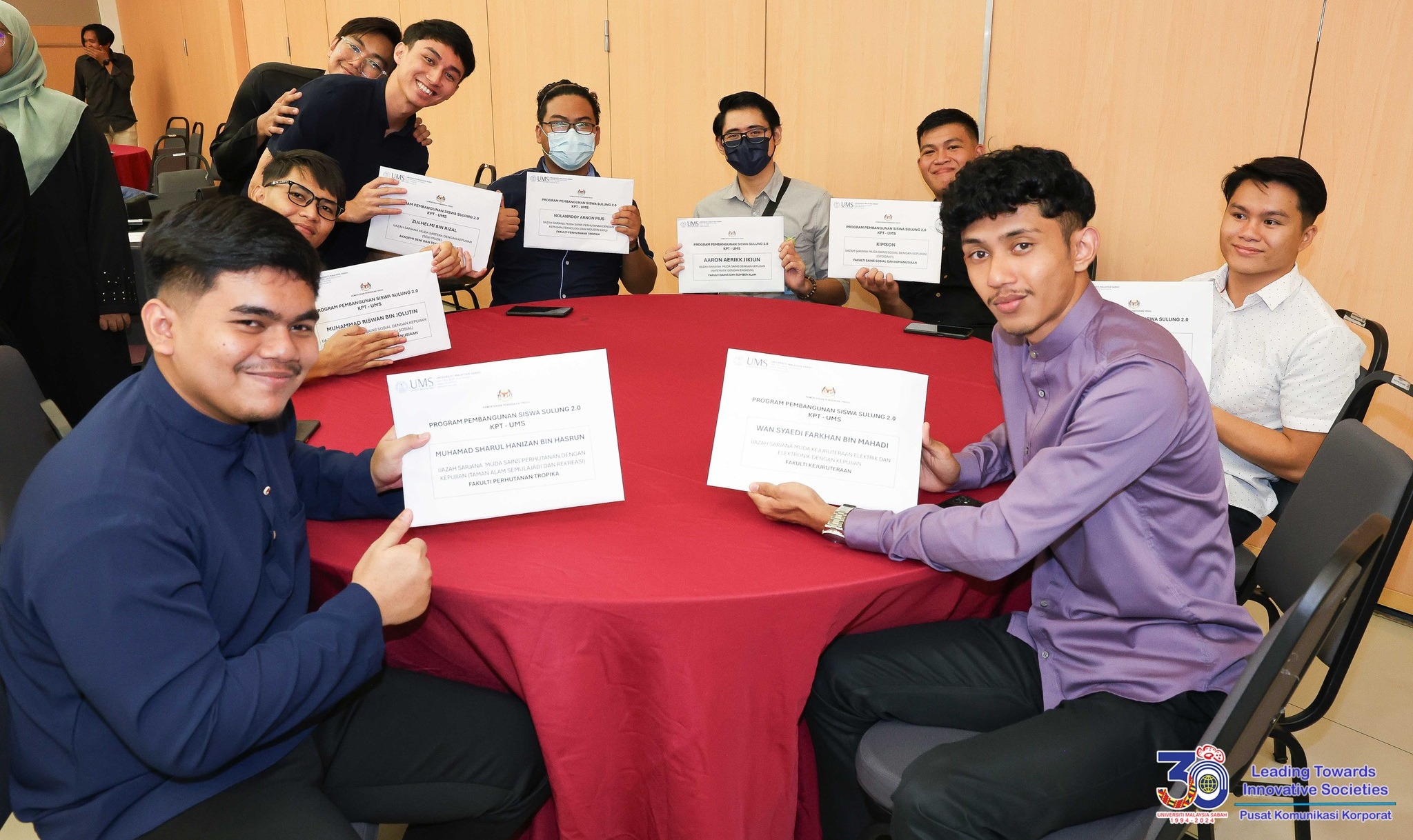
Introduced by the Ministry of Higher Education (MoHE) and implemented by UMS since 2021,Program Siswa Sulung UMS aimed to to uplift first-generation students from B40 (Bottom 40%) households who are the first in their families to pursue tertiary education. As one of Universiti Malaysia Sabah’s (UMS) key initiatives for inclusive growth, the programme removes economic barriers that often prevent talented students from continuing their studies. It offers comprehensive tuition sponsorships, academic mentoring, and personalised counselling, enabling participants to complete their degrees successfully while building the confidence and skills needed for long-term self-reliance.
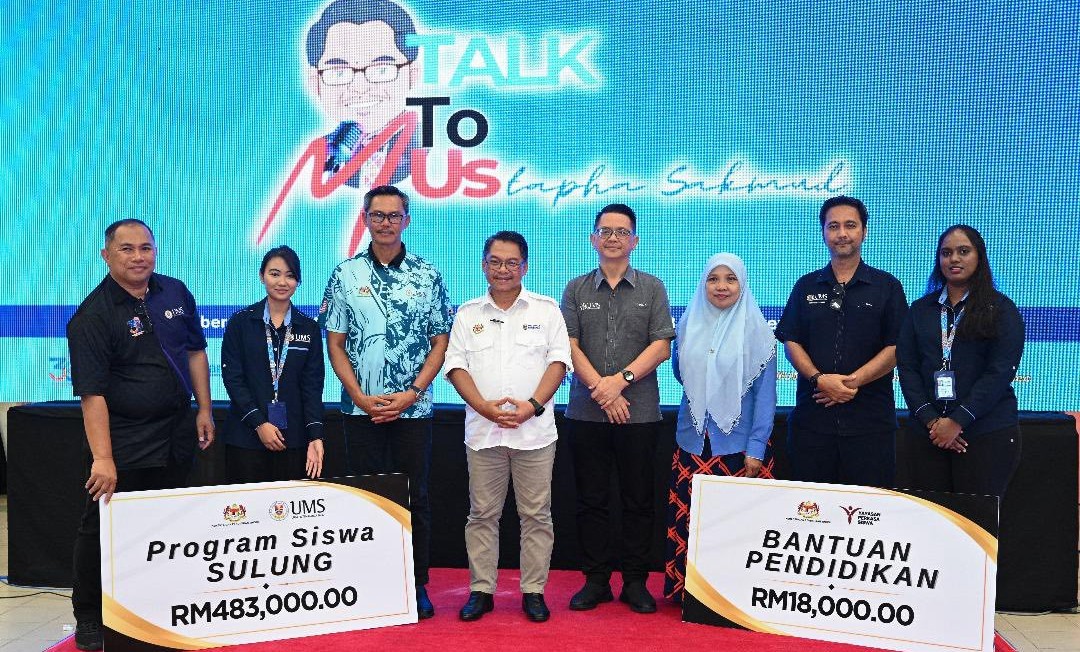
Since its launch, the programme has supported hundreds of first-generation university students, opening new pathways for academic and social mobility. In the 2025 cohort alone, 80 new students received financial assistance totalling RM 483,000, ensuring uninterrupted access to education. The university also extended the initiative’s inclusivity by awarding Bantuan Pendidikan Awal (BPA) worth RM 1,000 each to 18 students with special needs, reaffirming its deep concern for student welfare and equitable opportunity. These concrete measures demonstrate UMS’s proactive commitment to empowering underprivileged youth through sustained educational investment.
The Program Siswa Sulung UMS has become a catalyst for intergenerational transformation, directly addressing one of the root causes of poverty—limited access to higher education. By empowering first-generation students to obtain university degrees without financial hardship, the programme strengthens family resilience, raises household income potential, and contributes to a more skilled and equitable workforce in Sabah.
iv. UMS Food Assistance Programme
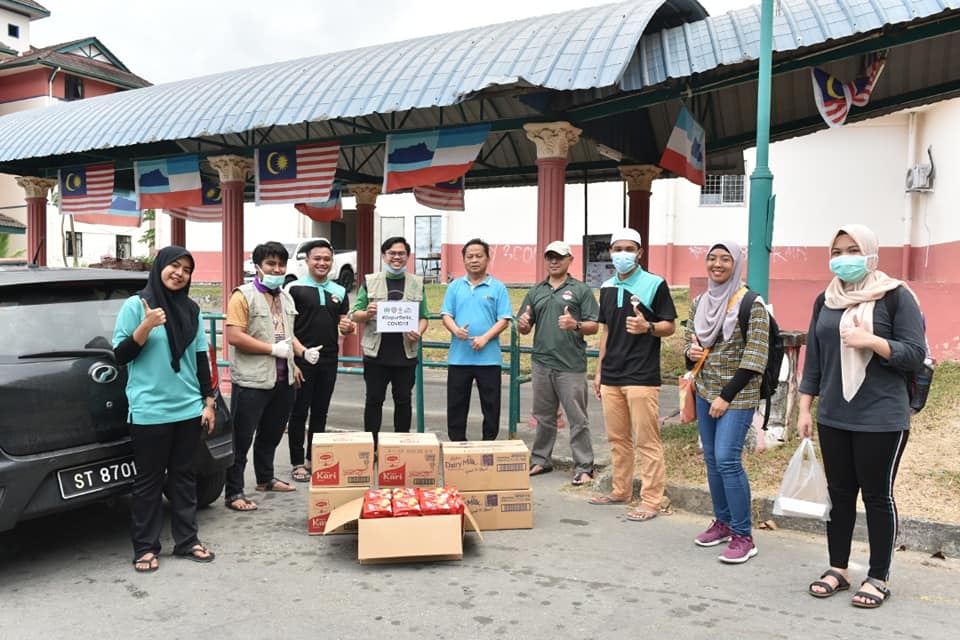
Recognising that hunger impairs learning and well-being, Universiti Malaysia Sabah (UMS) launched the Campus Food Bank in 2018 to ensure every student has reliable access to nutritious meals. The initiative evolved into the UMS Food Assistance Programme, a campus-wide effort to reduce food insecurity among students—especially those from B40 and vulnerable backgrounds. Rooted in the university’s values of compassion and equity, the programme ensures that financial difficulty never becomes a barrier to academic success.
Administered by the Student Affairs Department (HEPA), the programme operates through a coordinated network of welfare components to ensure accessibility, dignity, and continuity of support:
v. Provision of Free Transportation Facilities
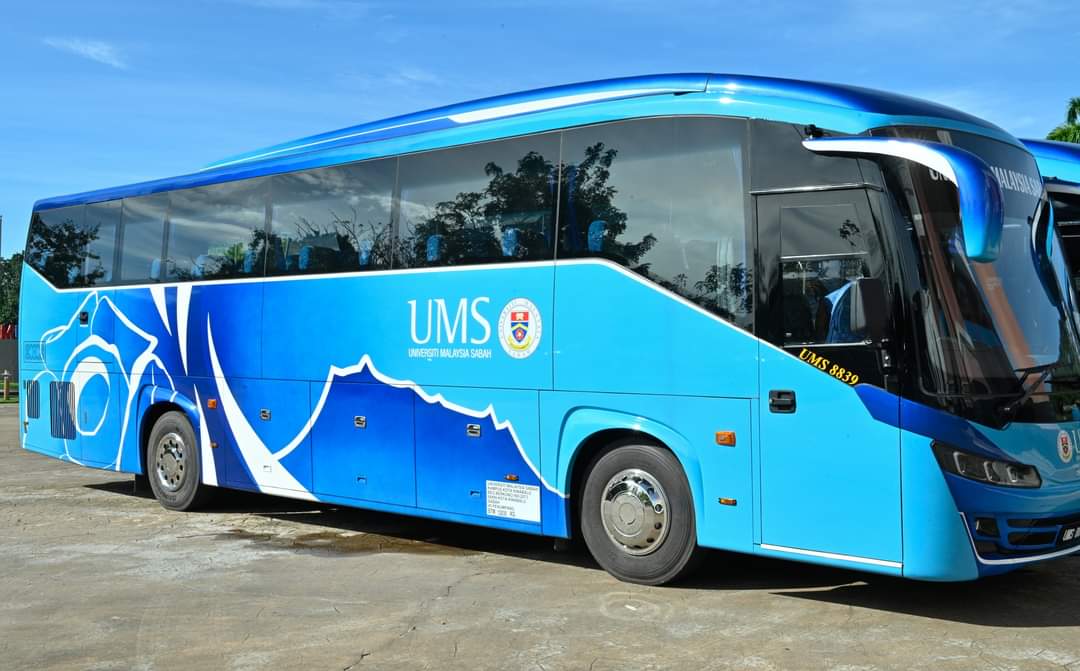
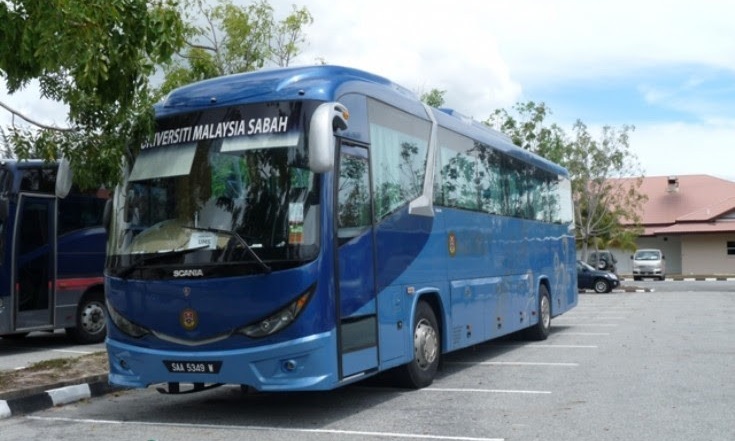
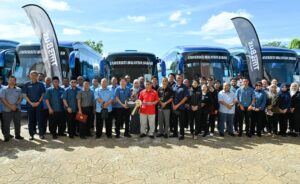
To promote equitable access to education, Universiti Malaysia Sabah (UMS) provides free campus transportation to ensure that mobility costs never become a barrier to learning. The initiative supports students—especially those from B40 (Bottom 40%) income households and rural backgrounds—by offering safe, reliable, and environmentally responsible transport options across the campus and nearby residential areas. This reflects UMS’s commitment to inclusivity, accessibility, and student welfare as part of its sustainable education ecosystem.
In 2023, UMS expanded its transportation service by adding eight new buses through an investment of RM4.9 million, significantly improving coverage and capacity. The enhanced fleet serves thousands of students daily, connecting residential colleges, lecture halls, and key university facilities. The initiative complements UMS’s broader student support framework, reducing out-of-pocket expenses for commuting and ensuring that all students—regardless of socioeconomic status—can participate fully in campus life and academic activities.
The Free Transportation Facilities initiative has reduced students’ financial burden, improved punctuality and attendance, and strengthened engagement in both academic and extracurricular programmes. For B40 students in particular, it has increased accessibility to education and reduced dropout risks associated with financial constraints. Beyond social equity, the initiative also supports sustainability goals by reducing carbon emissions through shared transport systems.
vi. Integrated Sponsorship and Student Welfare Assistance
To complement internal financial-aid programmes, Universiti Malaysia Sabah (UMS)—through its Student Affairs Department (HEPA)—actively assists students in securing external sponsorships from major agencies such as PTPTN, Yayasan Sabah, and corporate foundations. These sponsorships extend tuition and living support to thousands of students each year, ensuring that no eligible learner is excluded from tertiary education due to financial hardship.
Beyond external sponsorships, UMS operates a comprehensive internal safety-net through the UMS Financial Aid Scheme, established in 2015, which provides direct scholarships and tuition coverage for self-funded students who do not qualify for other forms of aid. This internal mechanism guarantees uninterrupted access to education and equitable academic progression for students from low-income families.
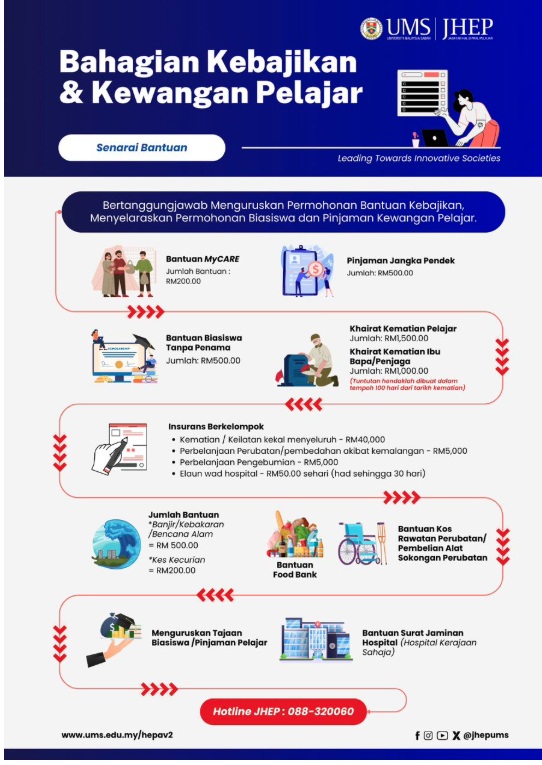
Complementing these initiatives is the Bahagian Kebajikan dan Kewangan Pelajar (BKKP), which plays a crucial welfare role in managing and delivering direct student-assistance schemes. BKKP oversees the Sistem MyCare for living-allowance disbursement and administers a range of welfare supports including:
Together, these mechanisms—spanning external sponsorships, internal scholarships, and structured welfare assistance—reflect UMS’s systemic and sustainable approach to tackling educational poverty across three critical dimensions: access, affordability, and resilience. By integrating financial empowerment with compassionate welfare management, UMS ensures that every student, regardless of socioeconomic status, can pursue and complete their studies with dignity, stability, and hope for a better future.
Collectively, these initiatives form a comprehensive and resilient model of education-driven poverty alleviation, addressing both immediate needs (such as food security, health, and transport) and long-term empowerment (through education, employability, and entrepreneurship). Through sustained investment and strategic alignment with the UN Sustainable Development Goals, UMS has enabled thousands of Sabahan youth from low-income backgrounds to transform their lives and communities. This enduring commitment not only advances SDG 1: No Poverty by ensuring equal access to education and economic resources but also reaffirms UMS’s role as a catalyst for inclusive, equitable, and sustainable development in Malaysia’s Borneo region.
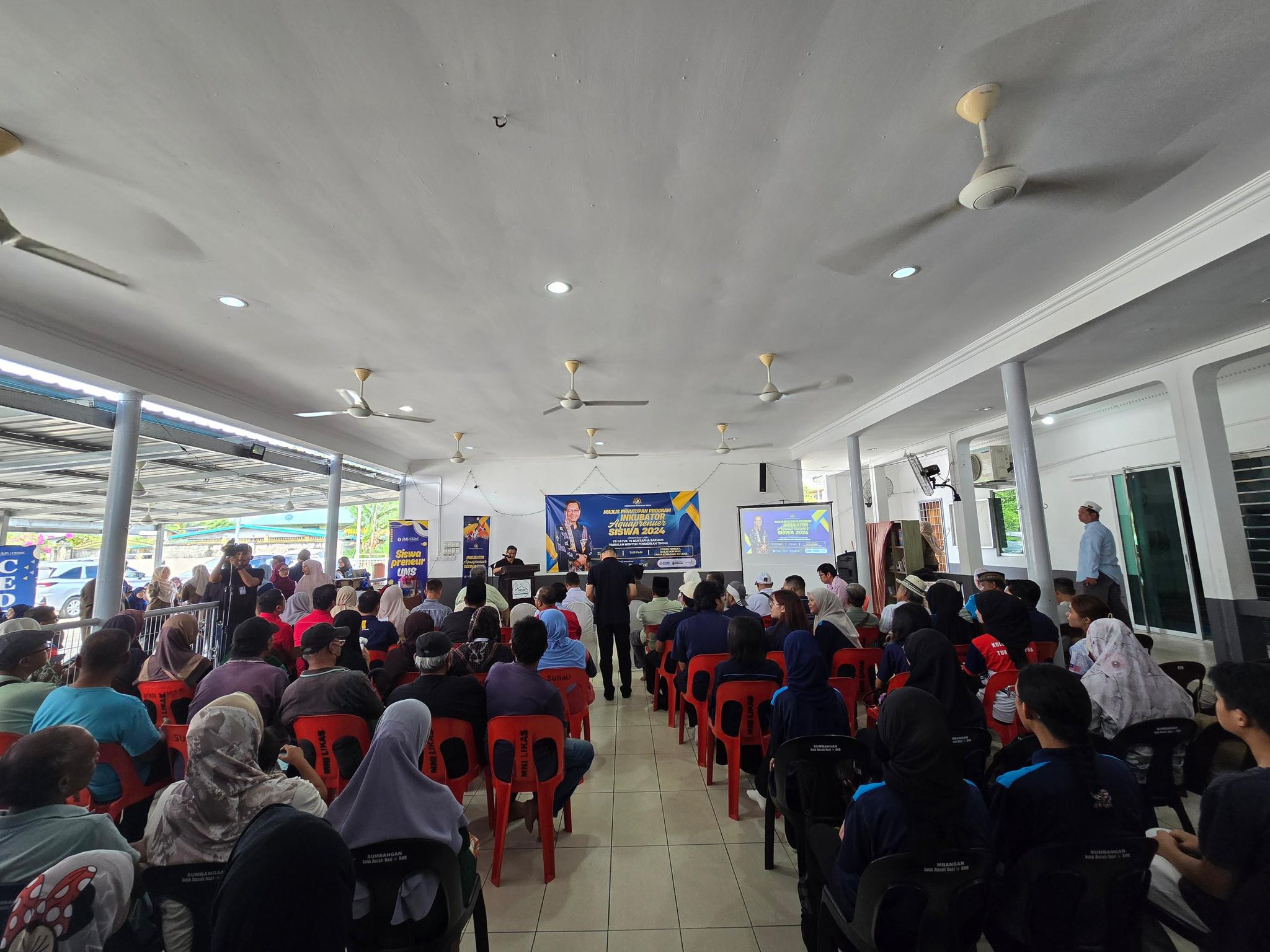
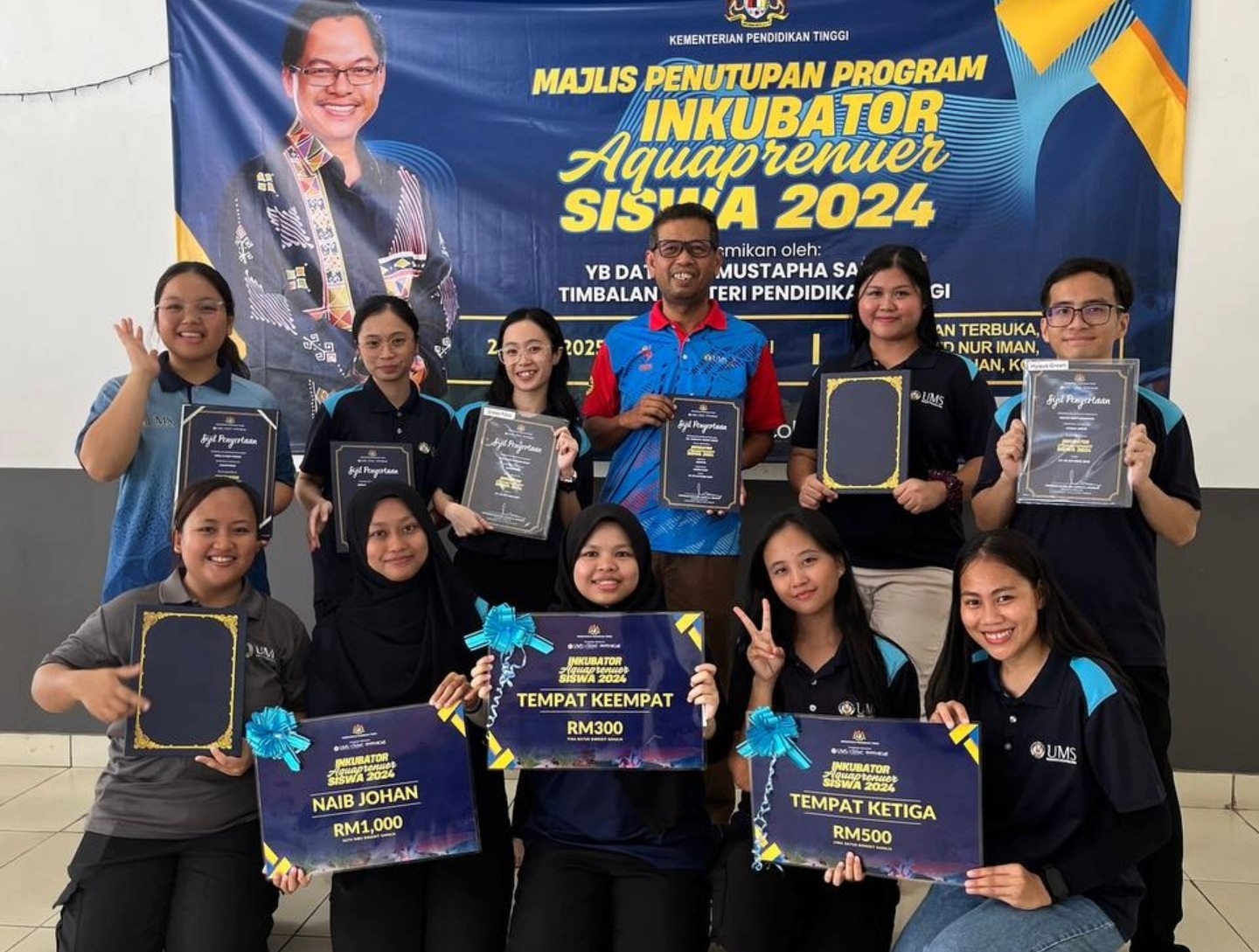
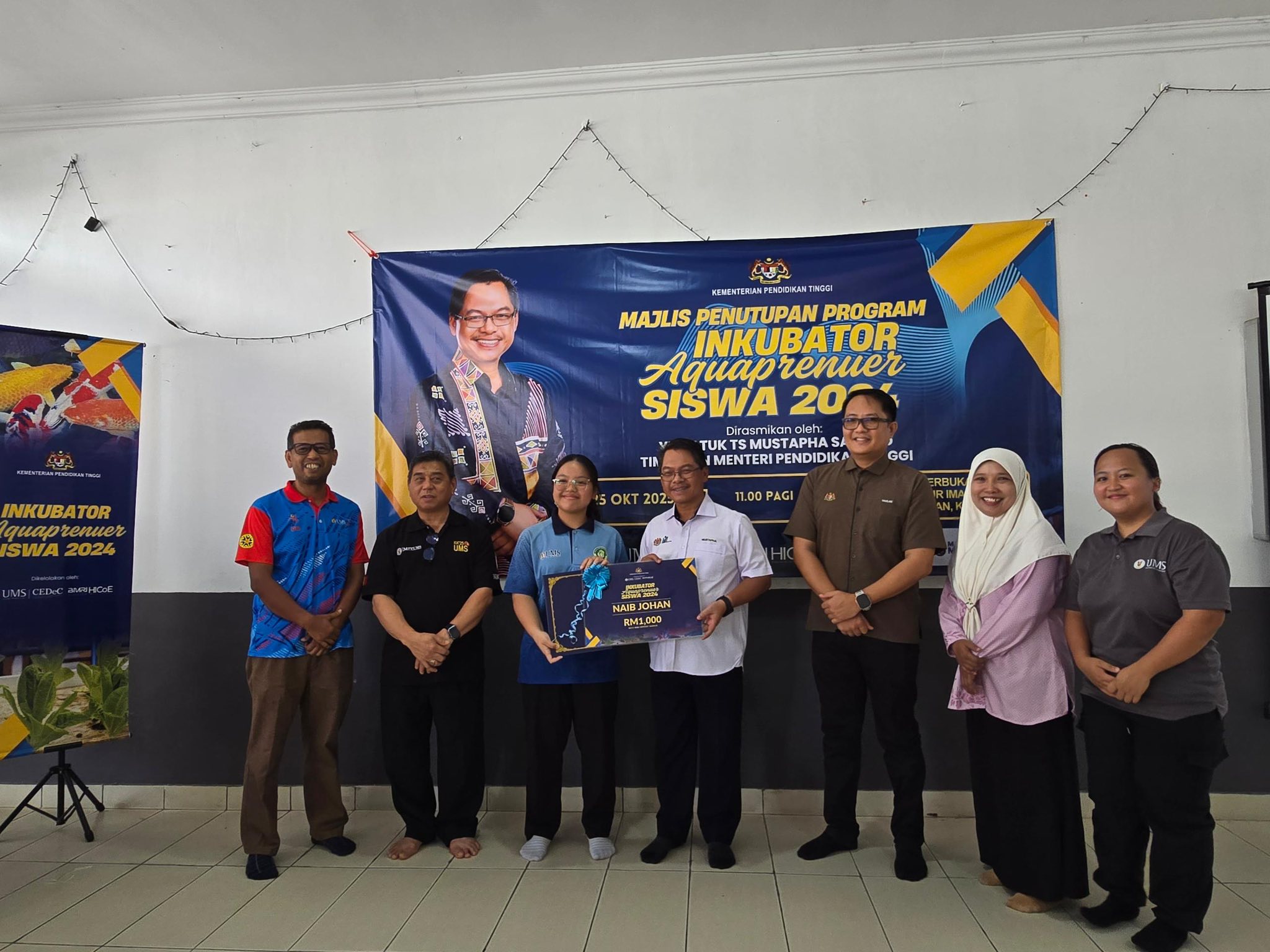
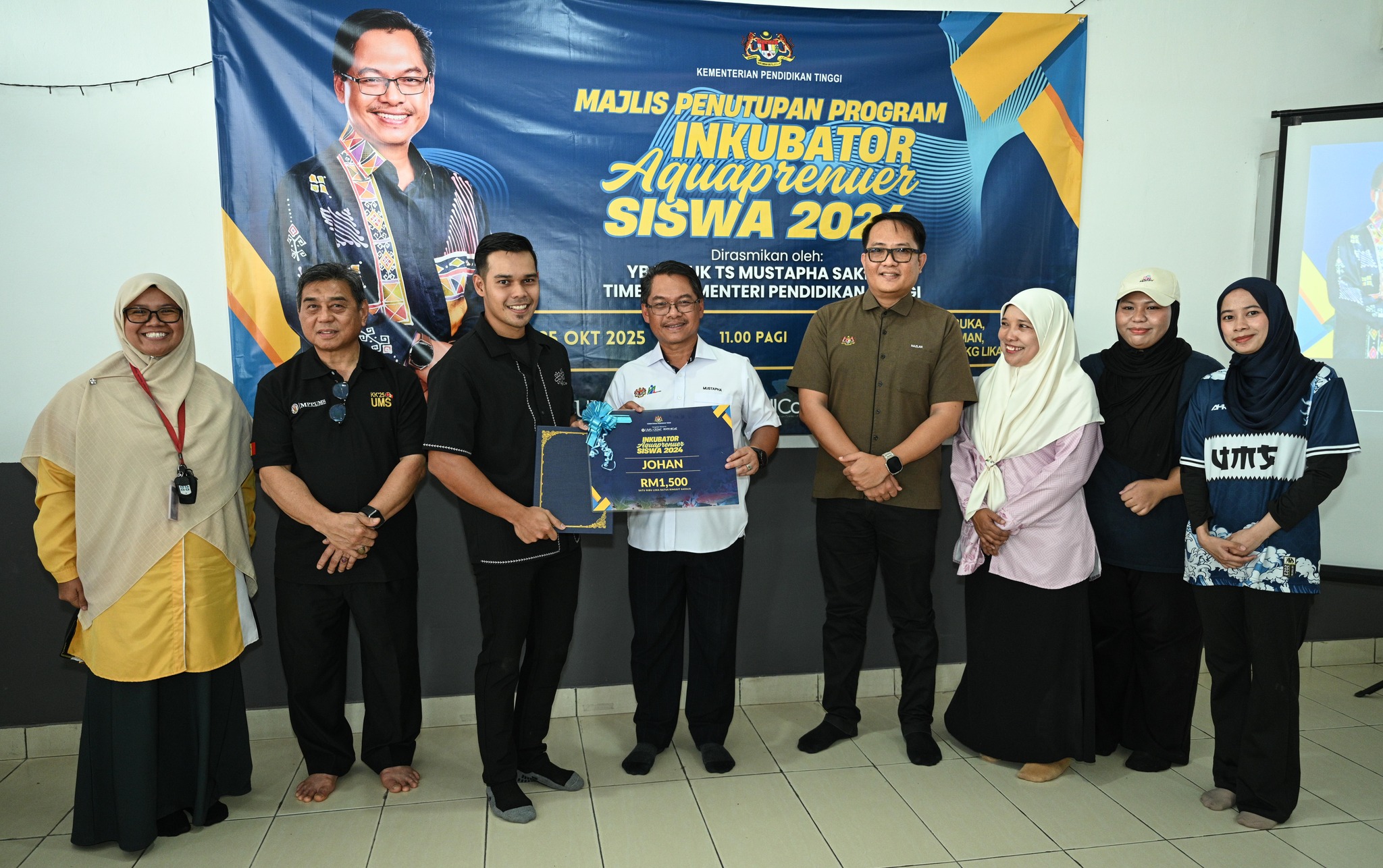
vi. Inkubator Aquapreneur Siswa UMS 2024
The Aquapreneur Student Incubator Program, jointly implemented by the Ministry of Higher Education (KPT) and CEDeC UMS, goes beyond financial aid—it tackles the root causes of poverty by transforming students into innovators, entrepreneurs, and changemakers. Through a year-long journey in modern aquaculture entrepreneurship and smart IoT-based technology, students learn to design, operate, and scale sustainable aquatic enterprises that generate real income and community impact.
This programme is not charity—it is empowerment. It equips students from low-income families with hands-on technical expertise, business acumen, and digital innovation skills, enabling them to become job creators rather than job seekers. By cultivating entrepreneurial resilience, the initiative builds pathways for long-term economic independence, food security, and environmental sustainability.
Graduates of the programme have successfully established micro aquaponic ventures, eco-fish farms, and seaweed product enterprises, proving that education can directly lift individuals and communities out of poverty. These student entrepreneurs reinvest their knowledge and income back into their villages, creating a multiplier effect that strengthens Sabah’s rural economy.
By aligning technology, education, and livelihood creation, the Aquapreneur Student Incubator Program embodies the spirit of SDG 1: No Poverty—empowering youth to break generational poverty cycles through innovation, not dependence. It is a living model of how universities can solve poverty, not just study it.
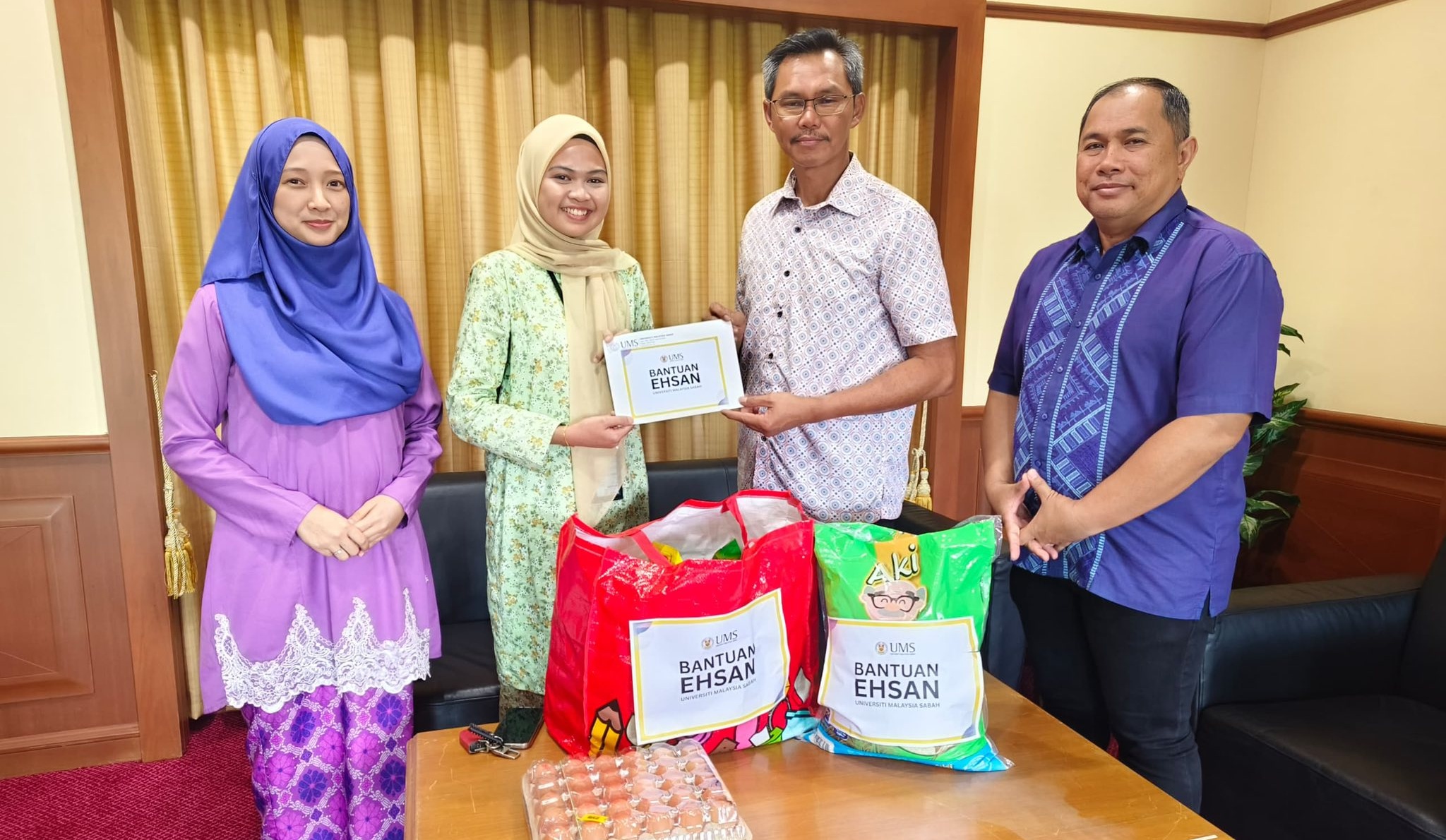
v. Bantuan Ehsan UMS
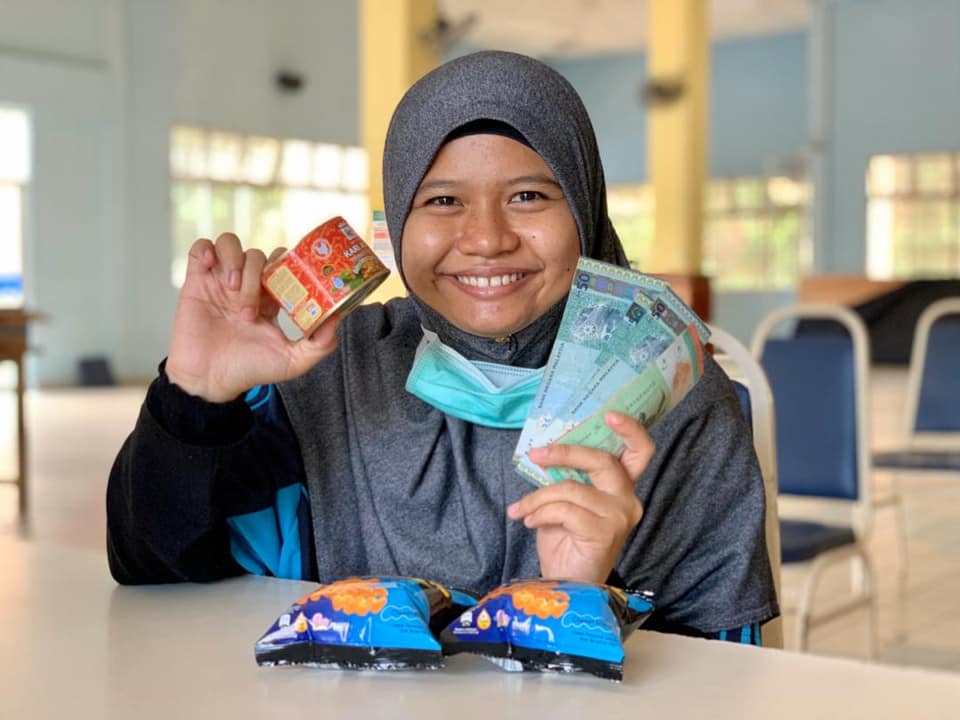
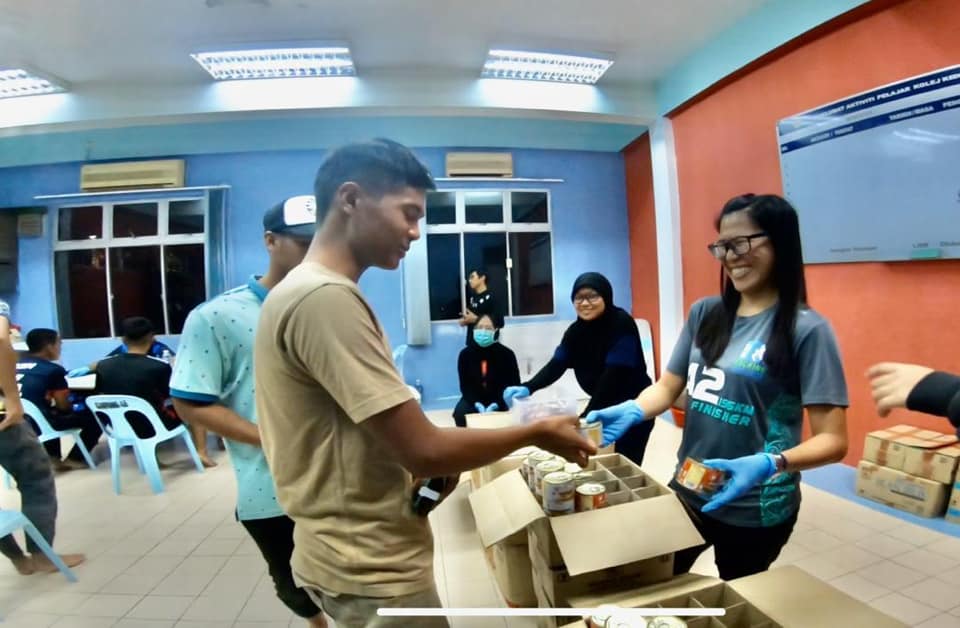
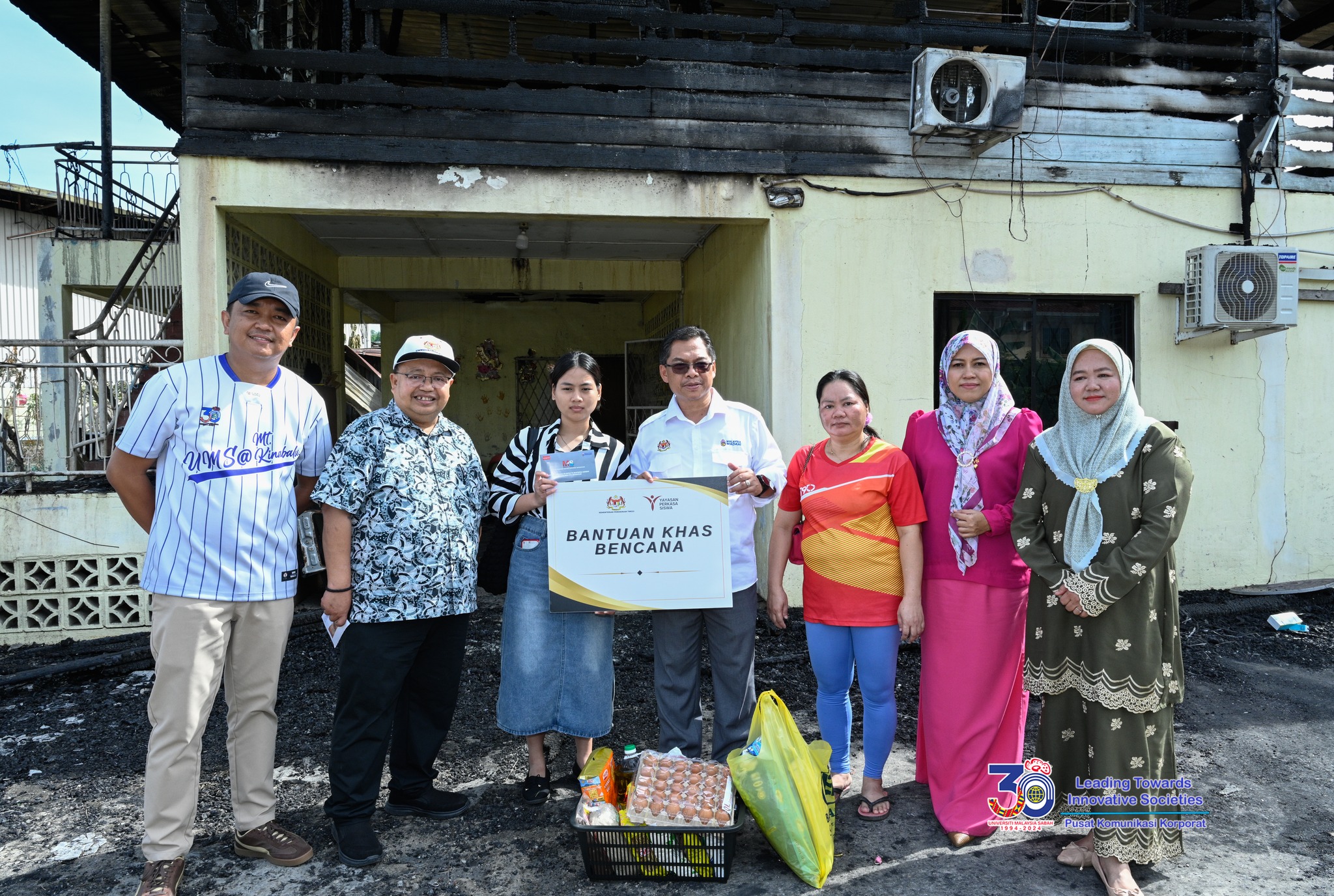
The Bantuan Ehsan UMS is a welfare assistance initiative that provides emergency financial and food support to students experiencing sudden economic hardship. This programme ensures that students affected by unforeseen circumstances — such as family income disruption, emergencies, or health-related issues — continue their studies without interruption.
The assistance covers daily meals, essential supplies, and short-term living expenses, helping students maintain stability and focus on their academic responsibilities. Administered by the Department of Student Affairs (HEP), Bantuan Ehsan UMS operates through a transparent, needs-based application process, ensuring fair access and immediate relief for those in genuine need.
Through this initiative, UMS reinforces its commitment to student welfare and inclusivity, ensuring that no student is left behind
Read More
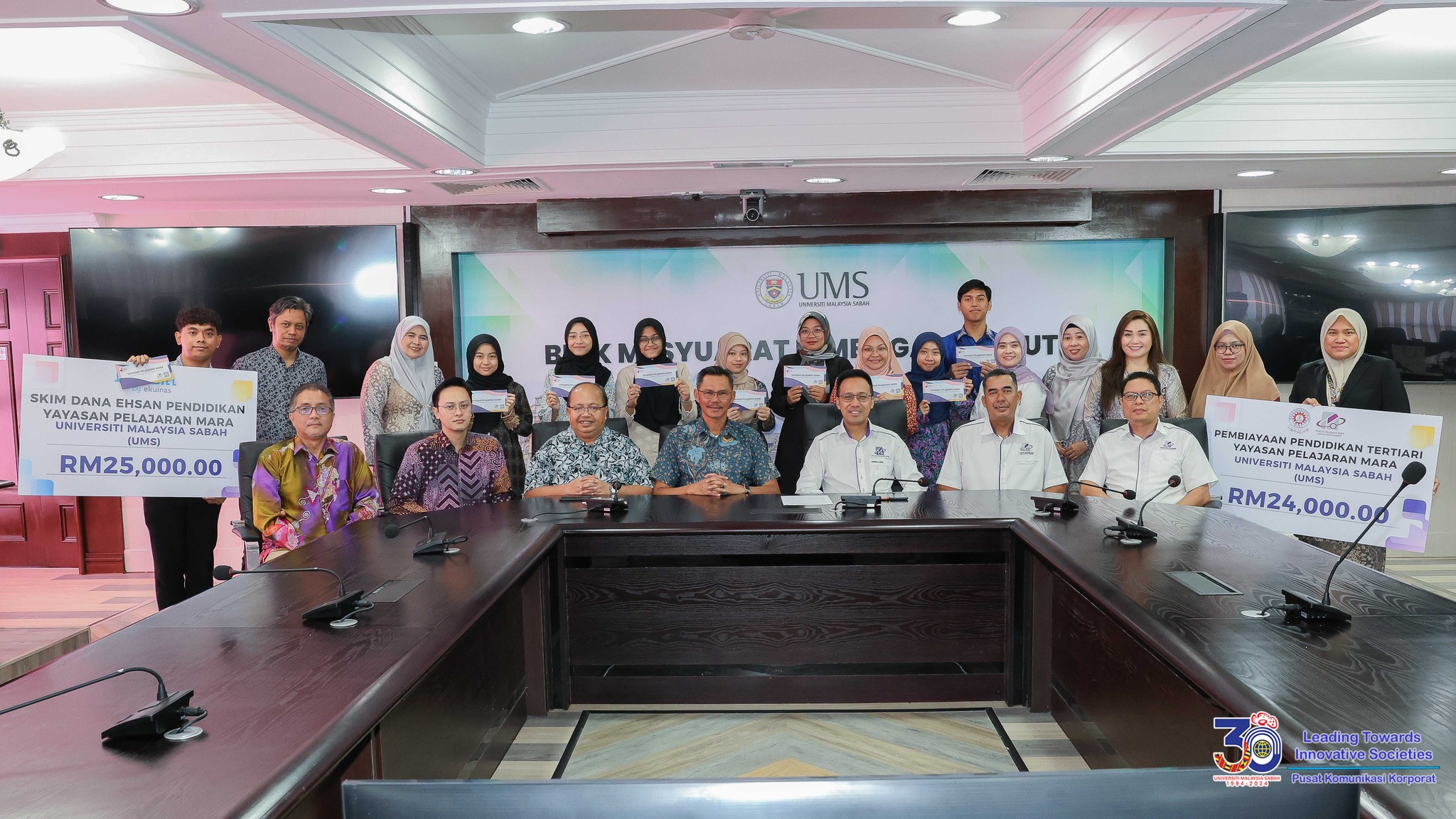
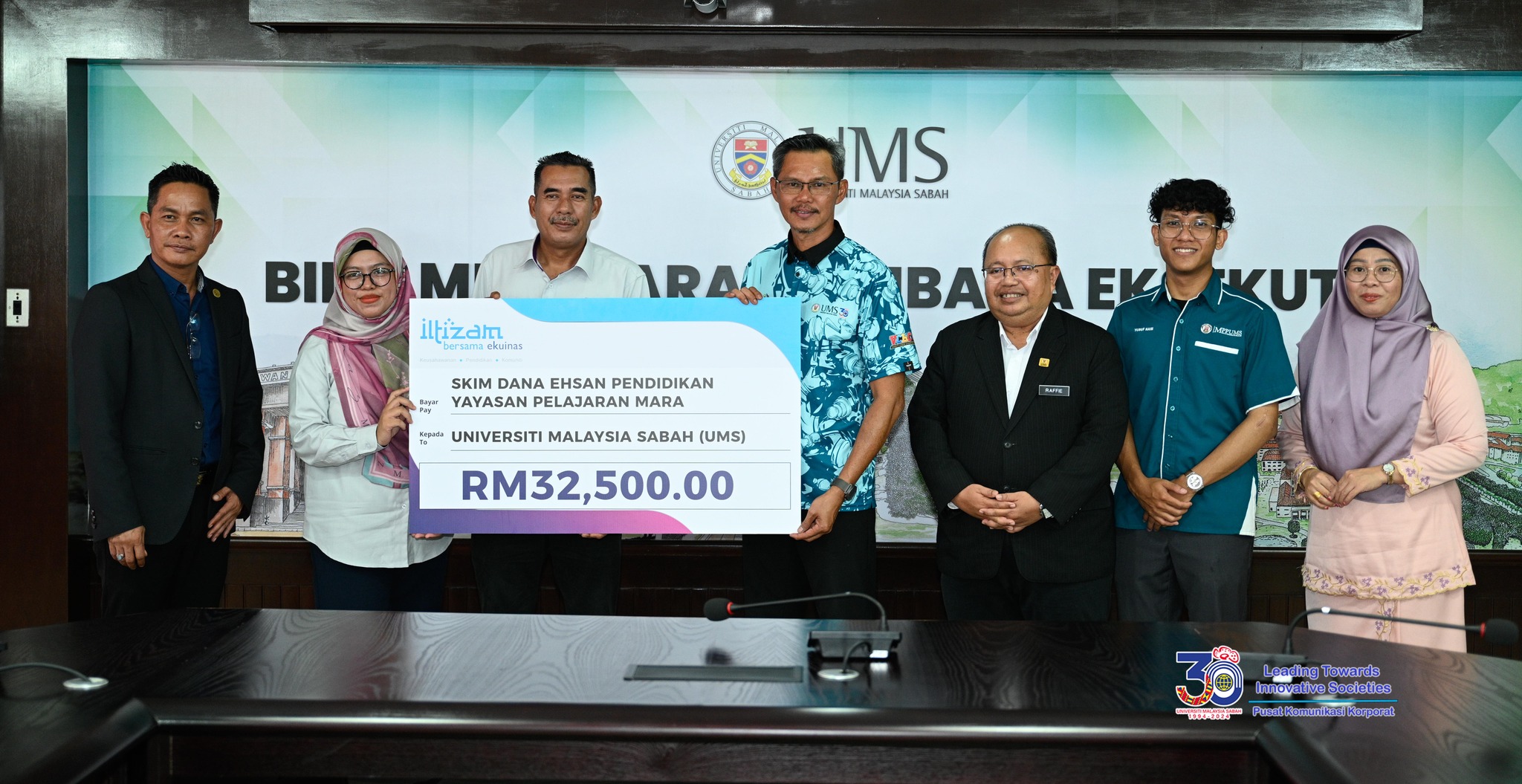
Empowering Dreams, Changing Lives
Since 2013, Program Meniti Kasih UMS has opened doors for students from B40 (Bottom 40%) Income Group and underprivileged families to pursue higher education — transforming aspirations into achievements and breaking the cycle of poverty through opportunity.
Hope Begins HereA Bridge of Hope and Education
Rooted in compassion, Meniti Kasih connects disadvantaged youths to the power of learning. Each success story reflects UMS’s commitment to inclusivity, social mobility, and a future where no dream is left behind.
Together We Build Brighter FuturesFrom Struggles to Success
More than a scholarship, Meniti Kasih is a journey of care — nurturing resilience, dignity, and confidence among first-generation students, empowering them to rise and lead their communities forward.
Together We Build Brighter FuturesUMS’s Heart for Humanity
Through Program Meniti Kasih, UMS embodies its role as a university for society — creating real impact across Sabah and Malaysia by transforming education into a force for equality and sustainable change.
Compassion. Education. Real Impact
Not just reaching the people—but rising with them
UMS Empowering Communities and Rural through Knowledge, Compassion, and Hope
UMS extends its commitment to poverty alleviation beyond the campus by strengthening community resilience, sustainable livelihoods, and local entrepreneurship across Sabah’s rural and indigenous regions. Guided by the principles of inclusive growth and sustainability, UMS integrates research, innovation, and social outreach to empower communities to generate stable incomes, diversify livelihoods, and build self-reliance in harmony with the environment.
Through long-standing initiatives involving knowledge transfer, enterprise mentoring, and local economic development, UMS contributes directly to SDG 1. These programmes align with the Sabah Maju Jaya Blueprint 2030 and Malaysia Madani vision, positioning UMS as a driver of inclusive and sustainable community transformation.
Transferring Knowledge, Transforming Lives: A Poverty Reduction Initiative
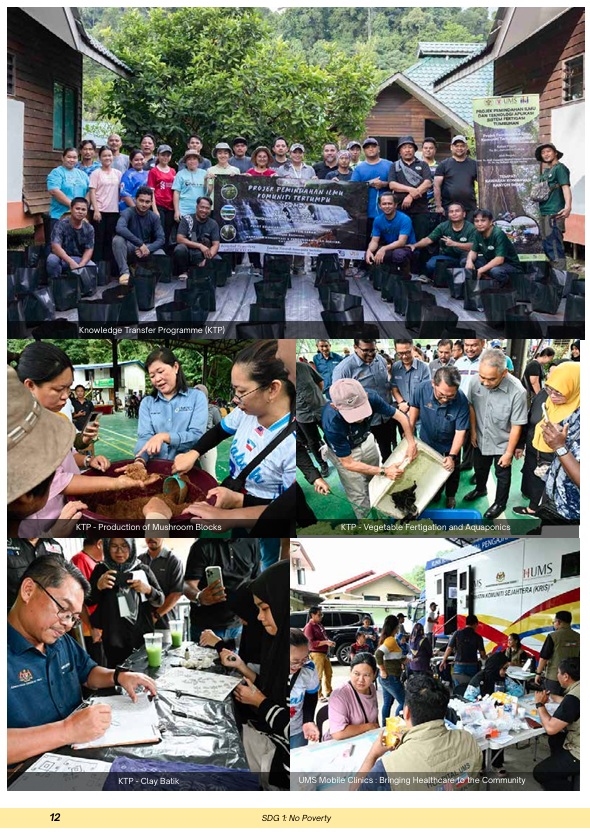
Universiti Malaysia Sabah (UMS), through its Pusat Kelestarian Libatsama Masyarakat (PKLM), spearheads a large-scale Knowledge Transfer Programme (KTP) that transforms research and academic expertise into tangible community empowerment. Anchored in the belief that knowledge shared is poverty reduced, this initiative nurtures inclusive growth across Sabah’s diverse communities.
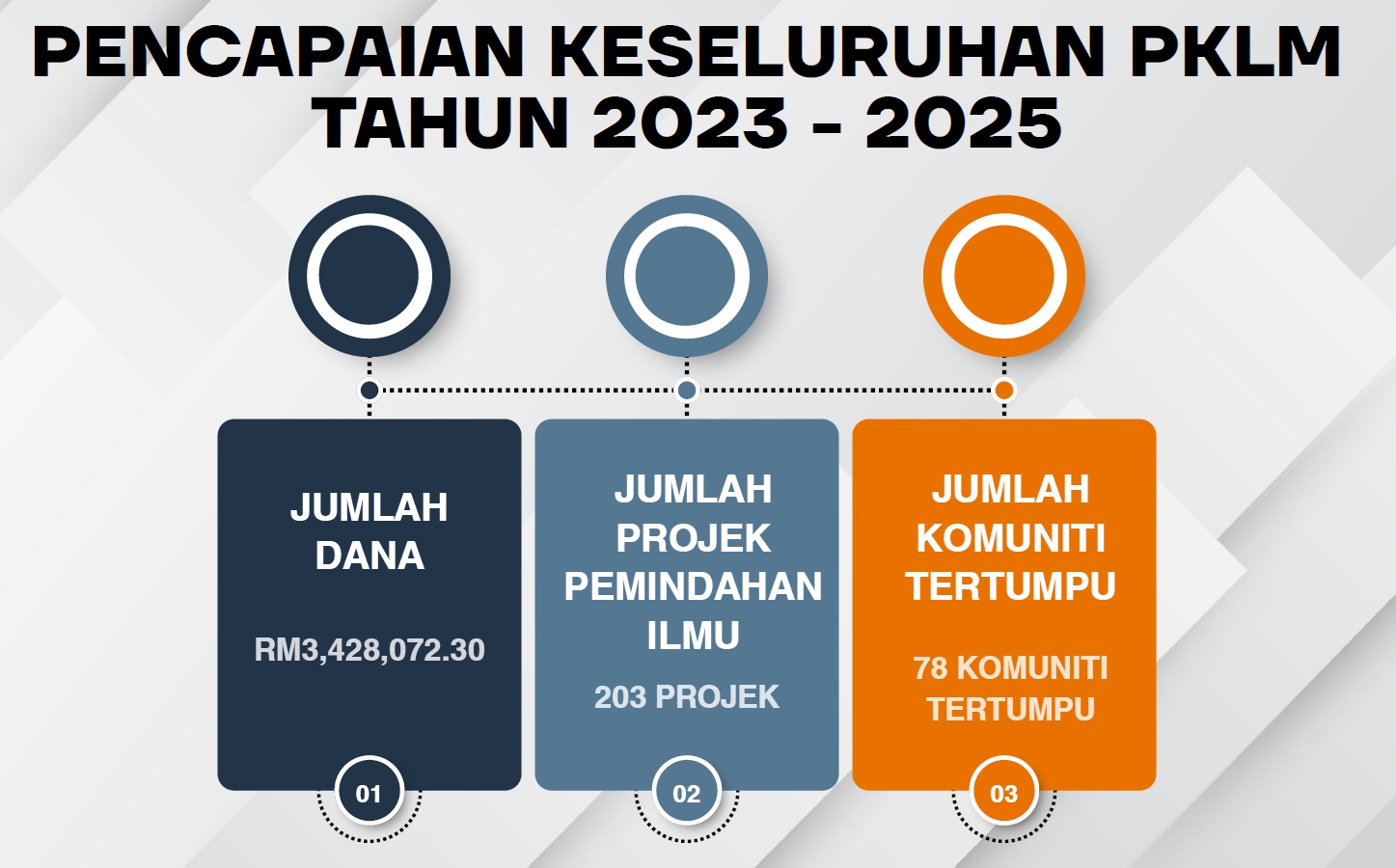
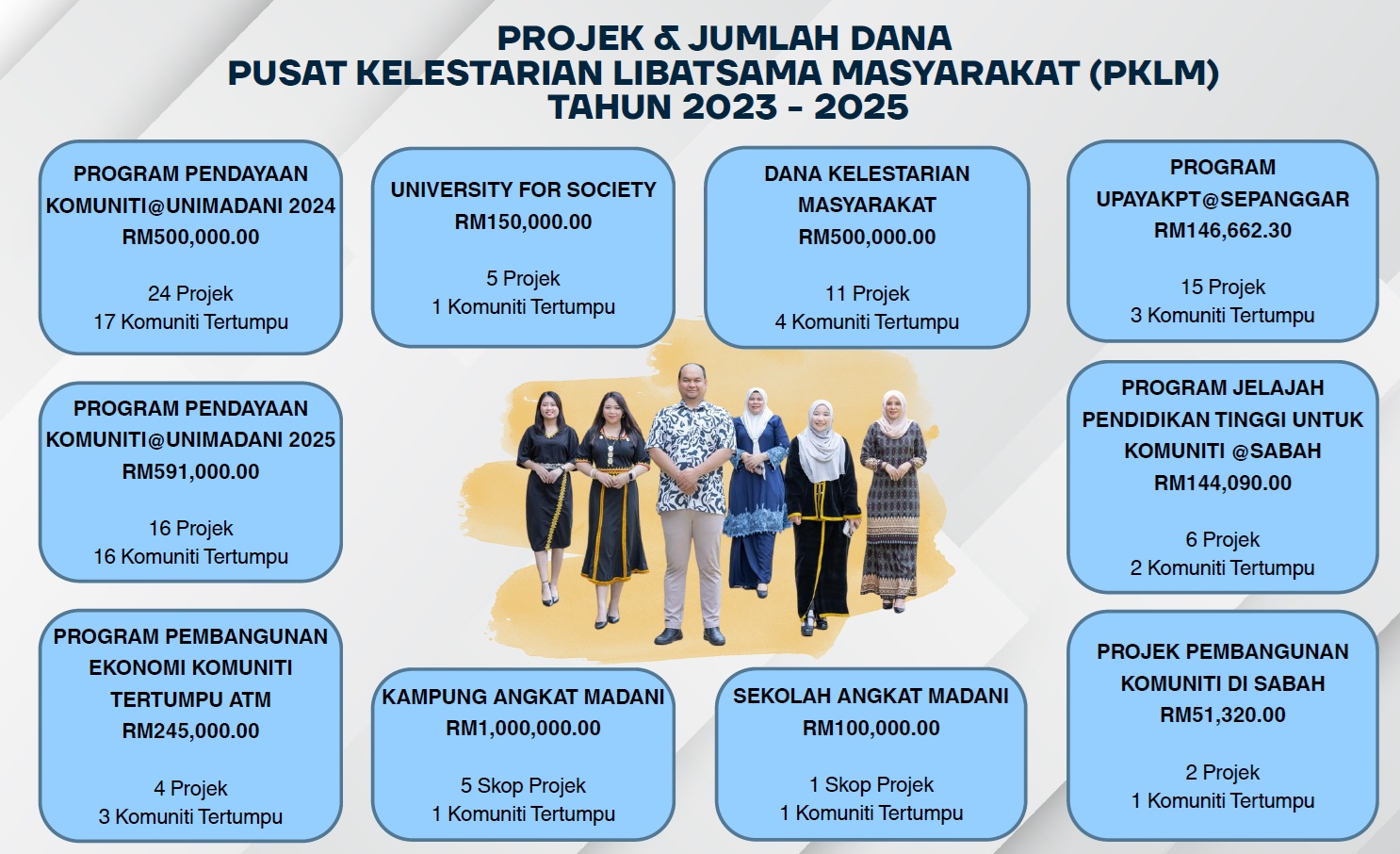
From 2023–2025, PKLM mobilized a total allocation of RM3.43 million to implement 203 knowledge-transfer projects benefitting 78 targeted communities across Sabah. These initiatives translate university research and innovation into real-world applications, addressing local challenges such as livelihood insecurity, food resilience, digital inclusion, and youth unemployment.
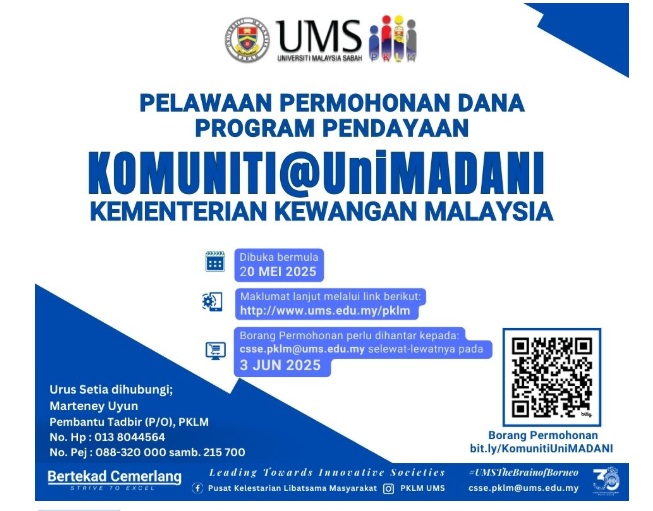
Key Programmes and Funding Streams
- Program Pendayaan Komuniti @UNIMADANI (2024–2025) — RM1.09 million supporting 40 projects across 33 communities, focusing on women’s entrepreneurship, agro-innovation, and digital literacy.
- Kampung Angkat Madani — RM1 million to strengthen five community project scopes, creating sustainable rural livelihood models.
- Dana Kelestarian Masyarakat — RM500,000 channelled into 11 projects that promote social cohesion, local innovation, and economic inclusivity.
- University for Society (U4S) — RM150,000 supporting five university–community collaboration projects linking students directly with grassroots problem-solving.
- Program Upaya KPT @Sepanggar & Jelajah Pendidikan Tinggi @Sabah — RM290,752 for 21 education-outreach projects, widening tertiary access among underprivileged and first-generation youth.
- Program Pembangunan Ekonomi Komuniti Tertumpu ATM & Projek Pembangunan Komuniti di Sabah — RM296,320 invested in six projects developing small-scale enterprises and economic diversification in rural localities.
- Sekolah Angkat Madani — RM100,000 dedicated to community-linked school innovation for youth and teacher capacity-building.
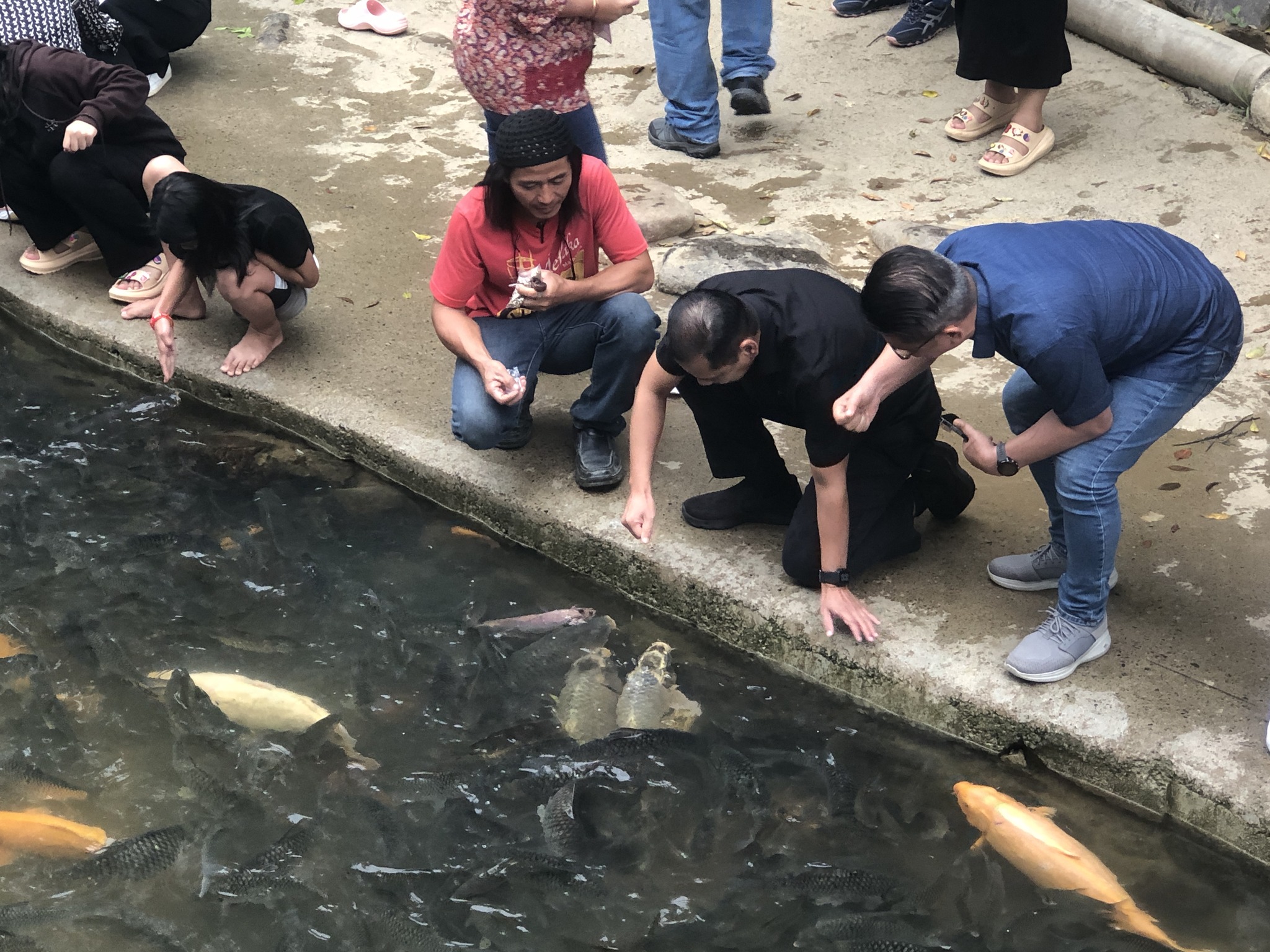
U4S (Zon Borneo) – Kg. Marakau Bombon, Ranau: Community Knowledge & Sustainable Growth
-
From Roots to Resilience.
Nestled in the highlands of Ranau, Kg. Marakau Bombon has been chosen as a model site under the University for Society (U4S) Programme by Universiti Malaysia Sabah (UMS) and the Pusat Kelestarian Libatsama Masyarakat (PKLM). Through this initiative, local families, youth and community leaders engage in tailored knowledge-transfer projects ranging from eco-tourism development and agro-entrepreneurship to digital-marketing of local products and value-added handicrafts. With expert guidance and community participation, the village is transforming into a living classroom for sustainable development — where tradition and innovation walk hand-in-hand. By leveraging the U4S platform, Kg. Marakau Bombon has opened new pathways for income, environmental stewardship and inter-generational knowledge-sharing. Its success underscores how targeted community empowerment, grounded in respect for culture and ecology, can bring meaningful, lasting change — helping villagers build resilient livelihoods, revive local heritage and contribute to Sabah’s sustainable future.
-
Community
Kg. Marakau Bombon - + Google Map
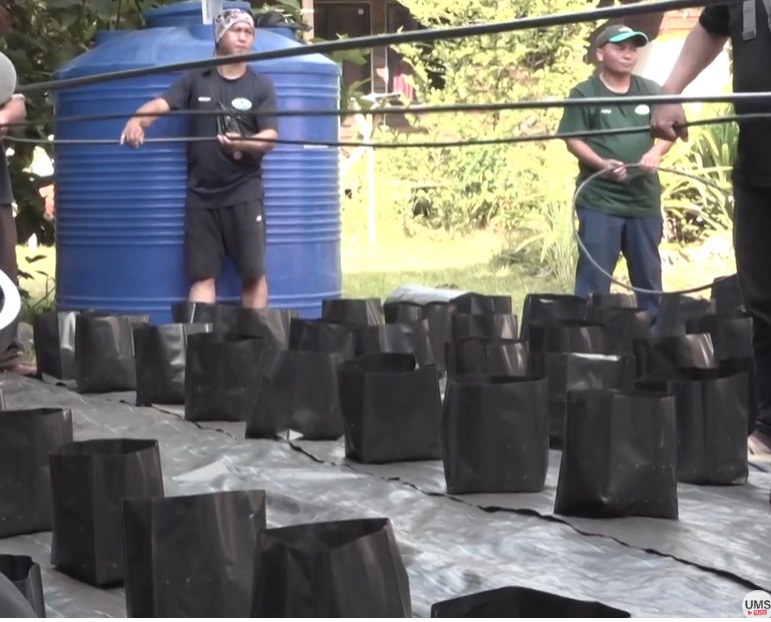
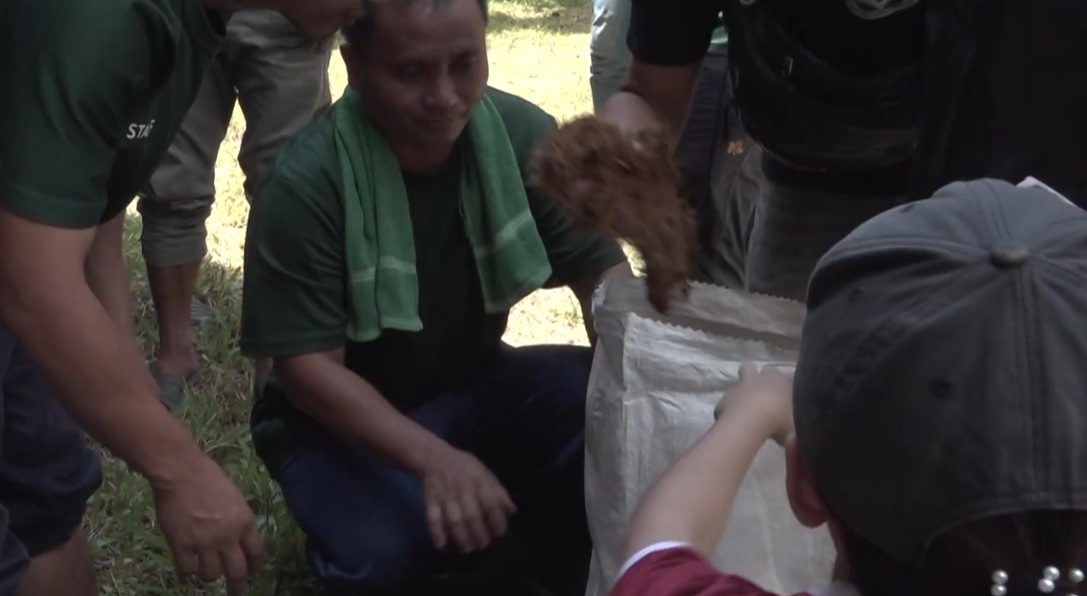
Komuniti Tertumpu Bombon, Kg. Marakau Ranau – DaMaI Initiative
-
From Nature to Nurture.
Nestled in the cool highlands of Ranau, the DaMaI (Dana Amanah Malaysia Madani) Initiative empowers villagers of Kg. Marakau Bombon to transform their environment into a living classroom for sustainability. Through eco-tourism, agro-based entrepreneurship, and community cooperatives, the project weaves livelihoods with stewardship of nature. Here, every seed planted, every trail preserved, and every visitor welcomed contributes to both income resilience and biodiversity conservation, ensuring that progress never comes at the expense of the environment.
-
Community
Bombon, Kg. Marakau Ranau - + Google Map
Kelulut Honey Entrepreneurship for Green Income (BAKAT Programme)
-
Sweet Sustainability, Shared Prosperity.
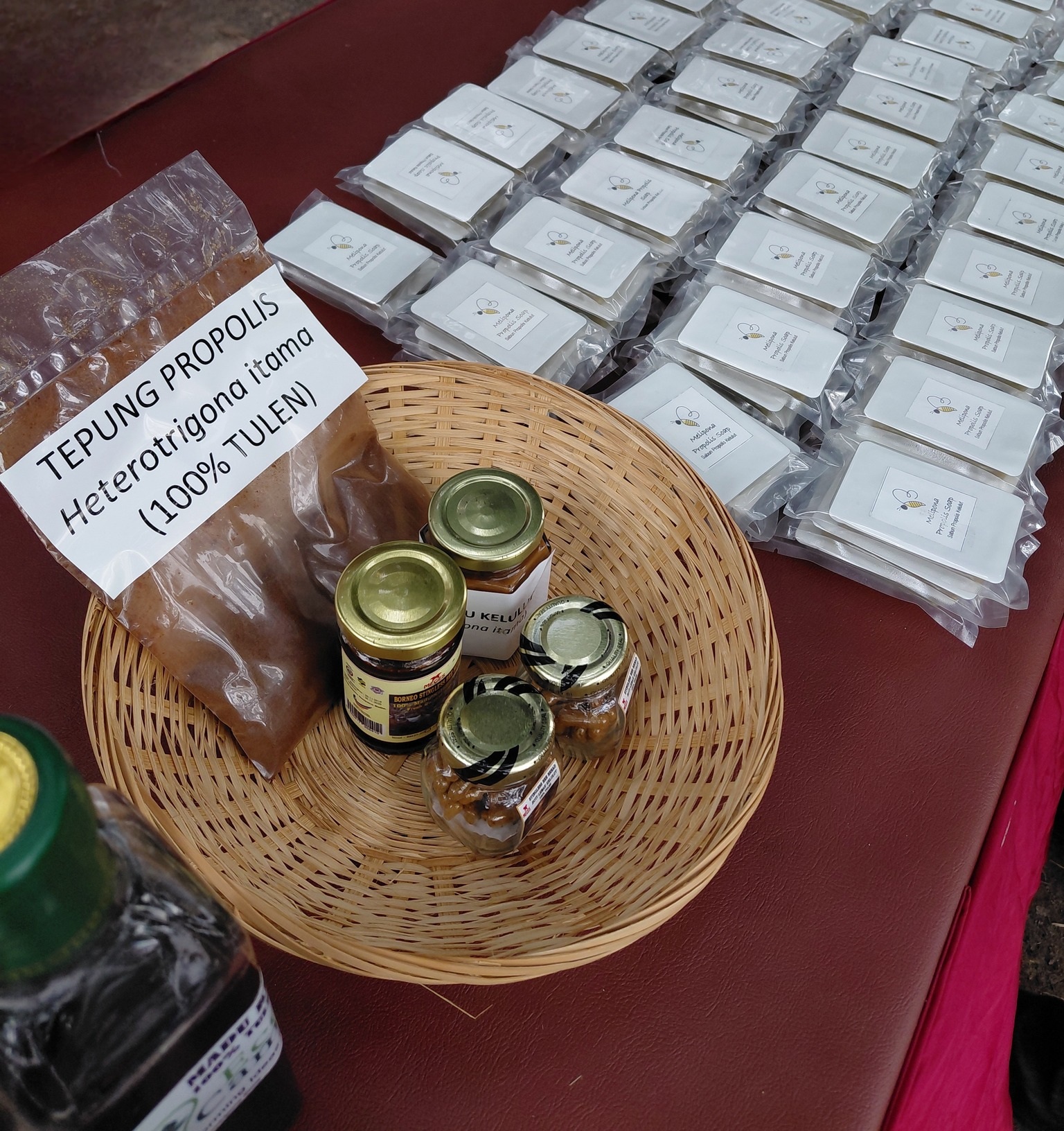
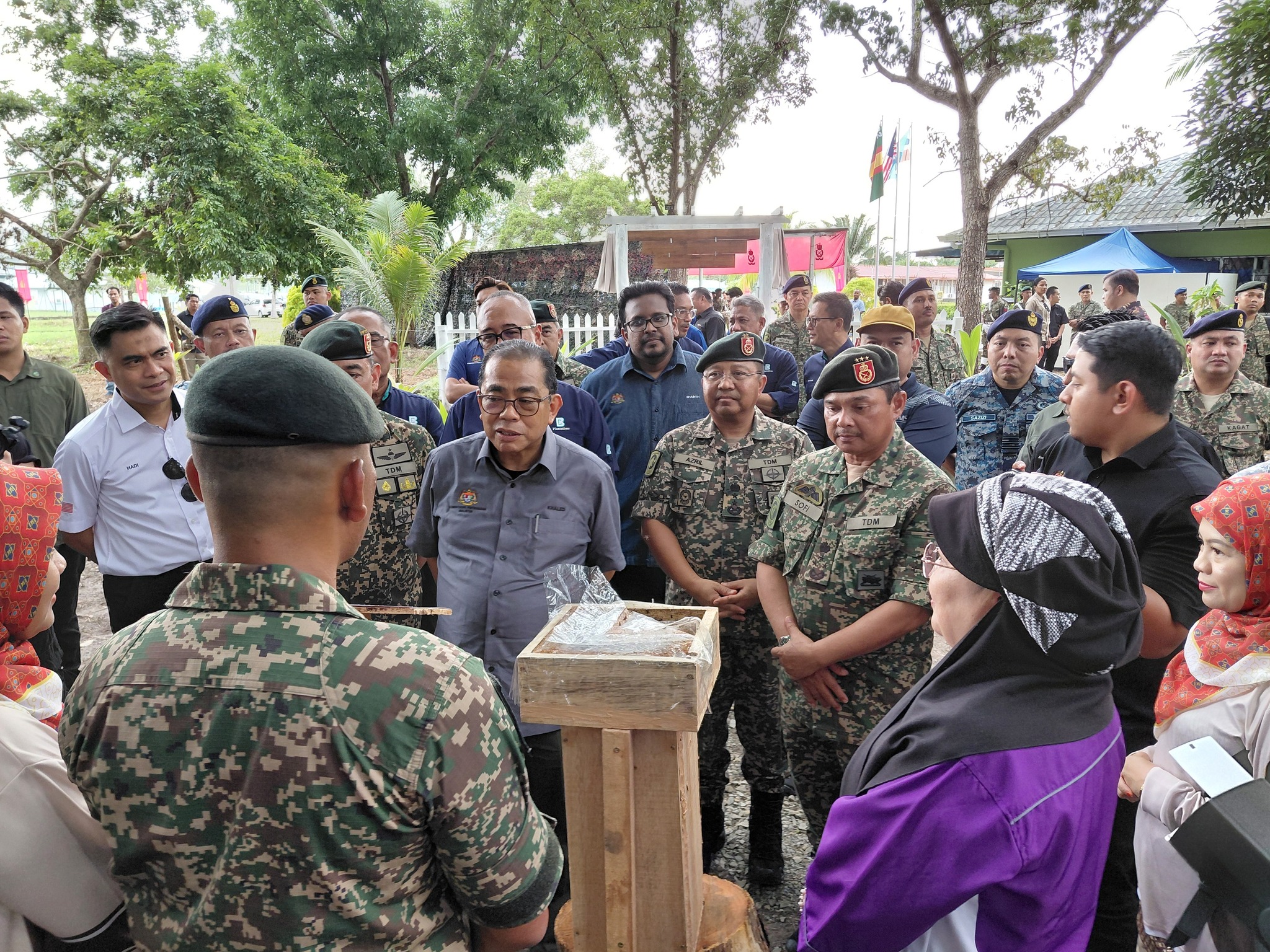
Amid Sabah’s rich tropical landscape, the Kelulut Honey Entrepreneurship Project under the Program Ekonomi MADANI turns nature’s smallest workers into agents of sustainability and empowerment. Coordinated by the Pusat Kelestarian Libatsama Masyarakat (PKLM) in collaboration with Universiti Malaysia Sabah (UMS), the initiative equips Badan Kebajikan Keluarga Angkatan Tentera (BAKAT) members, women, and youth with the knowledge and skills to cultivate kelulut (stingless bee) colonies, harvest pure honey, and develop value-added eco-products such as soaps, balms, and health supplements. Guided by experts from UMS’s Faculty of Sustainable Agriculture (UMS Sandakan Campus), the project integrates entrepreneurship with ecological stewardship — encouraging communities to protect pollinators that are vital for biodiversity and food systems. Beyond economic gains, participants develop an appreciation for the delicate harmony between human livelihood and the natural environment, forming the heart of a growing green micro-economy. The Kelulut Project represents more than income generation — it’s a symbol of resilience, creativity, and care for the planet. Every drop of honey produced tells a story of community empowerment, environmental awareness, and the sustainable spirit of Sabah’s people.
Smart Carbon-Free Hydroponics Project (BAKAT Programme)
-
Empowering Communities, Growing Futures.
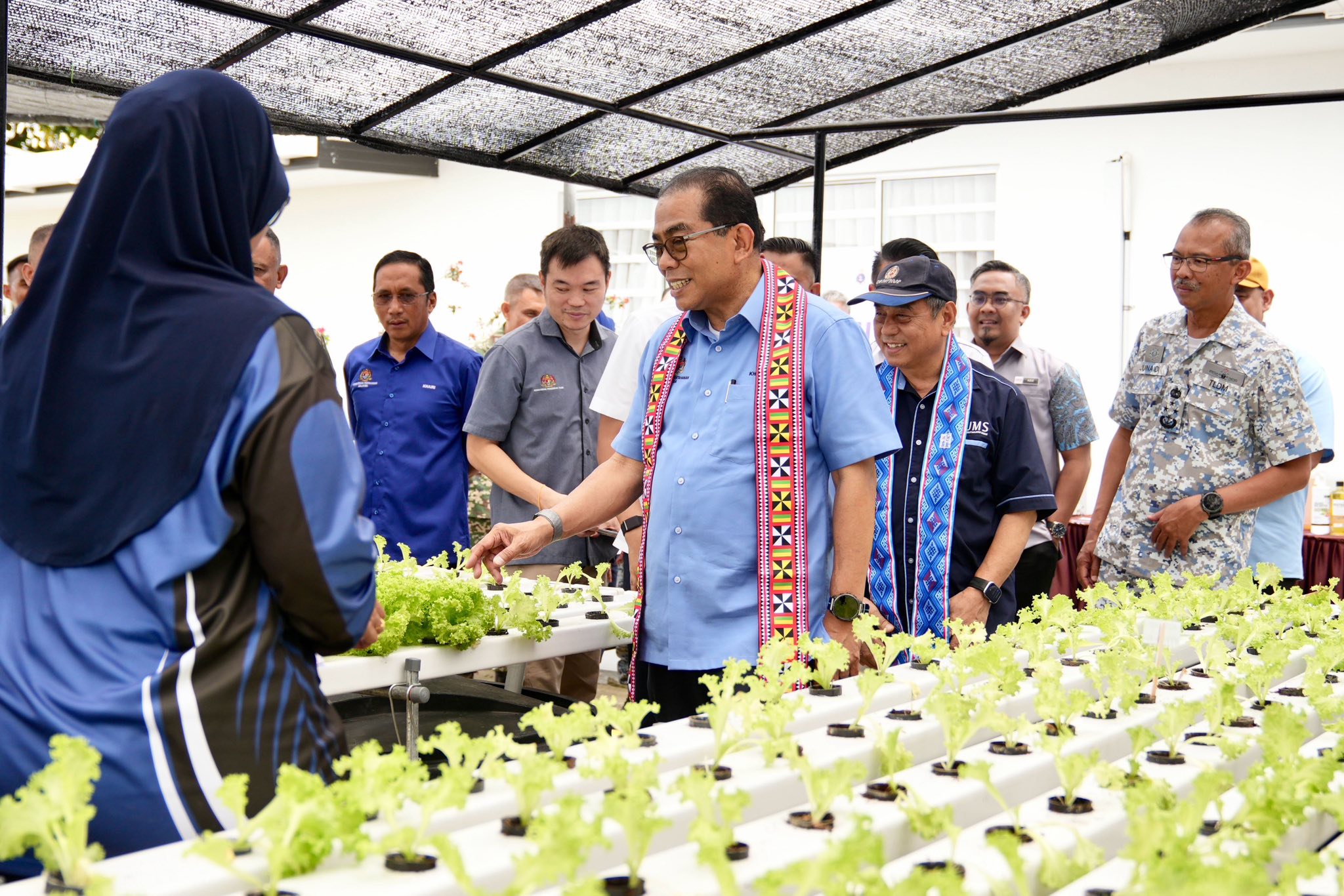
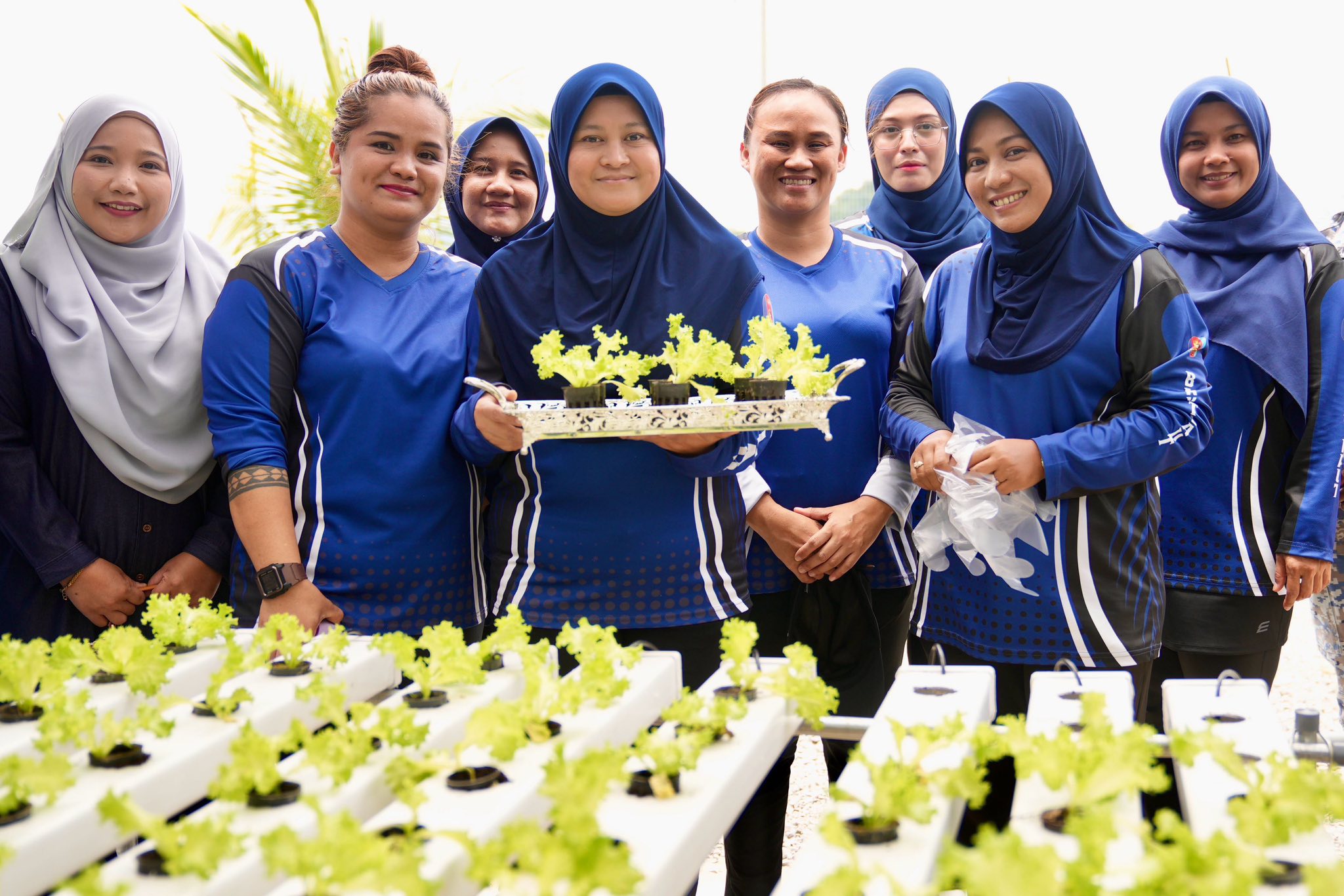
The Smart Carbon-Free Hydroponics Project, an innovative entrepreneurship initiative under the Program Ekonomi MADANI, was developed through collaboration between the Badan Kebajikan Keluarga Angkatan Tentera (BAKAT) and Universiti Malaysia Sabah (UMS) via the Knowledge Transfer Programme (KTP). This project empowers communities to embrace modern, sustainable agriculture by introducing automated hydroponic systems that use minimal water, land, and energy. Through comprehensive hands-on training led by experts from UMS’s Faculty of Sustainable Agriculture, participants gain technical knowledge, business acumen, and environmental awareness — transforming small urban spaces into productive, eco-friendly gardens. Beyond cultivating crops, the initiative cultivates confidence, innovation, and resilience among families and youth. It enhances household food security, creates opportunities for supplementary income, and fosters a culture of sustainability and self-reliance within the armed forces community. As a model of inclusive progress, the project embodies the MADANI values of care, partnership, and shared prosperity — proving that when knowledge is transferred with purpose, communities thrive together.
Fertigation, Mushroom Cultivation & Solar Energy Integration
-
Smart Skills, Sustainable Futures.
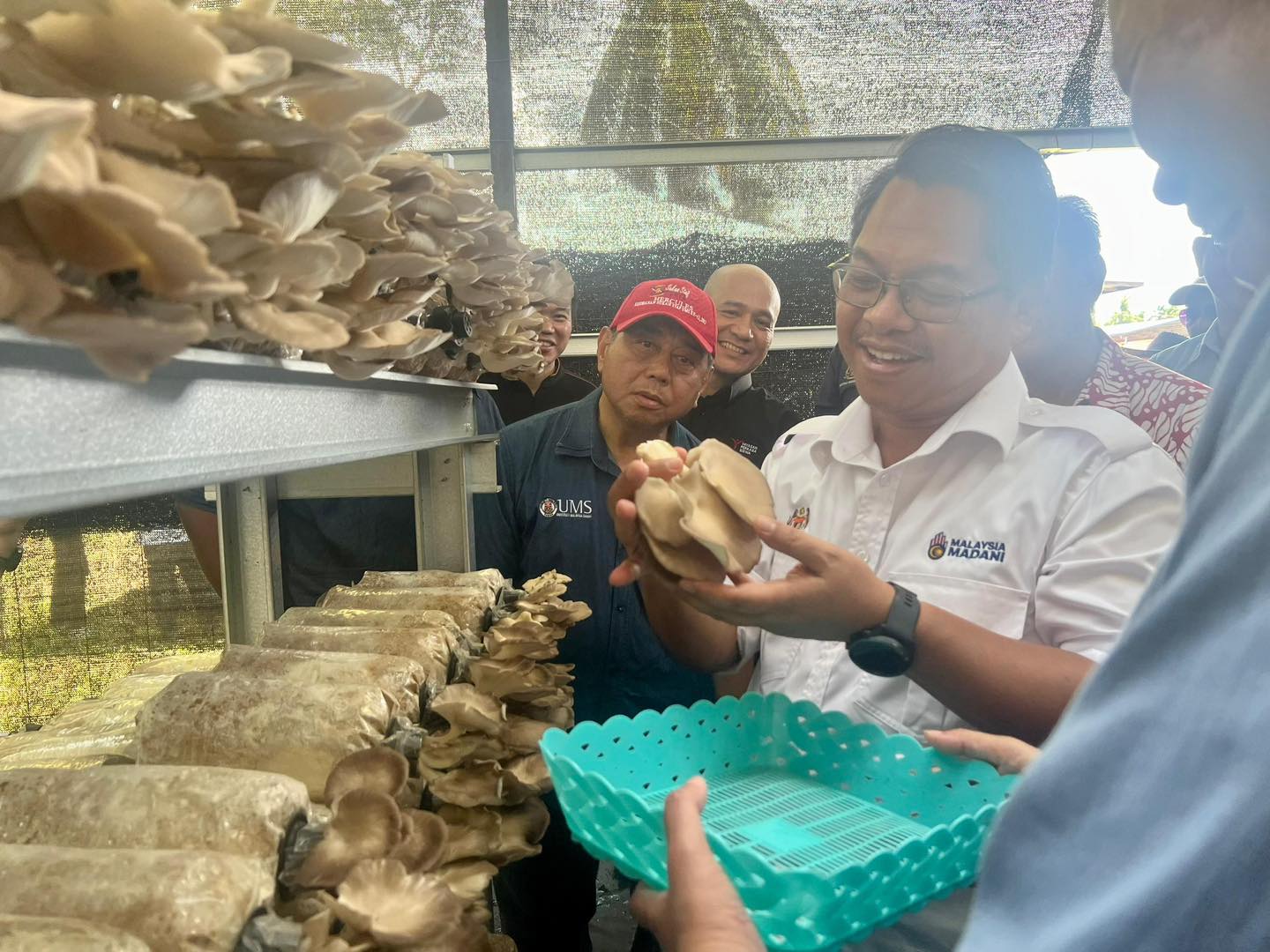
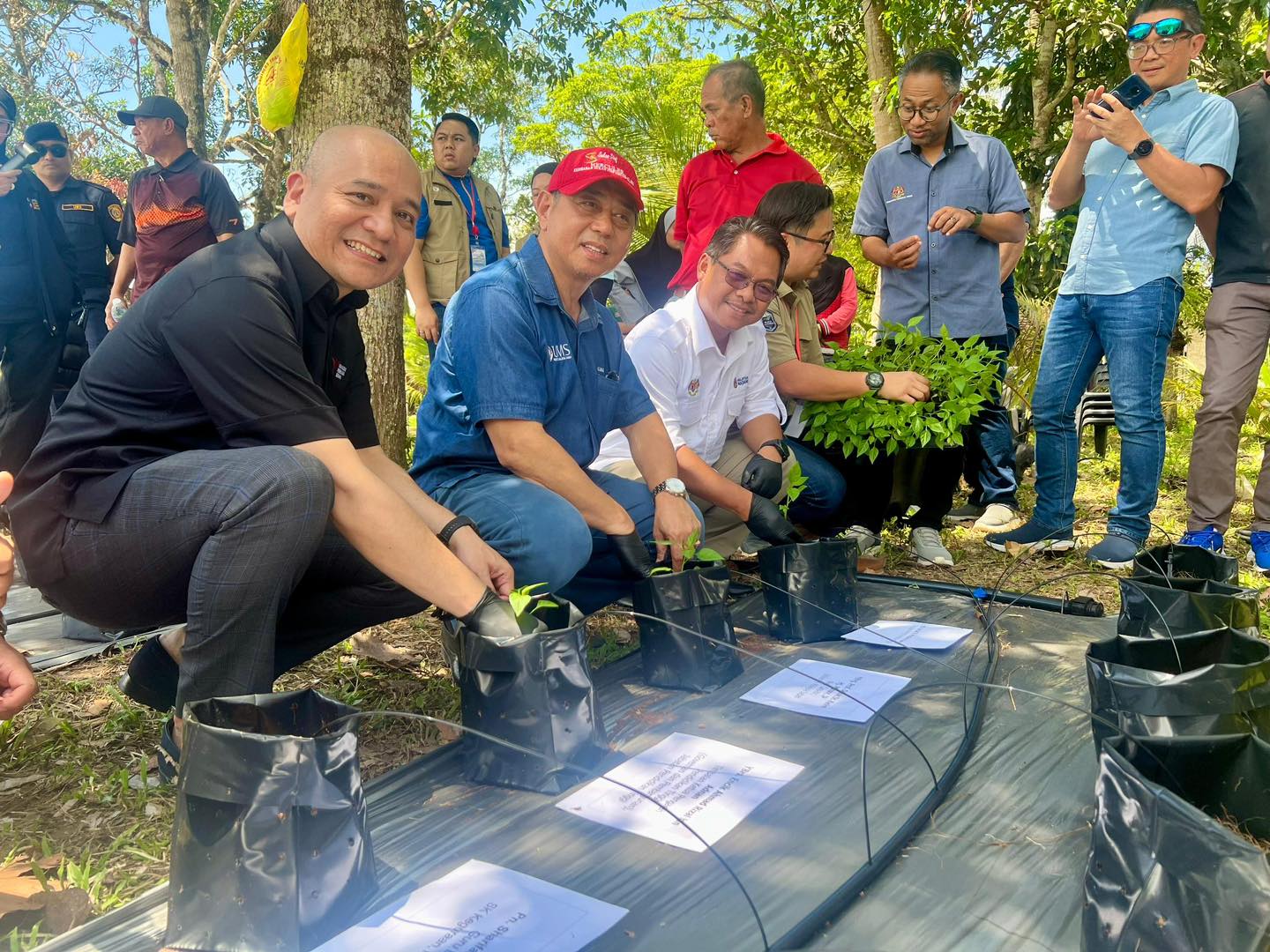
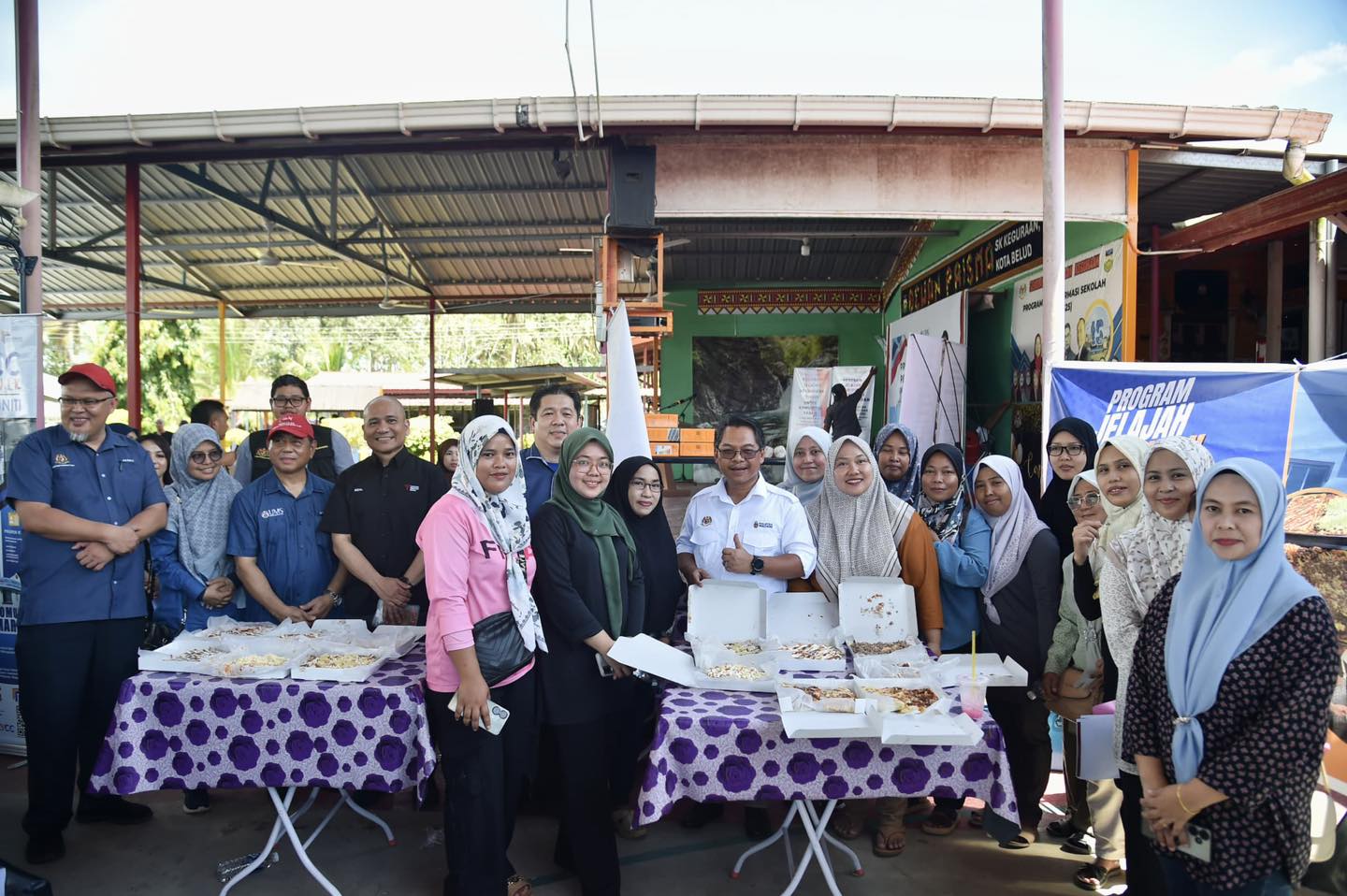
The Fertigation, Mushroom Cultivation & Solar Energy Integration Project is one of Universiti Malaysia Sabah’s most comprehensive community knowledge-transfer initiatives — designed to empower rural communities through a combination of agricultural innovation, renewable energy, and food entrepreneurship. Spearheaded by the Pusat Kelestarian Libatsama Masyarakat (PKLM UMS), this project equips participants with practical, future-ready skills that link sustainability with self-sufficiency. Through hands-on training, villagers and youth learn how to apply fertigation technology — a smart irrigation system that delivers water and nutrients directly to crops, reducing waste and improving yields. Alongside this, participants gain expertise in mushroom cultivation using eco-friendly methods that recycle organic materials such as sawdust or paddy husks, turning agricultural by-products into profitable resources. Complementing these efforts, the project also introduces solar-energy installation workshops, helping communities reduce dependence on non-renewable electricity while lowering operational costs for small enterprises. Beyond farming and energy, the initiative encourages local food innovation, guiding participants to create value-added products such as yellow noodles and pizza talam using locally sourced ingredients. These activities promote food security, circular economy principles, and low-carbon lifestyles, while strengthening community entrepreneurship. At its heart, the project represents UMS’s belief that sustainability begins with skill — that by empowering people with knowledge, innovation, and green technology, we build communities that can grow, adapt, and sustain themselves for generations.
-
Community
SK Keguraan, Kota Belud - + Google Map
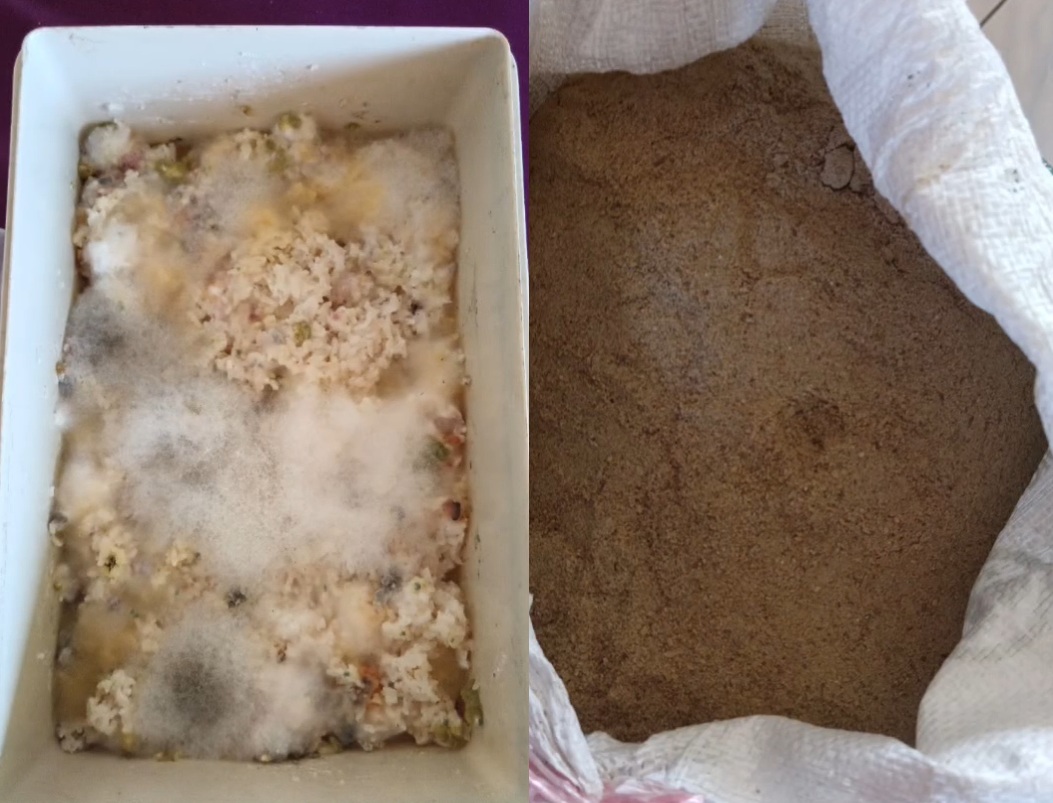
Composting for Circular Agriculture
-
Turning Waste into Worth.
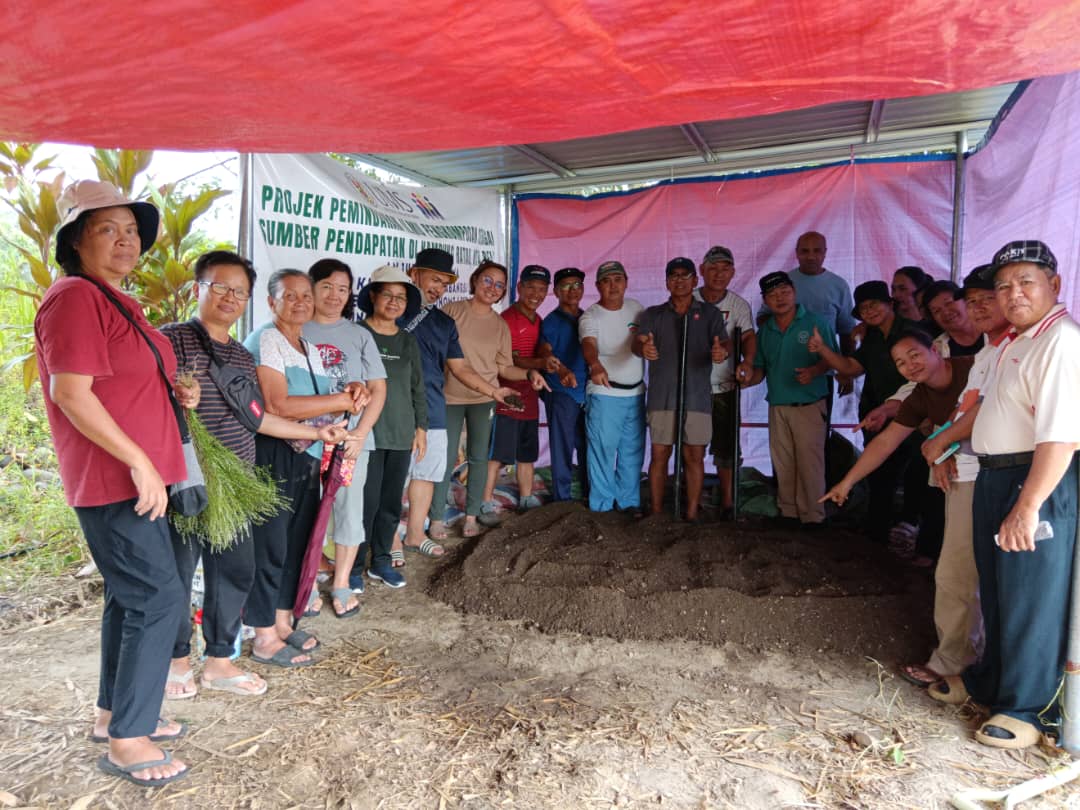
The Composting Knowledge-Transfer Project in Kg. Ratau, Kota Belud, empowers local farmers and families to transform their everyday organic waste into a valuable resource — nutrient-rich natural fertilizer. Led by Universiti Malaysia Sabah (UMS) through the Pusat Kelestarian Libatsama Masyarakat (PKLM), the project teaches participants practical composting methods using household and agricultural residues such as food scraps, leaves, and crop waste. This initiative not only reduces the community’s dependence on chemical fertilizers but also helps to restore soil health, improve productivity, and encourage more sustainable farming systems rooted in circular economy principles. Beyond its technical outcomes, the project cultivates a mindset of environmental stewardship and shared responsibility. Each compost bin becomes a classroom of change — where villagers learn that even waste holds potential when guided by knowledge and care. The process symbolizes regeneration and resilience: turning what was once discarded into new growth, bridging scarcity with innovation, and nurturing a zero-waste culture that supports climate-smart agriculture. The Kg. Ratau community now stands as an inspiring example of how small rural actions can ripple into a larger movement for sustainability and ecological balance.
-
Community
Kg. Ratau, Kota Belud - + Google Map
Bagang Bilis & Aquatic Entrepreneurship
-
Sustaining Seas, Empowering Shores.
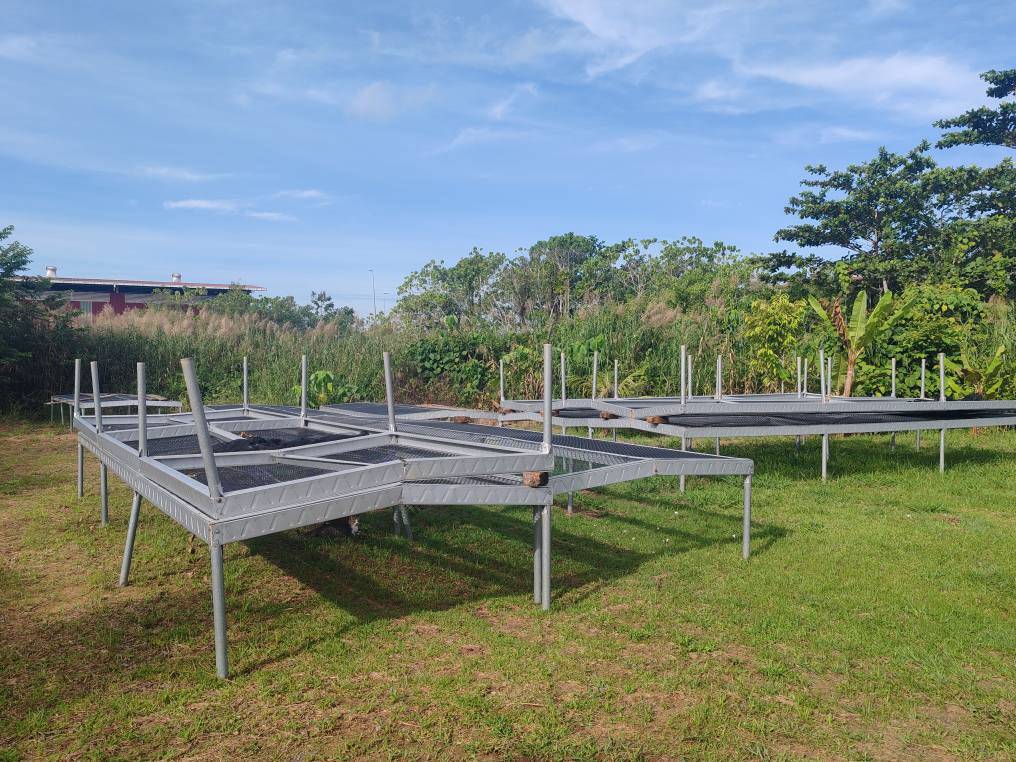
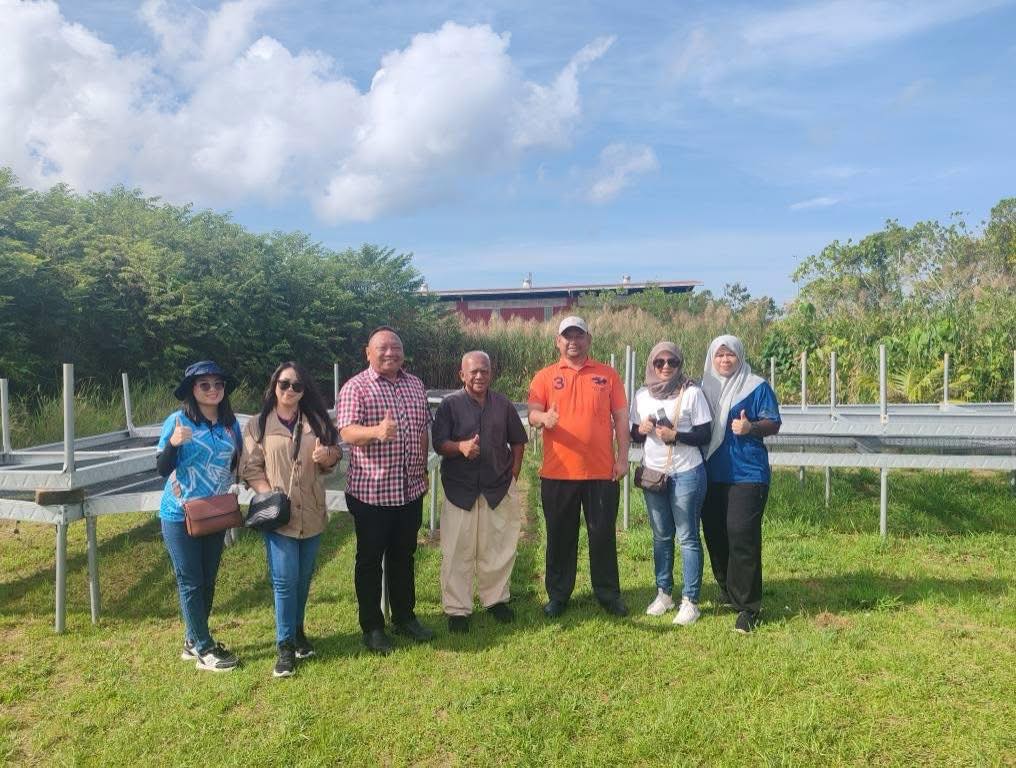
The Bagang Anchovy Fishing and Processing Project in Kg. Rancha-Rancha Darat, Labuan, stands as a shining example of how traditional livelihoods can evolve through innovation and knowledge transfer. Led by Assoc. Prof. Dr. Geoffrey Harvey Tanakinjal with project members Liew Anak Lubang, Abdul Kamal Bin Char, and Joehan Johan William, this initiative empowers the local fishing community under the guidance of Pusat Kelestarian Libatsama Masyarakat (PKLM UMS). Through the Knowledge Transfer Programme (KTP), fishers were trained in modern bagang fishing techniques, anchovy (bilis) processing, and product value enhancement. The project introduced significant innovations, including a pulley-based lifting system and modern drying platforms that ensure cleaner, faster, and more hygienic processing. These improvements safeguard products from contamination by dust, insects, and animals while increasing efficiency and product quality. The fishers now market both fresh anchovies (RM5/kg) and dried anchovies (RM20/kg), generating an average gross income of RM15,000 per month, with net earnings of RM7,000, despite operating only during the fishing season. Beyond economic success, the project revives coastal traditions while embracing sustainability — balancing productivity with respect for the sea. It has elevated the livelihoods of Kampung Rancha-Rancha Darat’s fishing families, strengthened community unity, and demonstrated how innovation and local wisdom can coexist harmoniously. The initiative is a true reflection of UMS’s mission to nurture sustainable, inclusive, and ocean-conscious communities.
-
Community
Kg. Rancha-Rancha Darat, Labuan - + Google Map
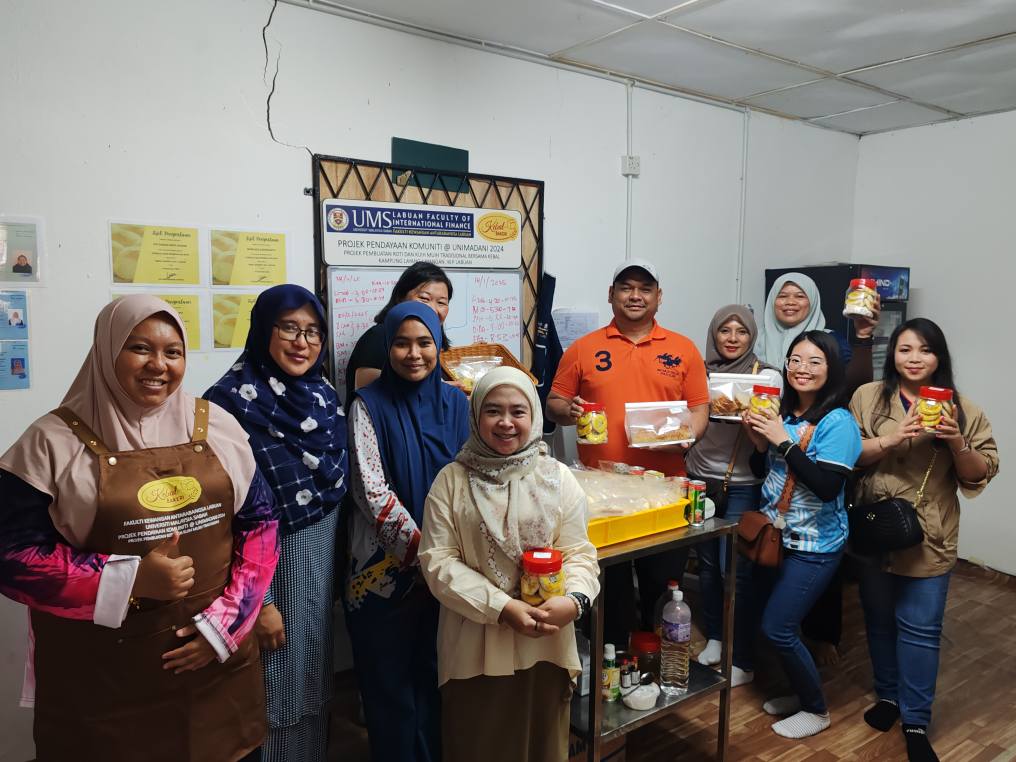
Traditional Bread and Local Pastries Entrepreneurship Project
-
From Local Taste to Lasting Prosperity.
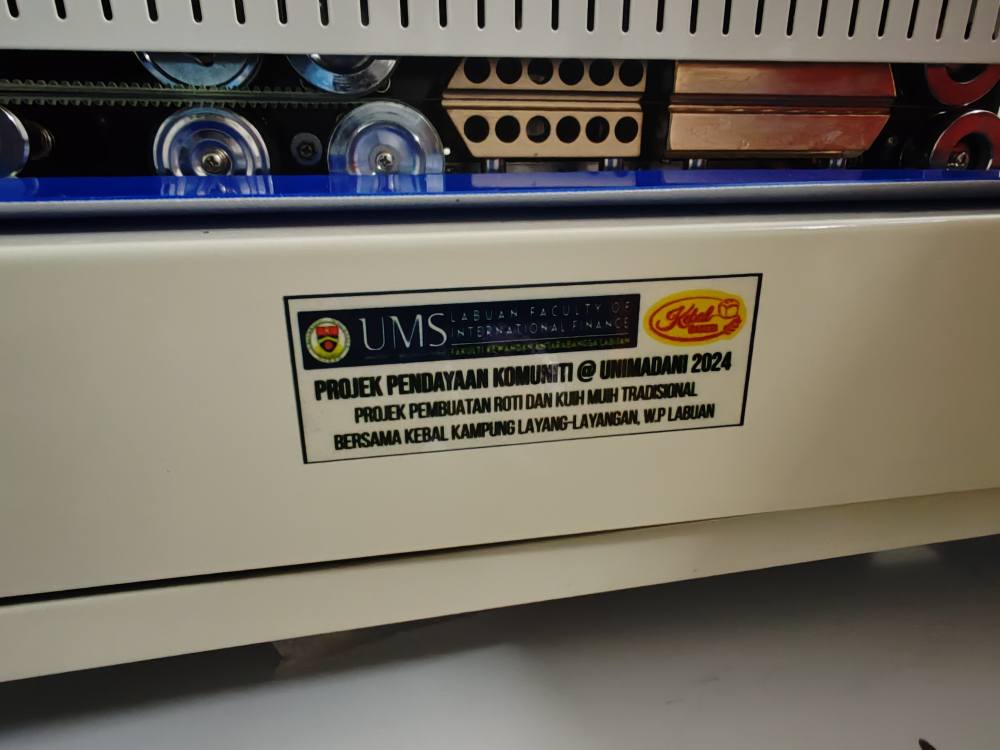
The Traditional Bread and Local Pastries Entrepreneurship Project in Labuan exemplifies how local creativity, innovation, and community spirit can drive sustainable economic growth. Spearheaded by Dr. Suzilah binti Sidek together with Dr. Sharinah binti Puasa, Dr. Emily Yapp Hon Tshin, and Dr. Nazarina Jamil, this project was implemented under the Program Pendayaan Komuniti @ UniMADANI 2024, funded by the Ministry of Finance Malaysia and coordinated by the Pusat Kelestarian Libatsama Masyarakat (UMS). Working with the Kelab Belia Anak Layangan (KEBAL) community, fifteen active participants received hands-on training in the art and business of traditional pastry-making. The project introduced healthier and innovative products such as sourdough, tausa piang, pandan buns, and buttermilk buns, achieving an impressive average monthly revenue of RM1,900. Particularly, the sourdough bread, one of only two of its kind produced in Labuan, has become a community favourite due to its low production cost, higher market value, and nutritional benefits. Beyond baking, the project integrates technology and innovation by introducing automated labelling and packaging machines, enhancing both efficiency and product quality. With expanding sales reaching even Peninsular Malaysia, orders now average 300 units per batch, up to twice a week. Participants have also diversified income streams through baking courses and ingredient sales, turning their passion into a sustainable micro-enterprise model. This initiative not only boosts income but also builds confidence, skills, and identity among the Labuan youth and families involved — a clear testament to the power of knowledge transfer in shaping resilient and self-sustaining communities.
Mushroom Cultivation Project
-
Cultivating Growth, Harvesting Hope.
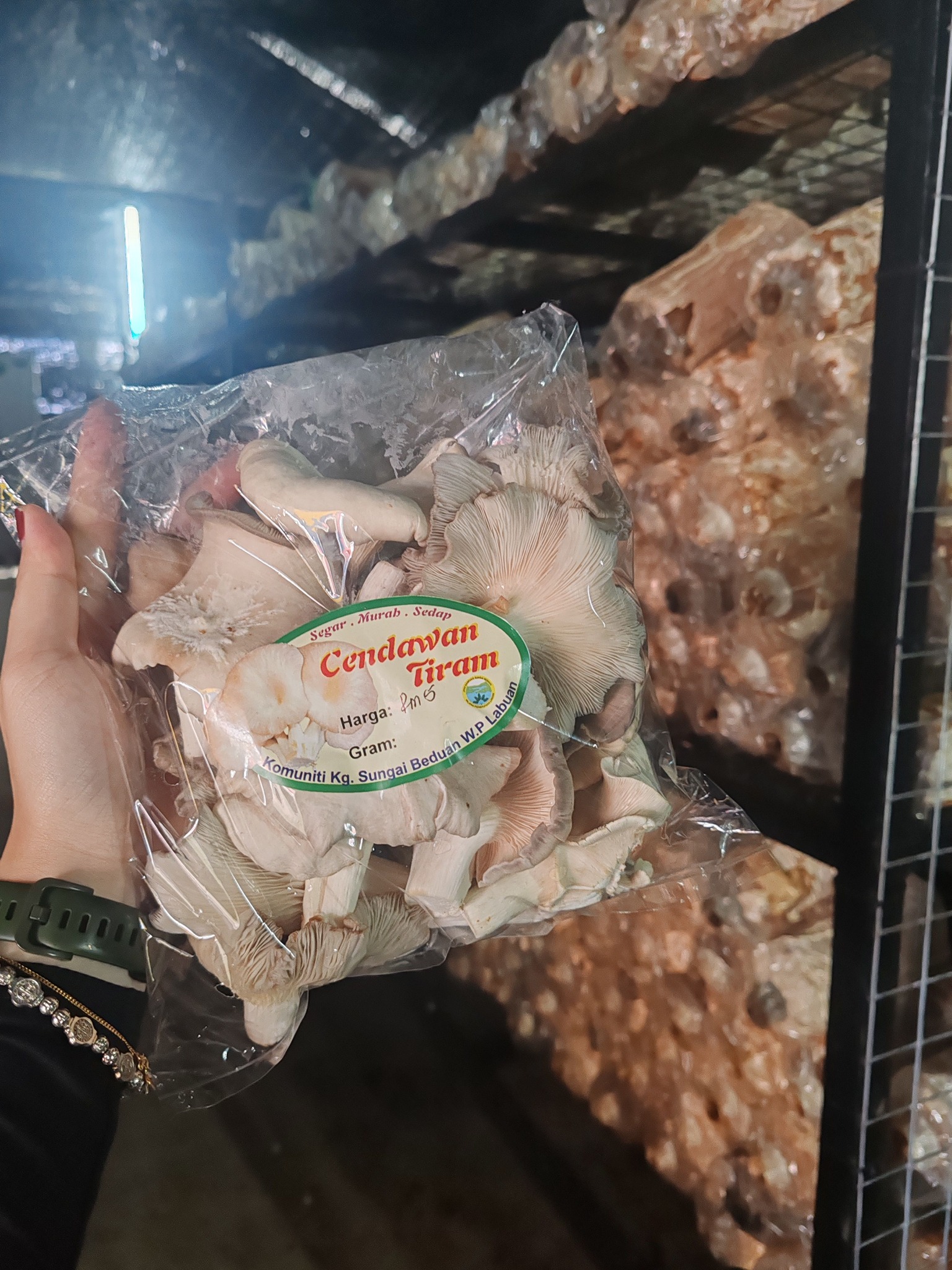
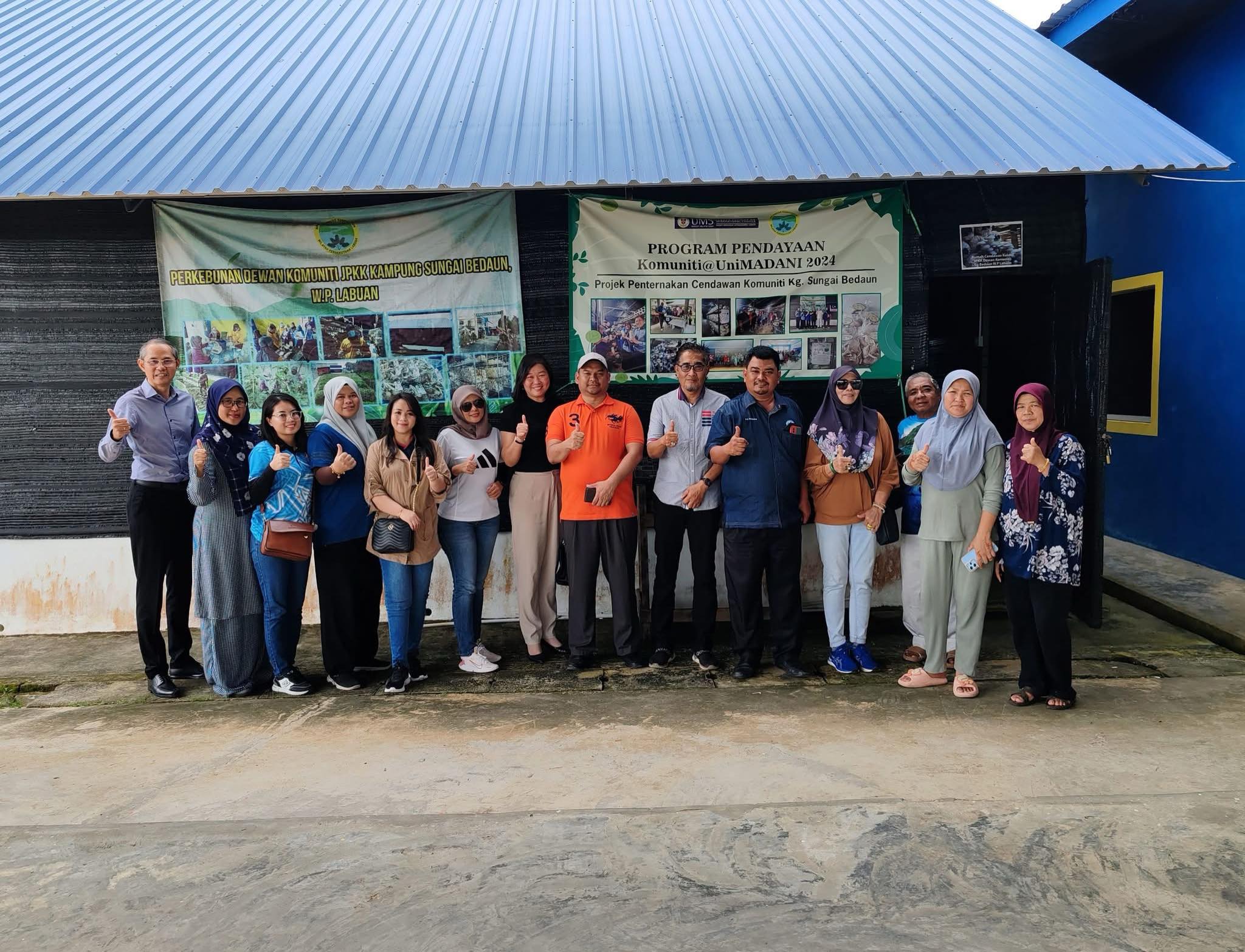
The Mushroom Cultivation Project in Kg. Sungai Bedaun, Labuan, exemplifies how knowledge transfer can transform small communities into sustainable, income-generating ecosystems. Implemented under the Program Pendayaan Komuniti @ UniMADANI 2024, funded by the Ministry of Finance Malaysia, and led by Dr. Emily Yapp Hon Tshin from the Faculty of International Finance Labuan (FKAL) alongside Dr. Nazarina Jamil, Dr. Sharinah Puasa, and Assoc. Prof. Lee Hock Ann, this initiative brought together innovation, community participation, and environmental awareness. The project introduced modern mushroom farming techniques using 1,500 cultivation blocks integrated with automatic irrigation systems, block-stacking methods for efficient space use, and lime-layered caps to simplify operations compared to traditional methods. Infrastructure upgrades — including water tanks, chillers, pumps, and packaging equipment — helped maintain product quality and streamline operations. In just three months, the project produced 150 kg of fresh mushrooms, generating RM3,000 in revenue per season, with two harvests expected annually. Beyond the numbers, the project’s heart lies in empowering 15 community members with practical agricultural and marketing skills. The combination of attractive packaging and digital promotion has expanded the market reach and improved local demand. By blending modern agrotechnology with community entrepreneurship, the initiative not only enhanced local income but also built a foundation for resilient, climate-smart rural economies that can thrive sustainably across generations.
-
Community
Kg. Sungai Bedaun, Labuan - + Google Map
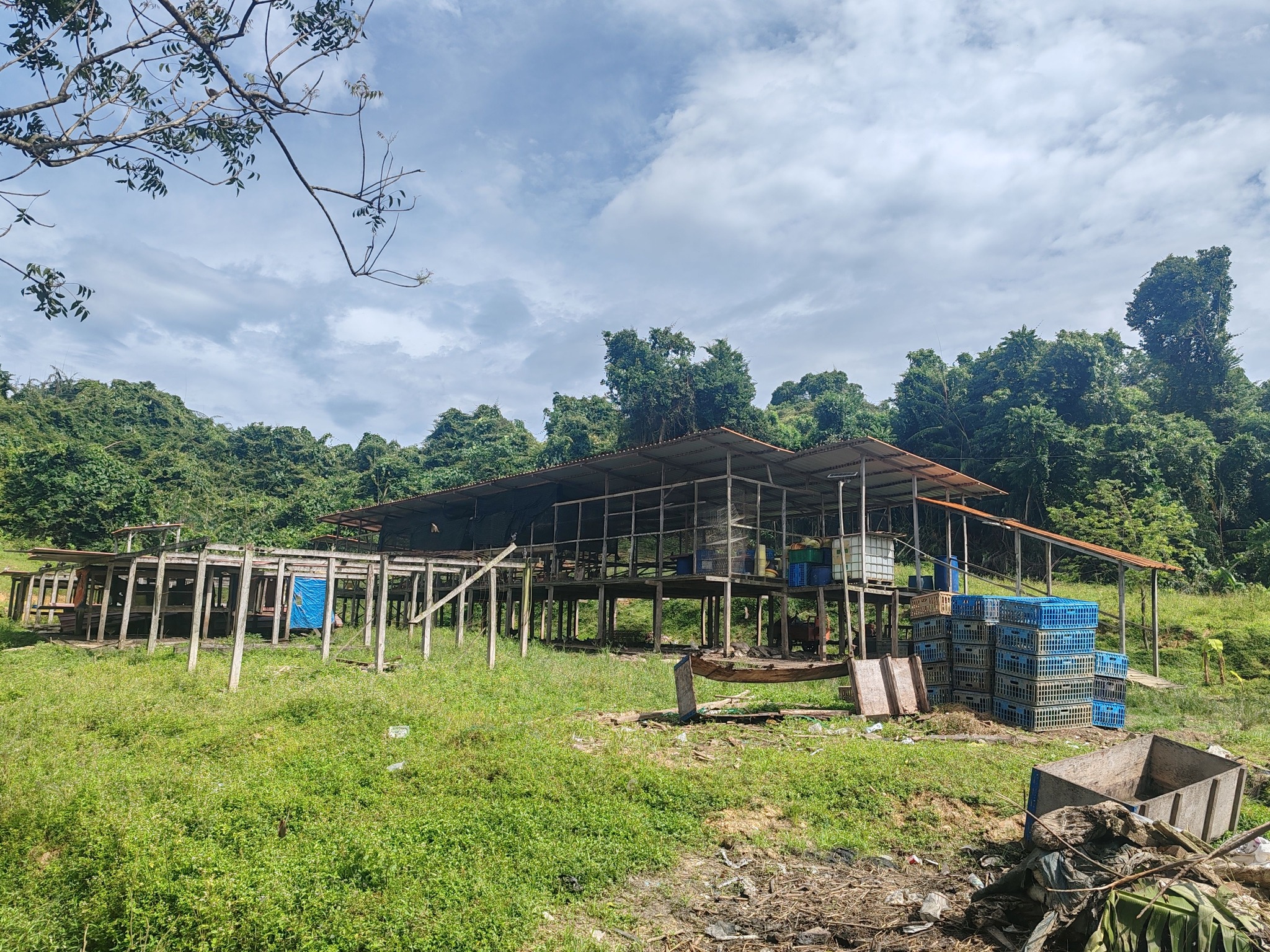
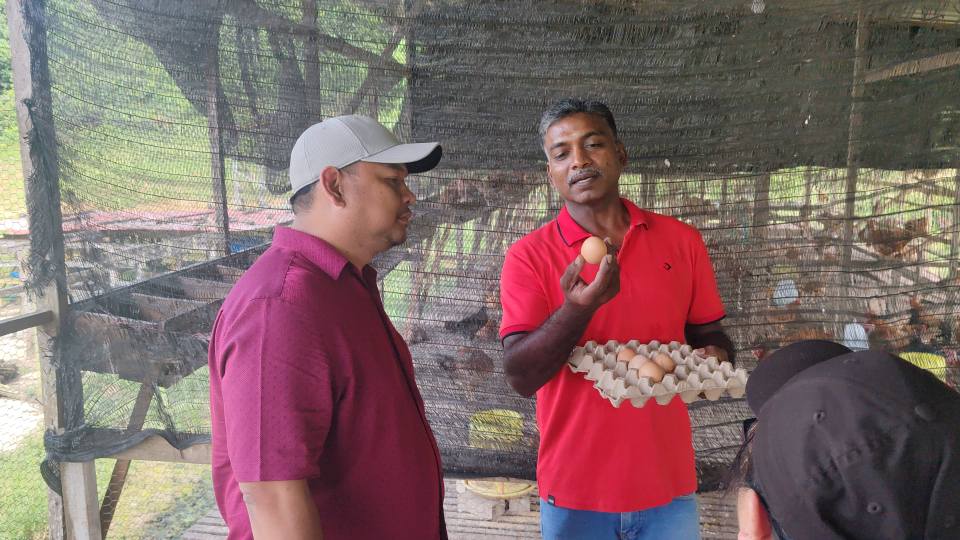
Sustainable Poultry Farming
-
Nurturing Livelihoods, Sustaining Growth.
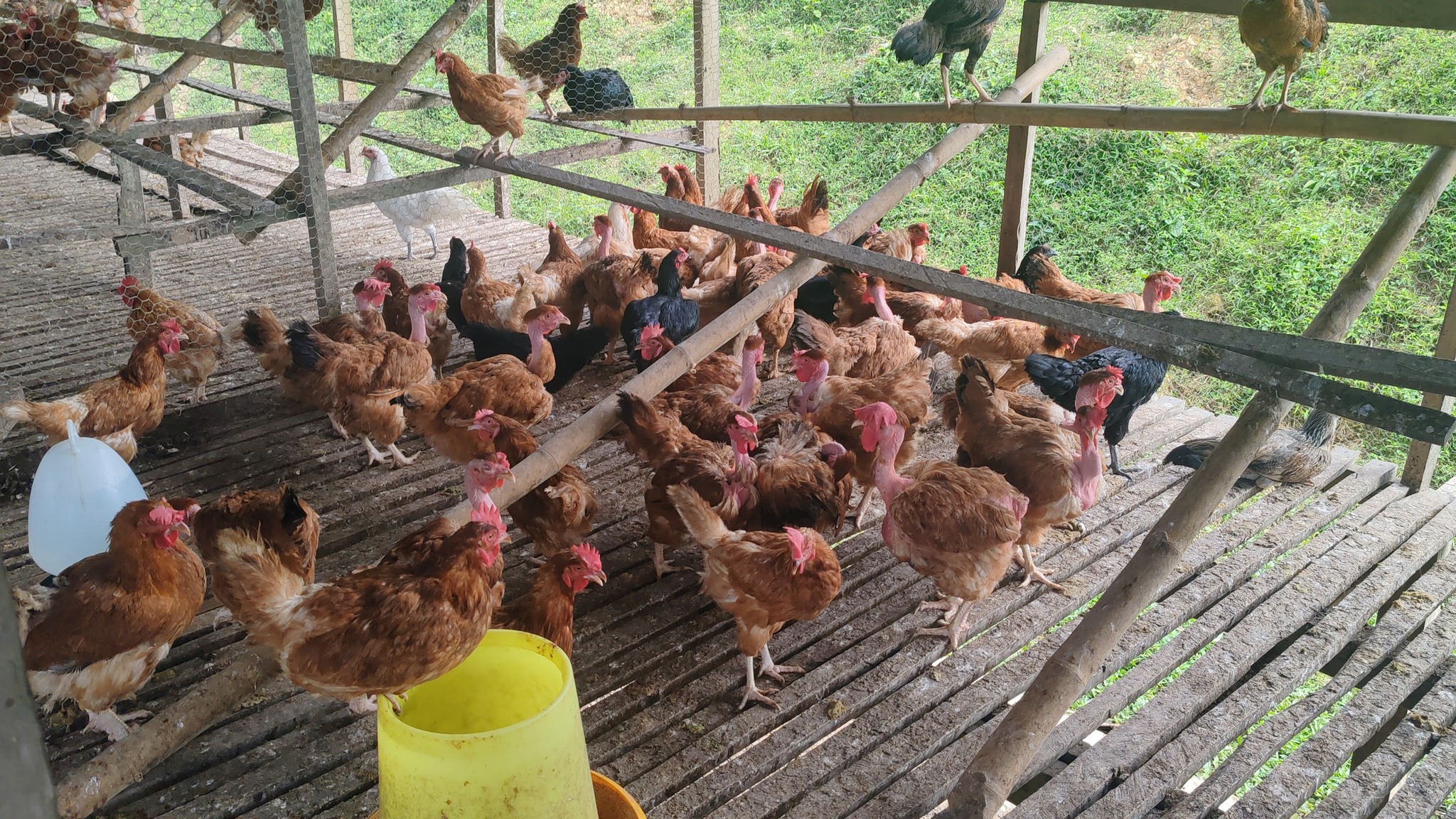
The Layer Chicken Farming Knowledge-Transfer Project in Kg. Bukit Kuda, Labuan, demonstrates how collaboration between academia and local communities can foster sustainable rural entrepreneurship. Implemented by the Faculty of International Finance Labuan (FKAL) under the Pusat Kelestarian Libatsama Masyarakat (PKLM UMS), and funded by the Program Pendayaan Uni@MADANI 2024 from the Ministry of Finance Malaysia, this RM10,000 initiative has successfully empowered 20 active participants from the Northern Labuan Farmers’ Association to strengthen their economic resilience through sustainable poultry farming. Led by Dr. Ooi Ai Yee (FKAL) with En. Sittha as the community leader, the project has expanded its flock from 100 to 130 chickens, producing 90–120 eggs daily. Innovation lies at the heart of its success — participants have formulated nutritious, low-cost chicken feed from local ingredients and adopted organic waste recycling by turning chicken manure into fertilizer for multi-livestock farms involving goats, cattle, deer, and quail. These efforts have reduced production costs while promoting zero-waste agricultural practices and integrated farm management. Supported by Assoc. Prof. Dr. Geoffrey Harvey Tanakinjal, Dr. Siti Nur Aqilah Ab Wahab, and Minah Anak Japang, the project team provided expertise in microfinance management, vaccination programs, and training module development. Strategic collaboration with the Department of Veterinary Services Labuan and Sabah Prisons Department further enhanced animal health, logistics, and technical support. During the monitoring visit by Ts. Dr. Ag Sufiyan Abd Hamid, Director of PKLM, on 24 February 2025, the initiative was praised as a model of effective university–community collaboration, blending academic knowledge with grassroots innovation. With plans to expand its chicken coops and digitalize its financial management, the project continues to evolve as a beacon of sustainable social enterprise, proving that when knowledge meets community, prosperity grows from the ground up.
-
Community
Kg. Bukit Kuda, Labuan - + Google Map
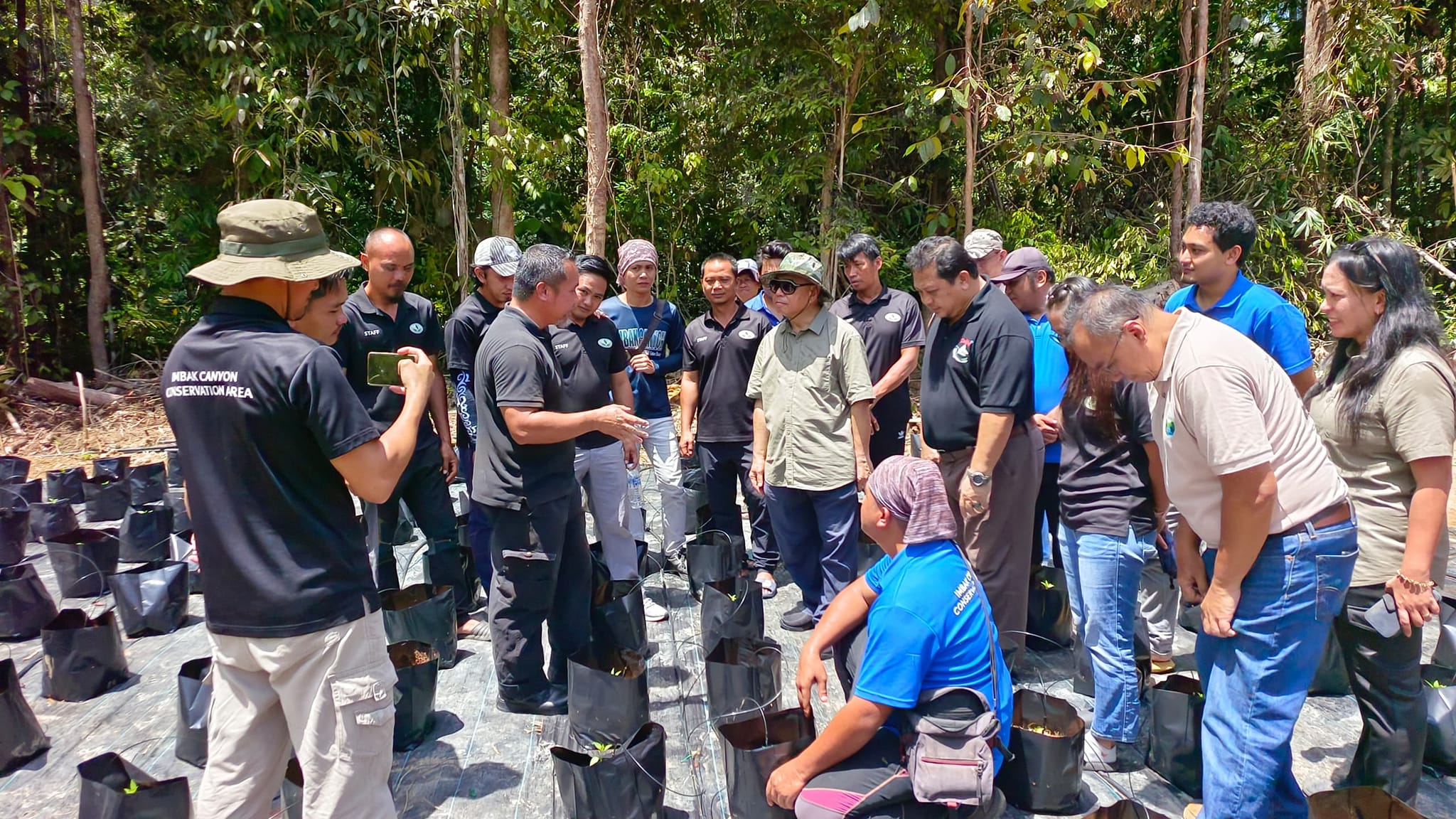
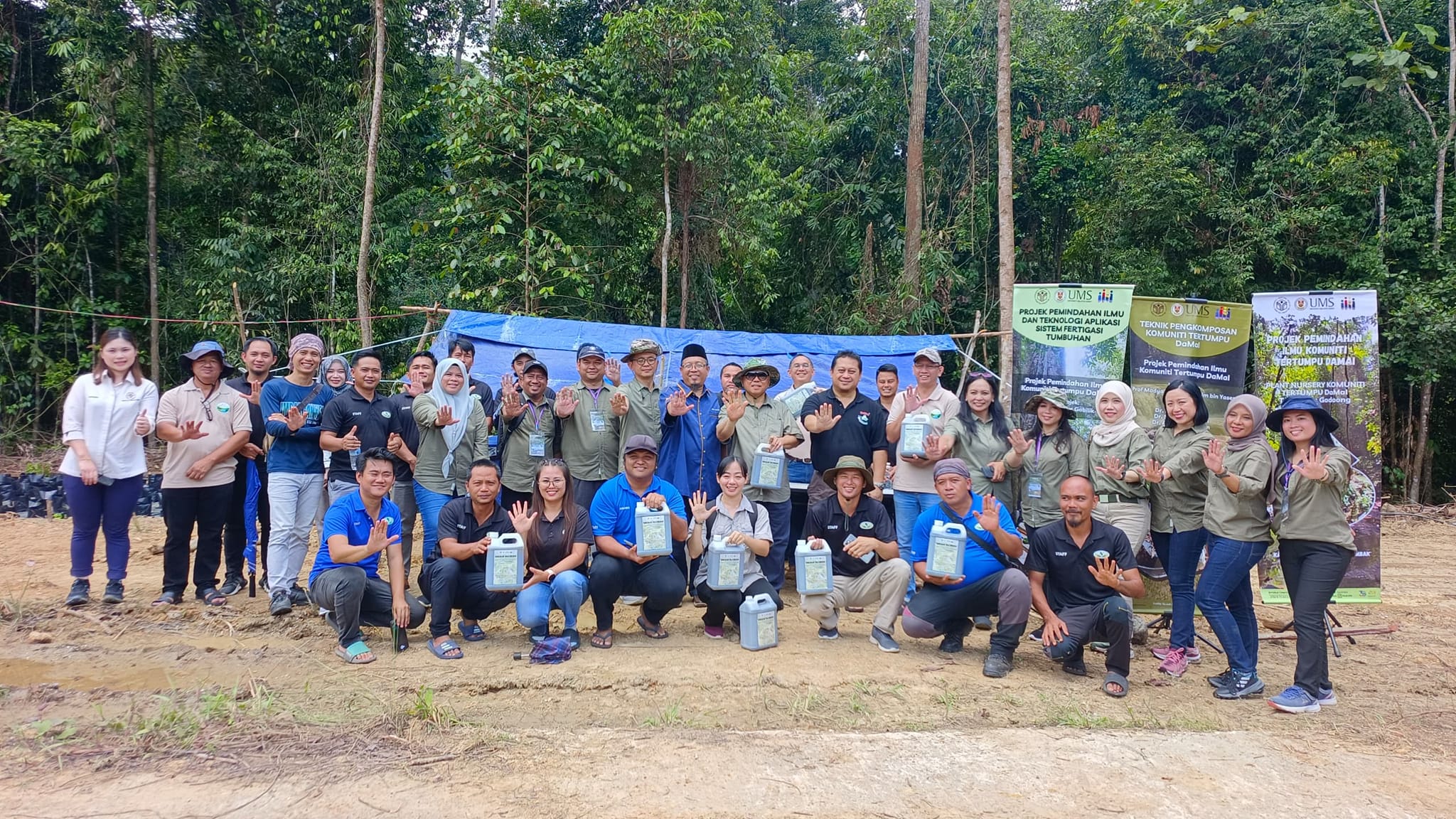
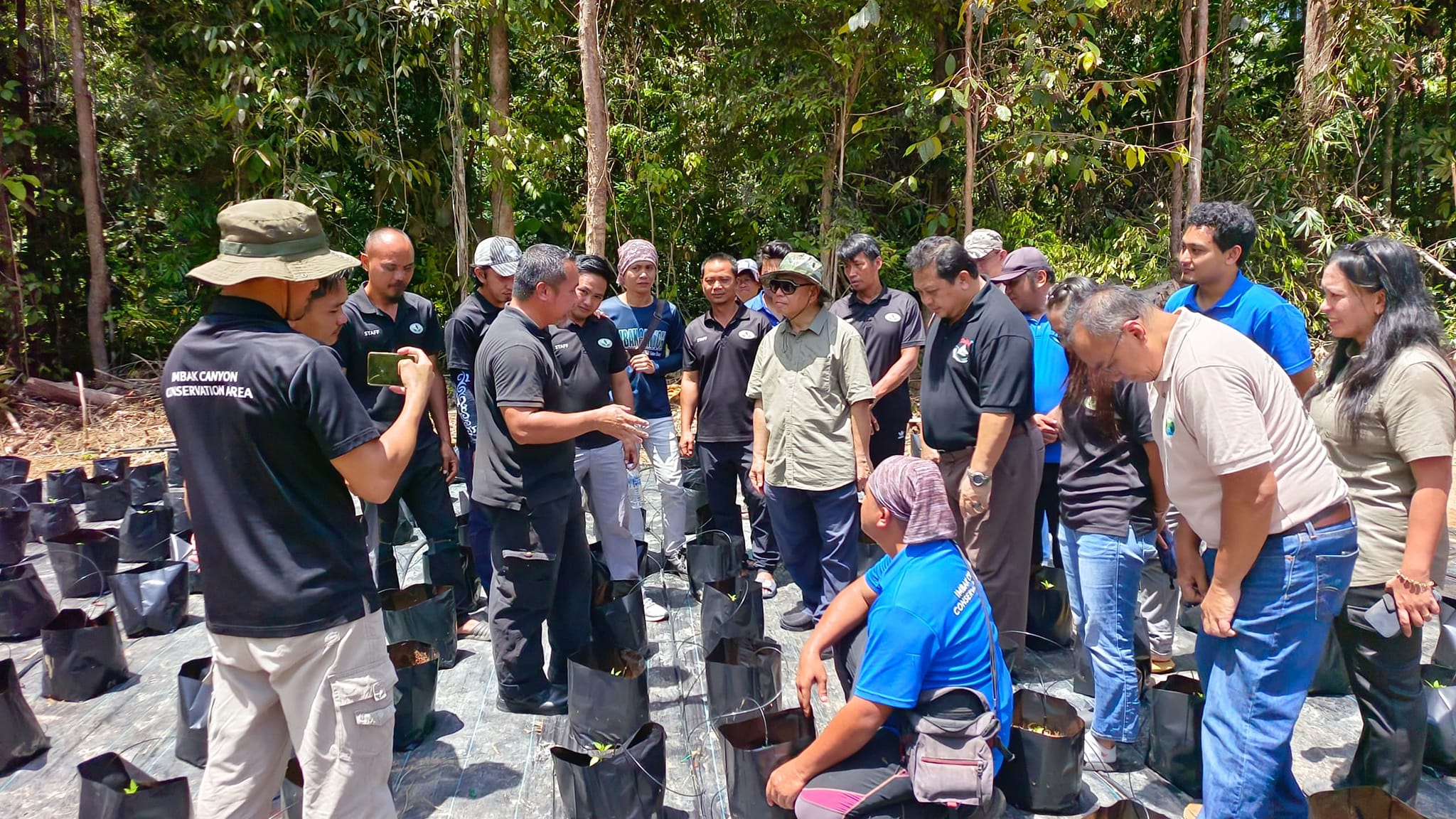
Community Knowledge-Transfer Project at Imbak Canyon Conservation Centre
-
From Roots to Resilience.
The Community Knowledge-Transfer Project at Imbak Canyon Conservation Centre reflects Universiti Malaysia Sabah’s enduring commitment to advancing sustainability through education, conservation, and community empowerment. Organized by the Pusat Kelestarian Libatsama Masyarakat (PKLM UMS), this annual programme unites researchers, conservationists, and the Yayasan Sabah community within the DaMaI (Danum–Maliau–Imbak) Triangle — one of Malaysia’s most biodiverse conservation landscapes. Through immersive, hands-on activities, participants engage in the exchange of indigenous knowledge, scientific expertise, and practical sustainability practices. Among the key initiatives are organic fertilizer production, pepper cultivation technology, and forest-based biodiversity awareness modules, all aimed at supporting sustainable livelihoods and responsible resource management. Beyond training, the experience deepens appreciation for nature’s interconnectedness — from observing flying squirrels and rare birds to learning about medicinal plants and ecological balance. This collaboration stands as a living model of how universities can bridge academia with the heart of nature — empowering conservation workers and local communities alike to become guardians of Sabah’s natural heritage. It is a journey of shared learning, mutual respect, and hope for a sustainable tomorrow where knowledge nurtures both people and the planet.
-
Community
Imbak Canyon Conservation Centre - + Google Map
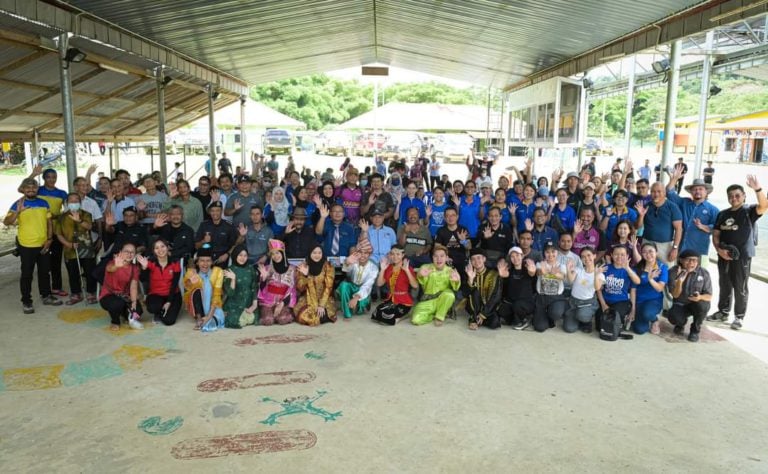
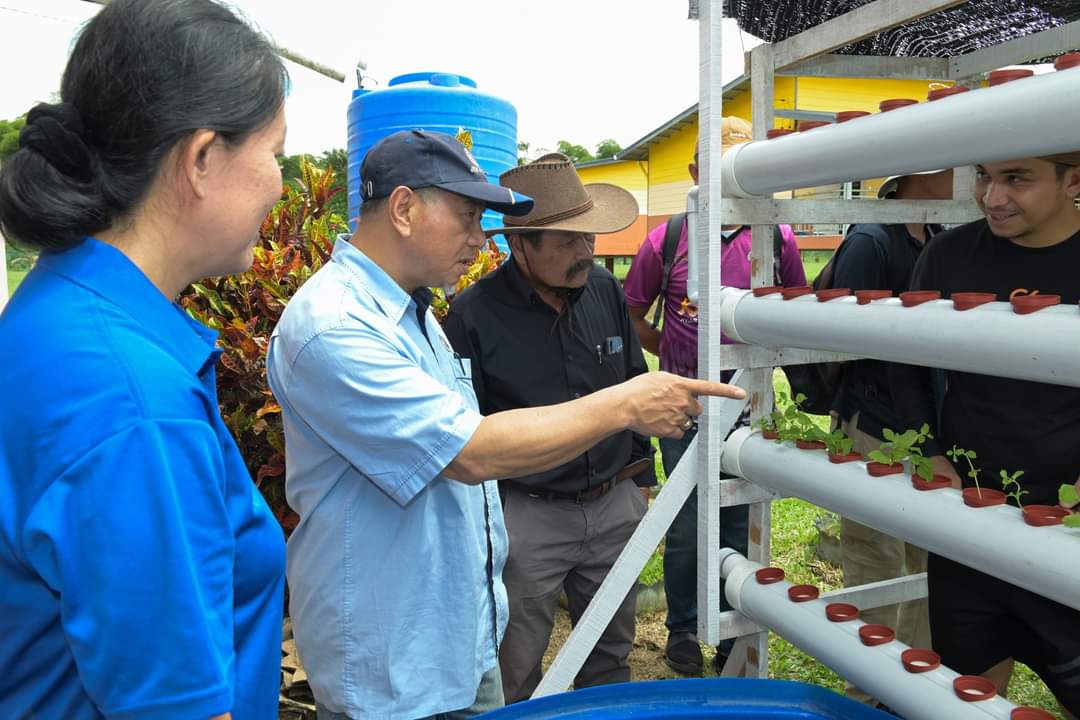
Trans Borneo 2023 Knowledge Transfer Program
-
Cultivating Growth, Harvesting Hope.
Under the Ministry of Higher Education’s Knowledge Transfer Initiative (KRIS), Universiti Malaysia Sabah (UMS) spearheaded ten multidisciplinary community projects in Kampung Long Pasia, Sipitang—a remote highland village located near the Sabah–Sarawak border. The programme mobilised over 90 UMS academics, researchers, and students, working directly with more than 200 local residents across sectors such as health education, aquaculture, smart solar e-Desa systems, ICT literacy, composting, and biodiversity conservation. By integrating scientific expertise with local wisdom, the initiative enhanced livelihood opportunities through sustainable fish-farming, organic fertiliser production, and eco-tourism potential, while also improving access to clean energy and digital communication. Environmental awareness campaigns and health outreach activities strengthened community wellbeing and self-reliance, especially among women and youth. Through this holistic approach, the Long Pasia community gained both economic resilience and ecological literacy, reducing dependency on external aid and vulnerability to socio-economic and environmental shocks. The project exemplifies UMS’s model of community-based sustainability, where education and technology become enablers for rural transformation
-
Community
Kampung Long Pasia,Sipitang - + Google Map
Empowering every life to rise above poverty
From Education to Empowerment: UMS’s Mission to Deliver Basic Services for All
Universiti Malaysia Sabah (UMS) believes that higher education must serve humanity by ensuring that every individual—regardless of income, location, or background—has access to life’s most essential services: clean water, healthcare, sanitation, education, and digital connectivity. Rooted in Sabah’s unique social and geographic landscape, UMS extends its academic expertise beyond the campus to the most underserved communities across the state. Guided by the UMS Strategic Plan 2023–2027, Universiti Malaysia Sabah (UMS) plays a transformative role in improving access to basic services—clean water, sanitation, healthcare, and digital inclusion—for underserved and remote communities across Sabah. Situated in one of Malaysia’s most geographically diverse states, UMS understands that access to these fundamental needs remains uneven, particularly in rural and island areas where communities often depend on rainwater, river sources, or basic facilities. The university’s mission goes beyond academic excellence; it extends into real-world impact, ensuring that knowledge, technology, and innovation become tools for uplifting the lives of those who are most in need. Many rural areas in Sabah face unique challenges of geographical isolation, limited infrastructure, and economic vulnerability, which continue to hinder access to essential public services. In some coastal and interior settlements, households struggle with waterborne diseases due to unsafe water sources, limited sanitation infrastructure, and inadequate healthcare access. The digital divide also remains a pressing issue, limiting educational and economic opportunities for rural youth. UMS responds to these challenges through targeted interventions that blend scientific expertise with local wisdom, focusing on building sustainable systems that communities can manage independently over the long term. Recognising its social responsibility as a public university, UMS integrates education, research, and community service to bridge these gaps and ensure that the benefits of knowledge extend far beyond university walls. Through community-based learning, living labs, and collaborative partnerships with government agencies and international organisations, UMS transforms classrooms into platforms for social innovation. Its outreach programmes empower communities not merely to receive aid but to acquire the skills and confidence needed to sustain essential services themselves—turning education into empowerment and ensuring that no one is left behind in the pursuit of equitable development.
Water, Sanitation and Hygiene (WASH) Capacity Building
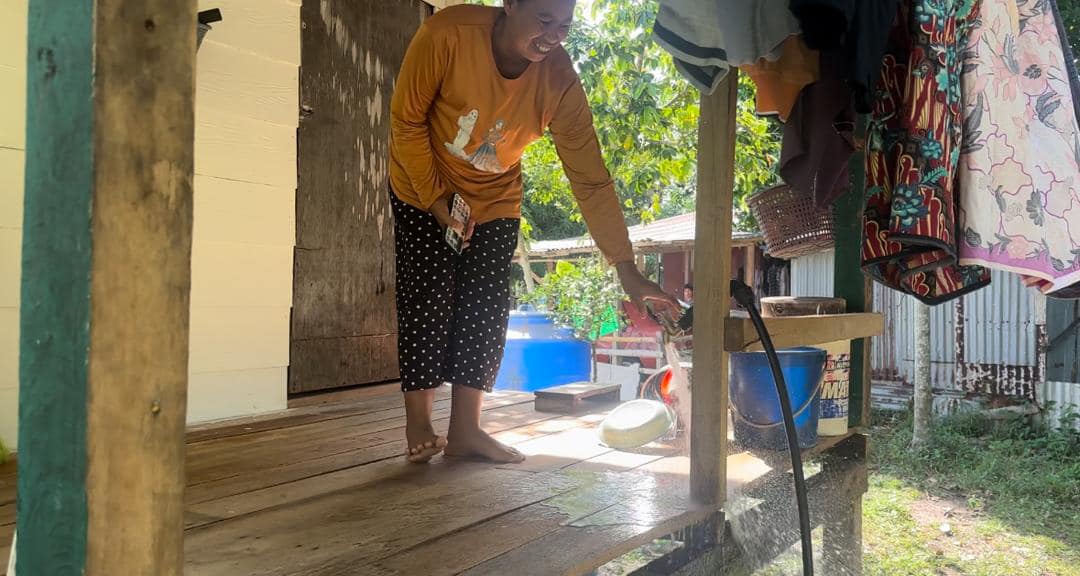
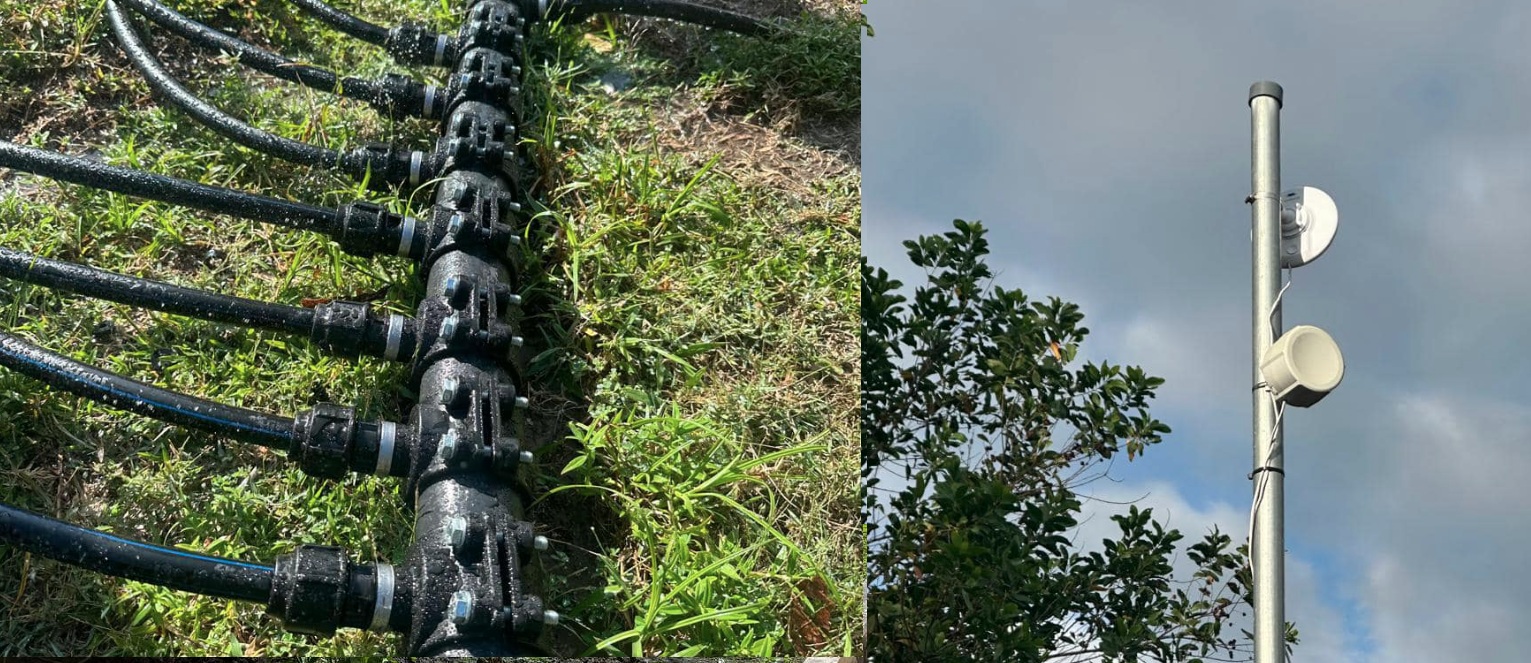
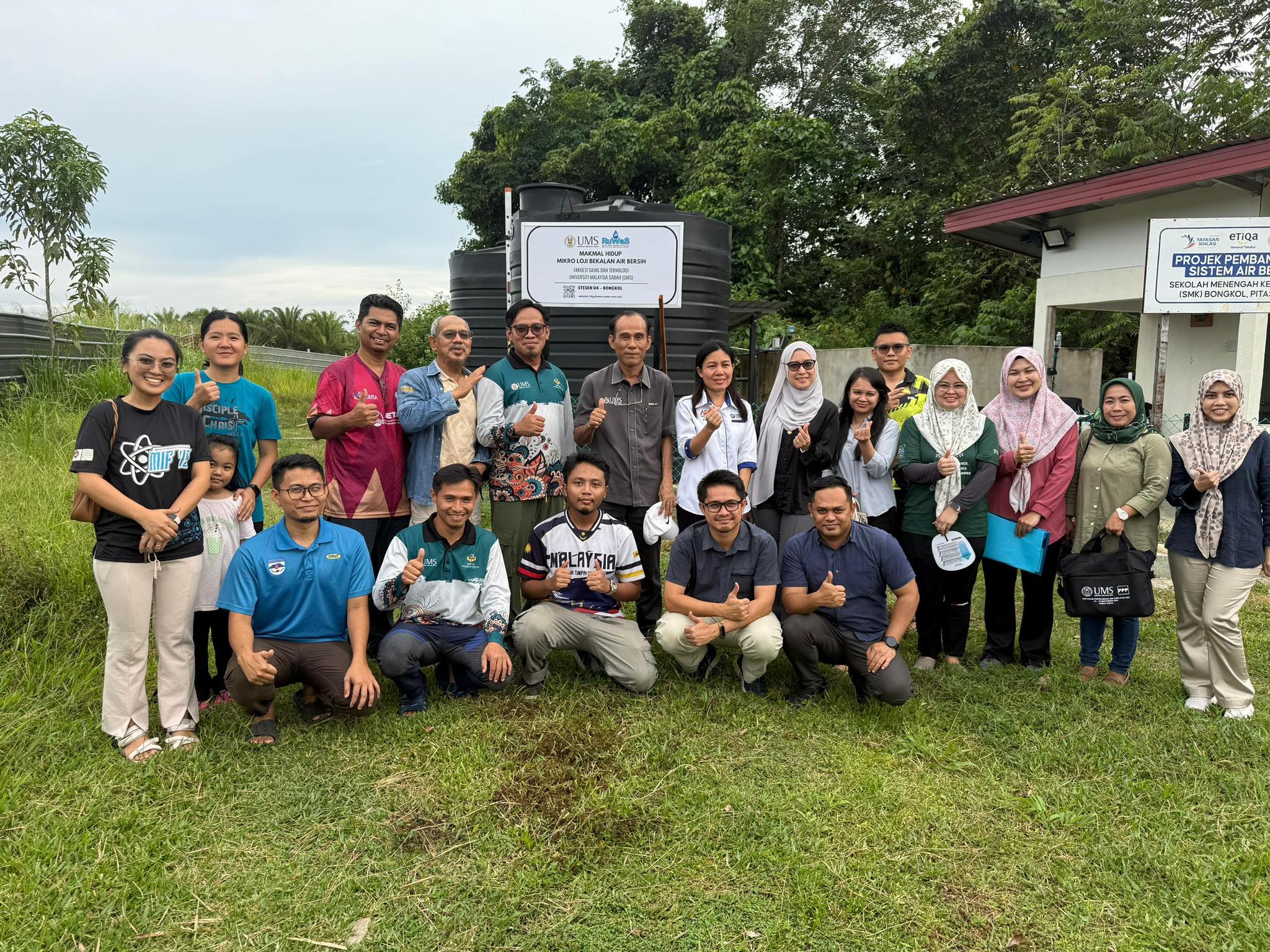
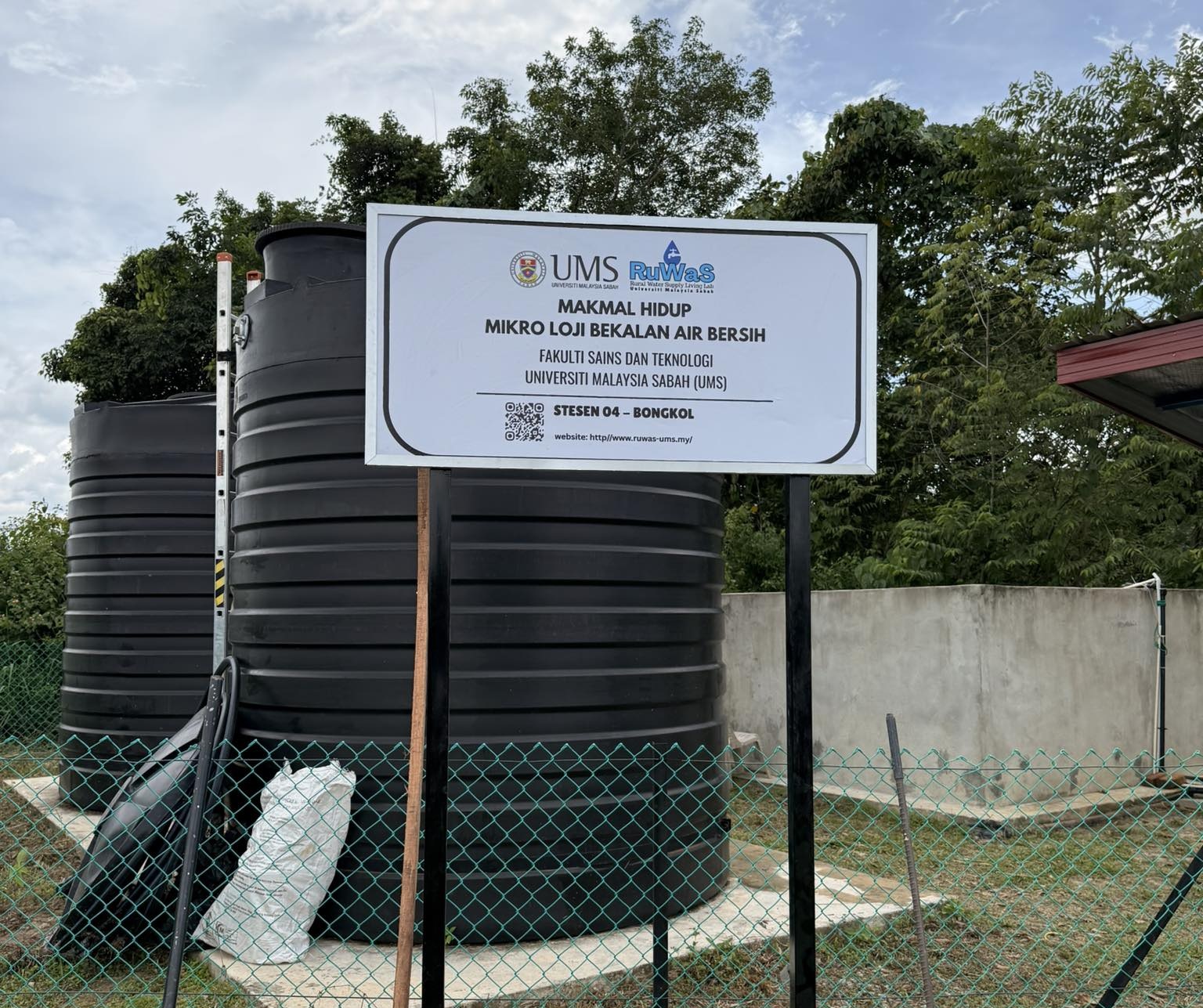
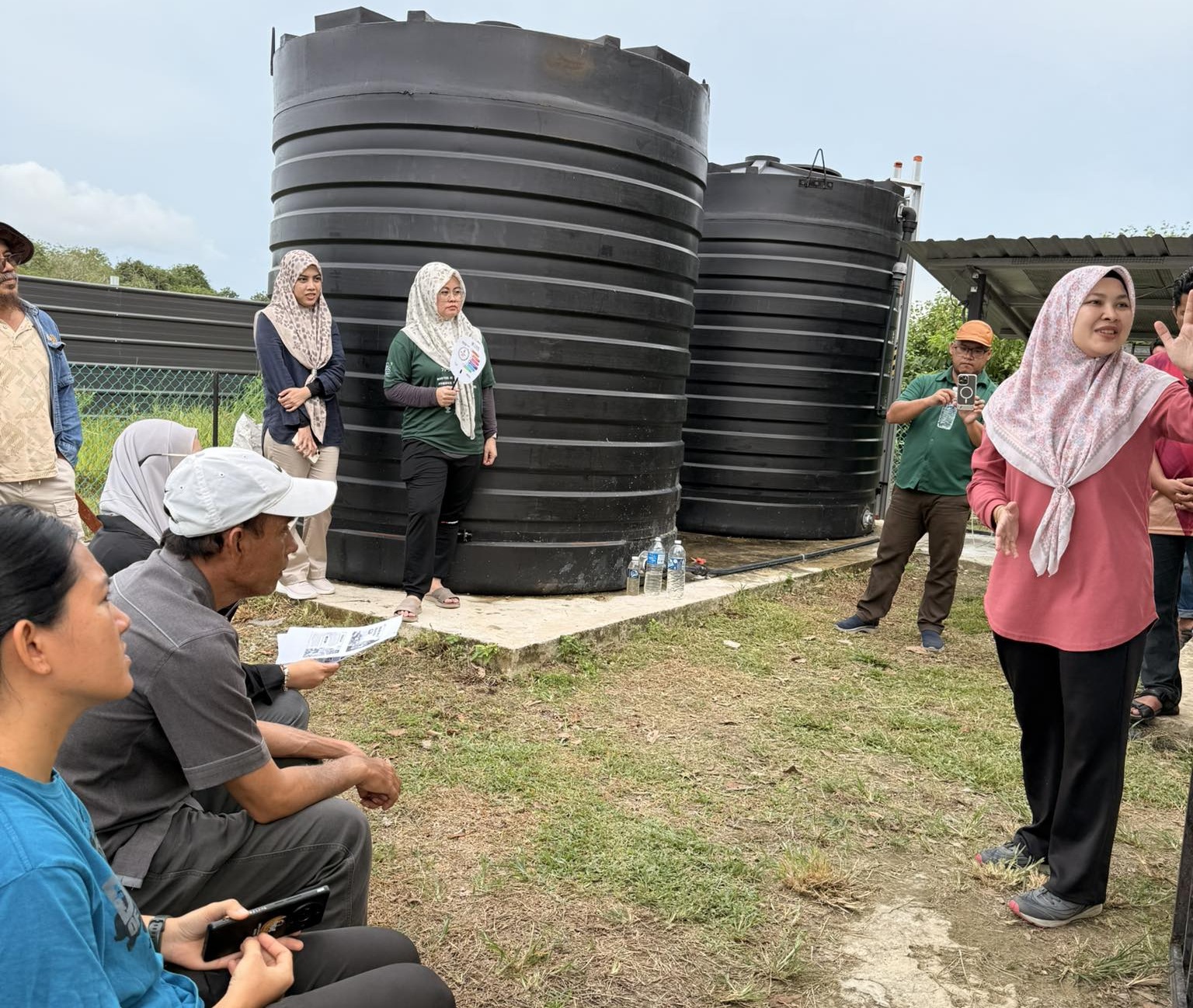
Access to safe water and adequate sanitation remains a daily struggle for many rural and coastal settlements in Sabah. To address this, UMS conducts extensive training and technology-transfer programmes through its Smart Sanitation for Water Settlements Project, implemented jointly with the United Nations Environment Programme (UNEP) and ACT Malaysia. The project trains villagers in rainwater harvesting, greywater reuse, and solar-powered filtration systems that are easy to maintain using local materials. Workshops combine environmental engineering with hygiene education, ensuring that communities understand both the technology and the behavioural practices required to keep systems sustainable. On 2024, a successful trial run was conducted for the Kg Lok Dangkaan Micro Water Supply Plant in Pitas, Sabah. The integrated micro water plant, capable of producing 30,000 litres of clean water per day, is powered by solar energy and equipped with IoT-based monitoring technology for real-time system tracking and maintenance. This project, the third micro water plant developed under a CSR initiative by academic staff from the Faculty of Science and Natural Resources, Universiti Malaysia Sabah (UMS), was funded by the Economic Implementation and Strategic Coordination Agency (LAKSANA) under the Ministry of Finance Malaysia, in collaboration with Perbadanan Baitulmal Negeri Sabah (PBNS) and UMS. According to village representative Mr. Latif bin Asang, the plant provides a vital solution to the community’s long-standing water challenges, especially during the dry season when many household wells run dry, ensuring a sustainable and reliable source of clean water for all residents.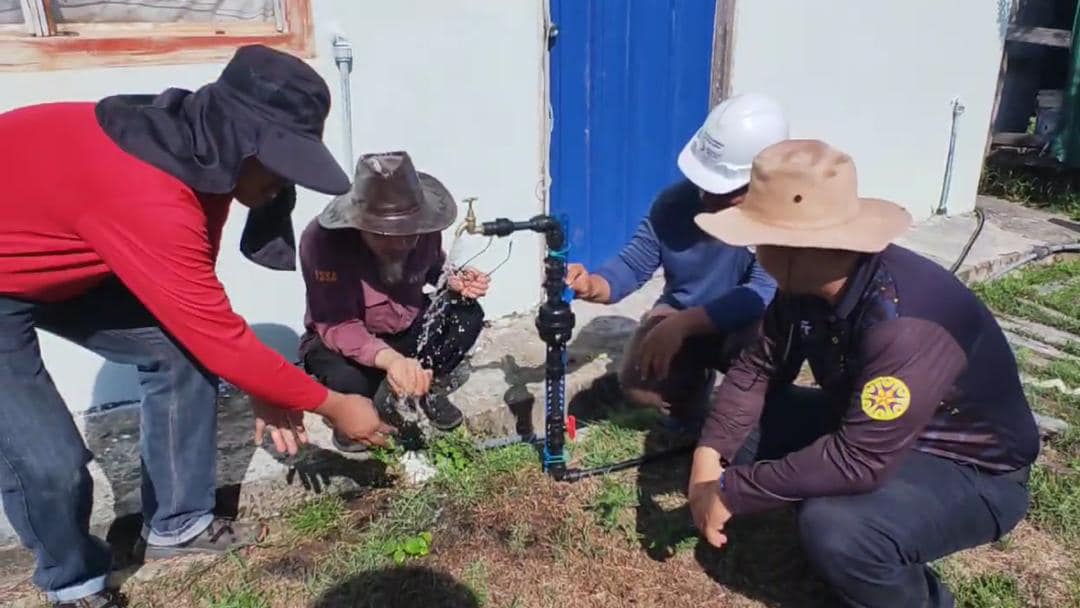
Renewable Energy for Basic Infrastructure Support
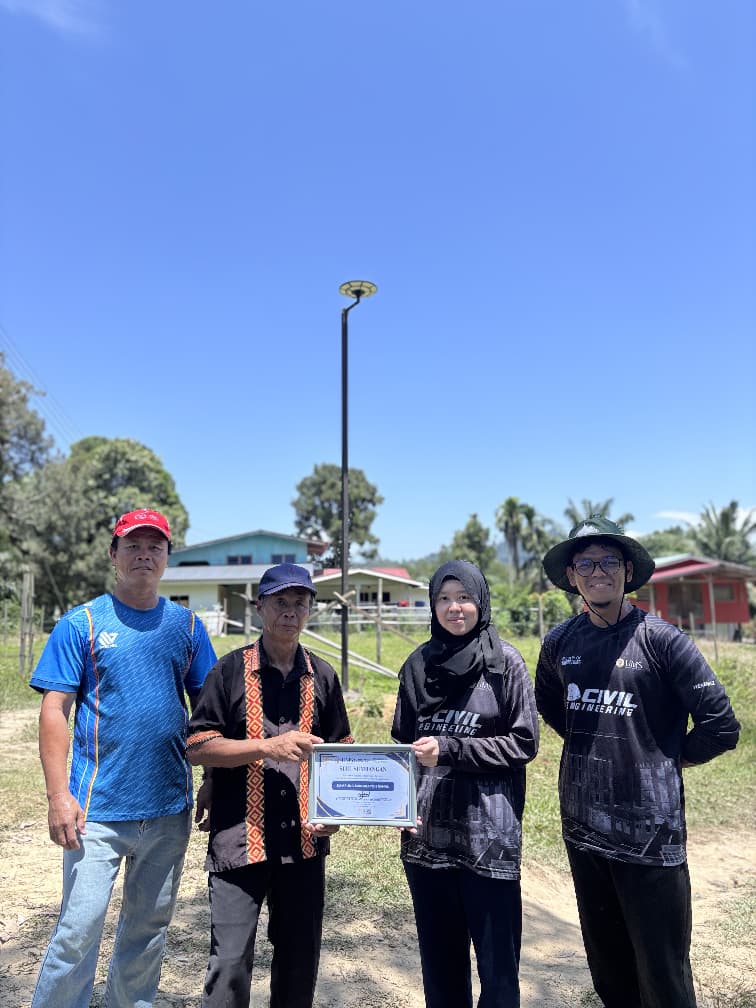
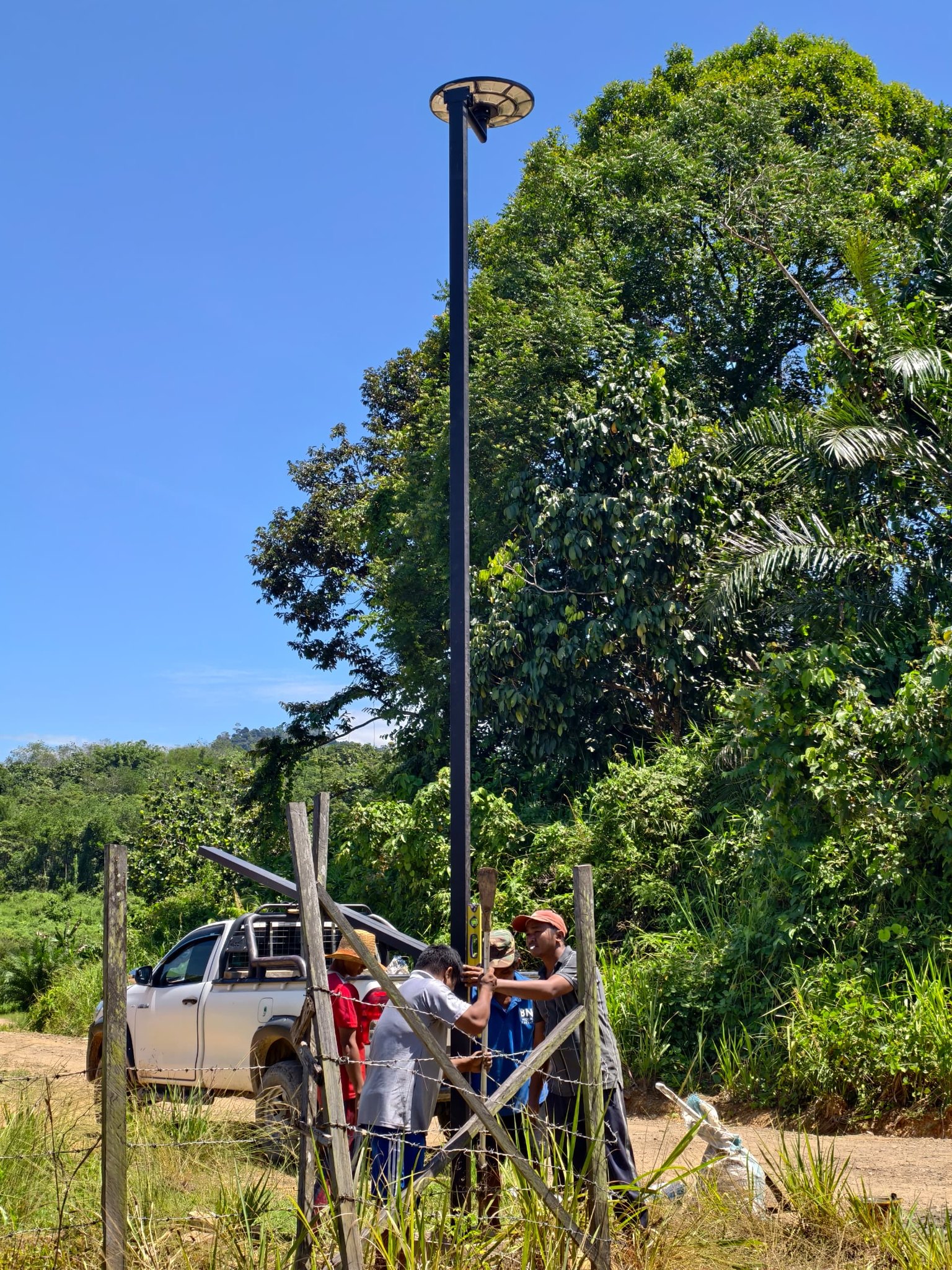
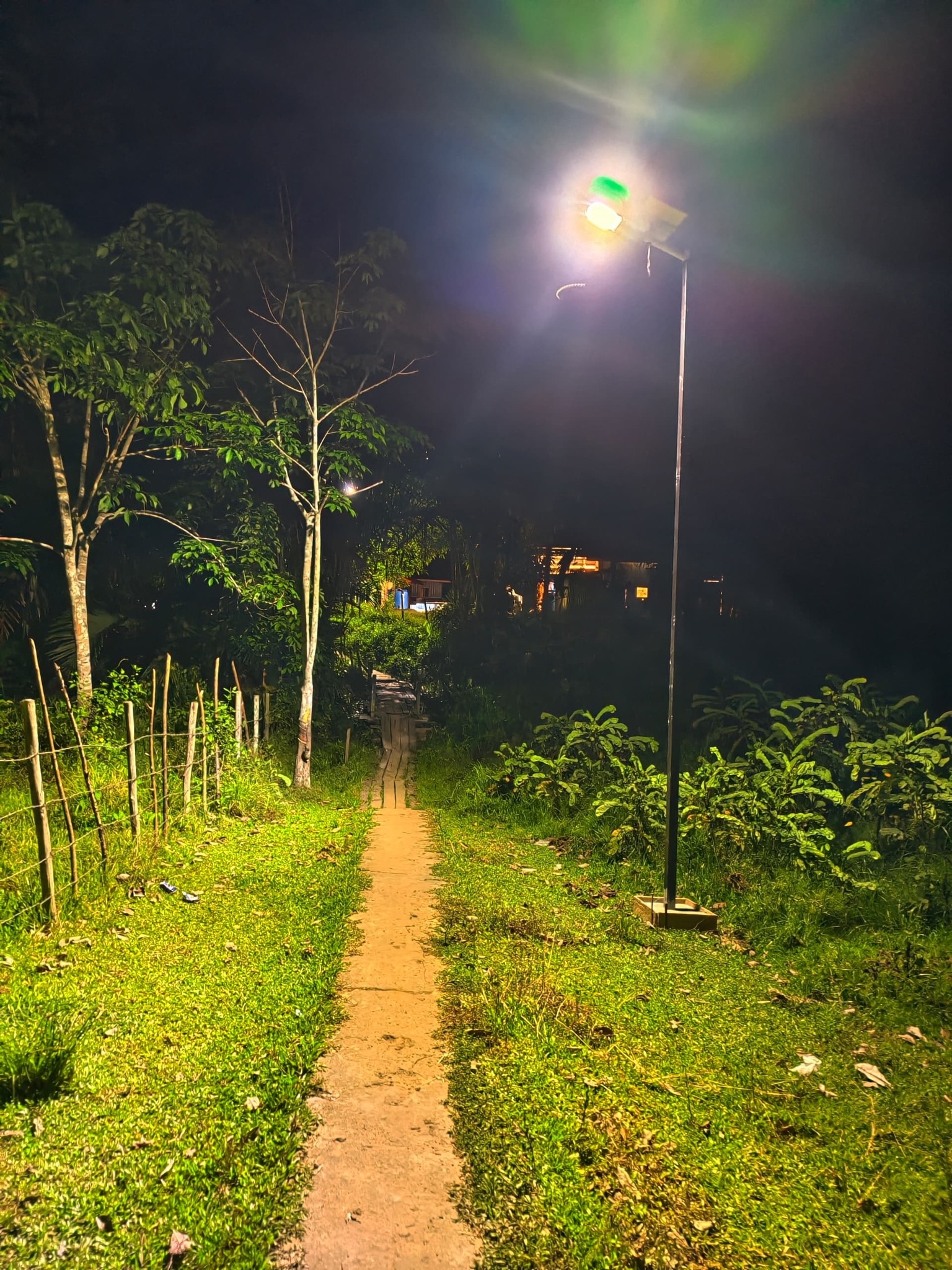
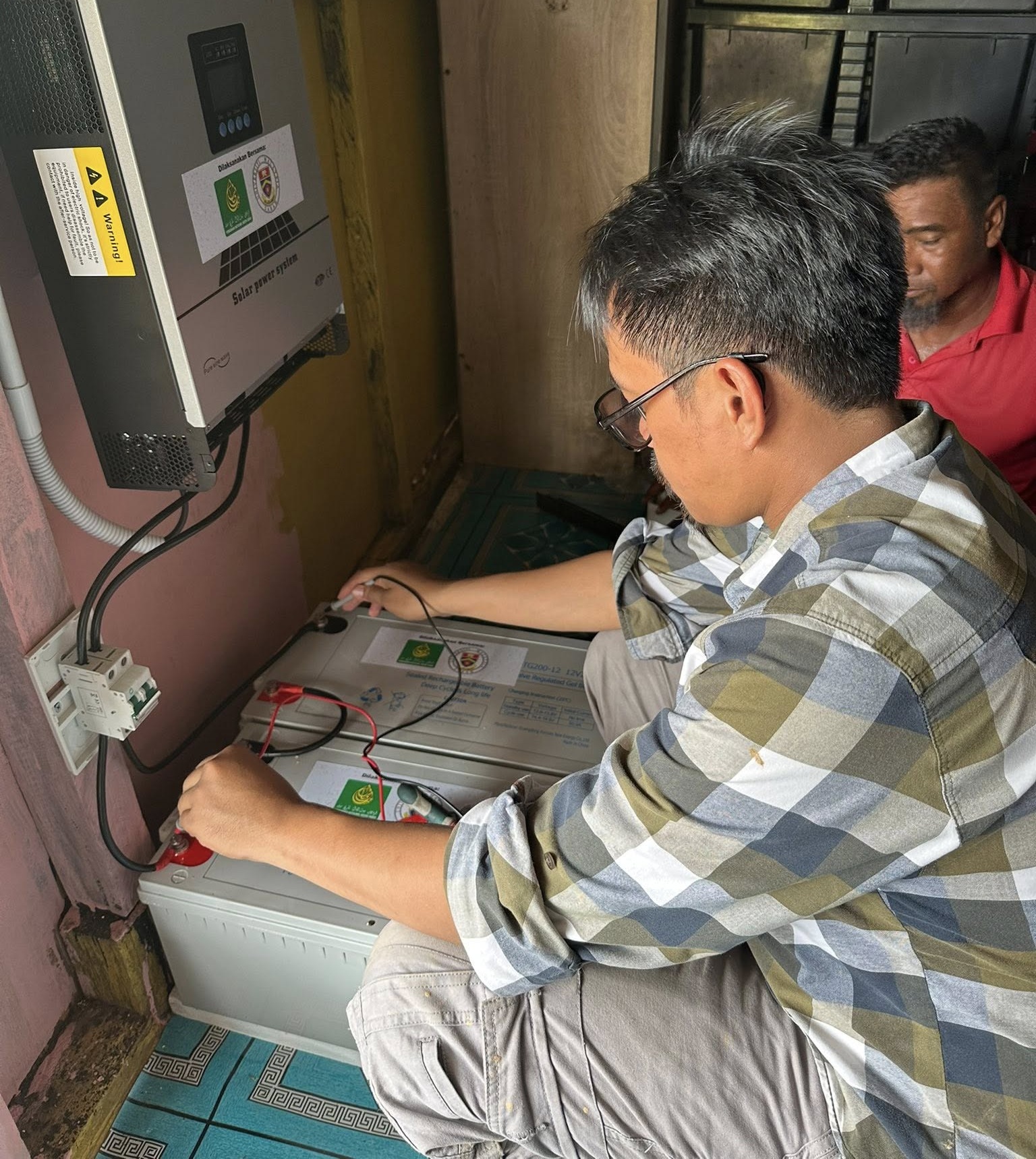
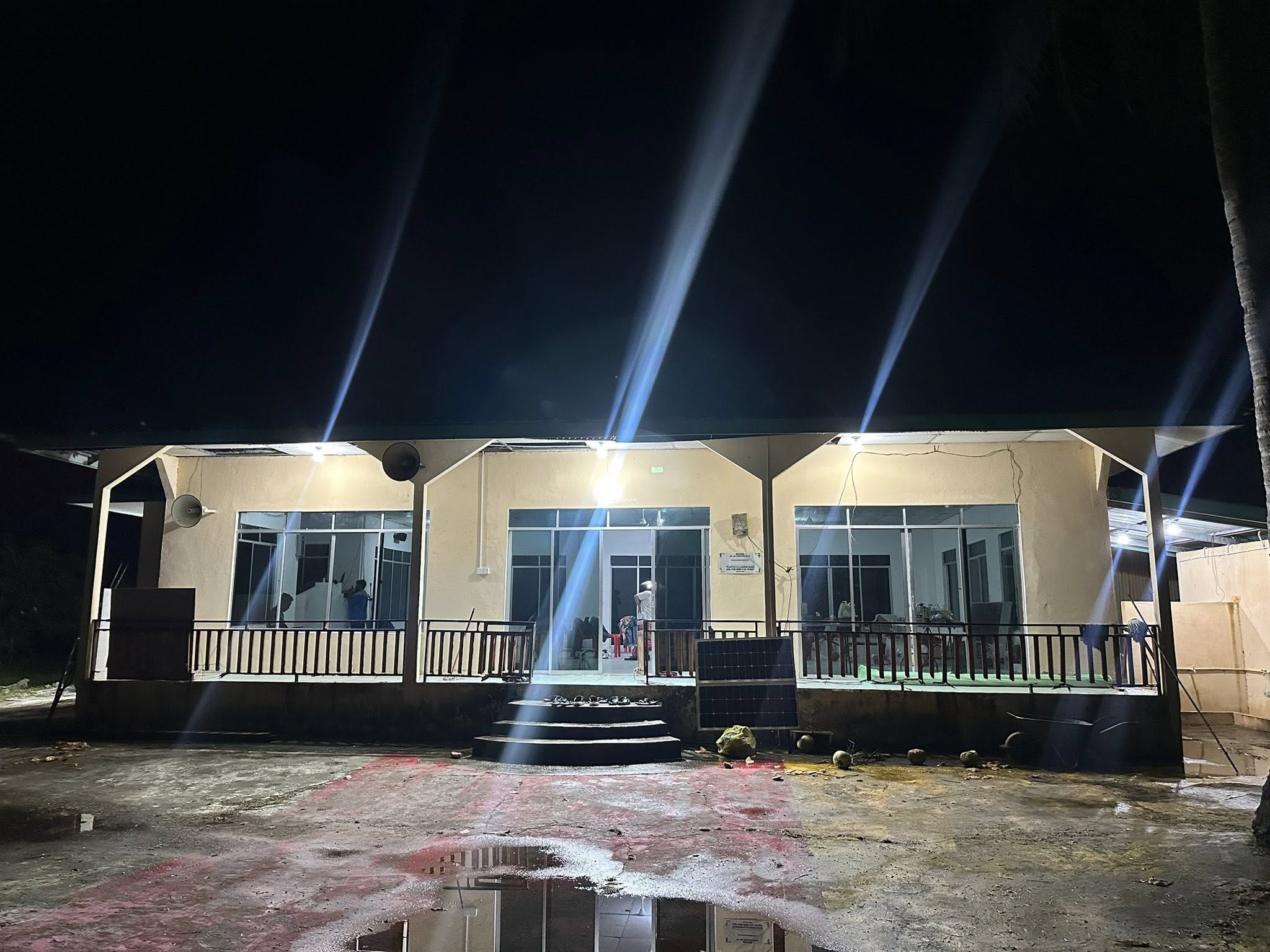
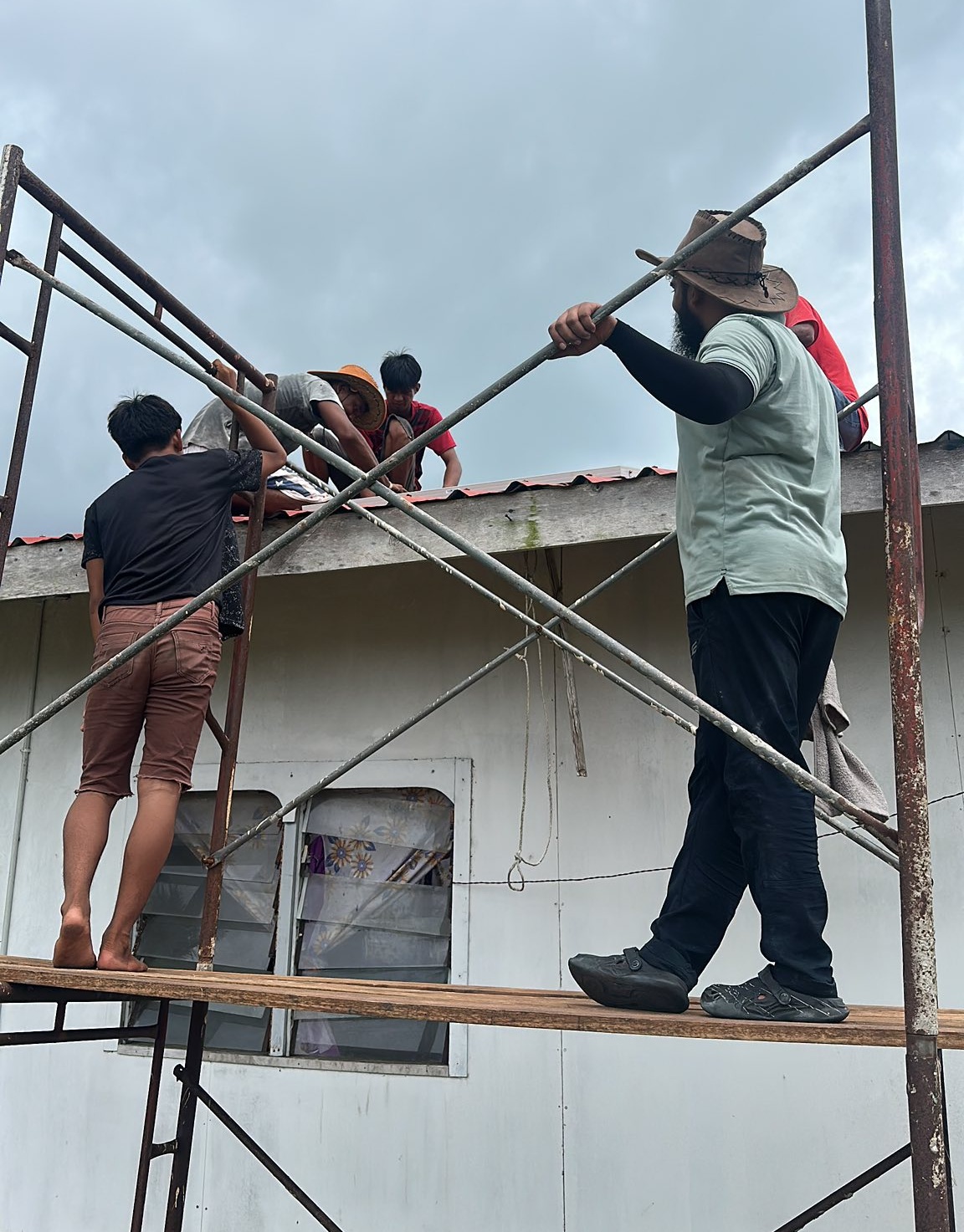
Clean energy underpins access to other basic services such as water and healthcare. Through its Renewable Energy Living Lab, UMS provides training to villagers and local technicians on installing and maintaining solar-powered systems that support community water pumps, schools, and health outposts. These hands-on sessions, led by the Faculty of Engineering, teach safe wiring, maintenance, and system troubleshooting. Communities in Ranau, Tenom, and Pitas now operate micro-solar grids that provide consistent power for lighting, refrigeration of vaccines, and digital connectivity. By integrating renewable energy into community training, UMS strengthens the sustainability of other essential-service initiatives. The “Shine On Sustainably (S.O.S)” Project by Civil Engineering program from Universiti Malaysia Sabah (UMS) achieved national recognition after winning 2nd Place at the Projects for Happiness 2024 (Year 2025) Final Presentation, organized by My Starfish Foundation. Led by Safawati binti Japri and a team of nine final-year students under the supervision of Ts. Br. Dr. Asmawan Mohd Sarman, the project exemplifies creativity, sustainability, and social impact. Through the S.O.S initiative, the team successfully improved safety and quality of life for villagers in Kampung Mangkapoh, Ranau, by installing 20 solar lamps and 2 solar spotlights along a 950-meter stretch, illuminating the main access road and village bridge. This solar-powered lighting system has enhanced nighttime mobility, reduced safety risks, and fostered a sense of security within the community. The success of the S.O.S project not only showcases the technical competence and civic responsibility of UMS engineering students but also highlights the university’s commitment to sustainable and community-driven innovation. By combining engineering knowledge with empathy and purpose, the team demonstrated how youth-led projects can make tangible differences in people’s lives—reflecting UMS’s vision of empowering future engineers as agents of social transformation and sustainable development.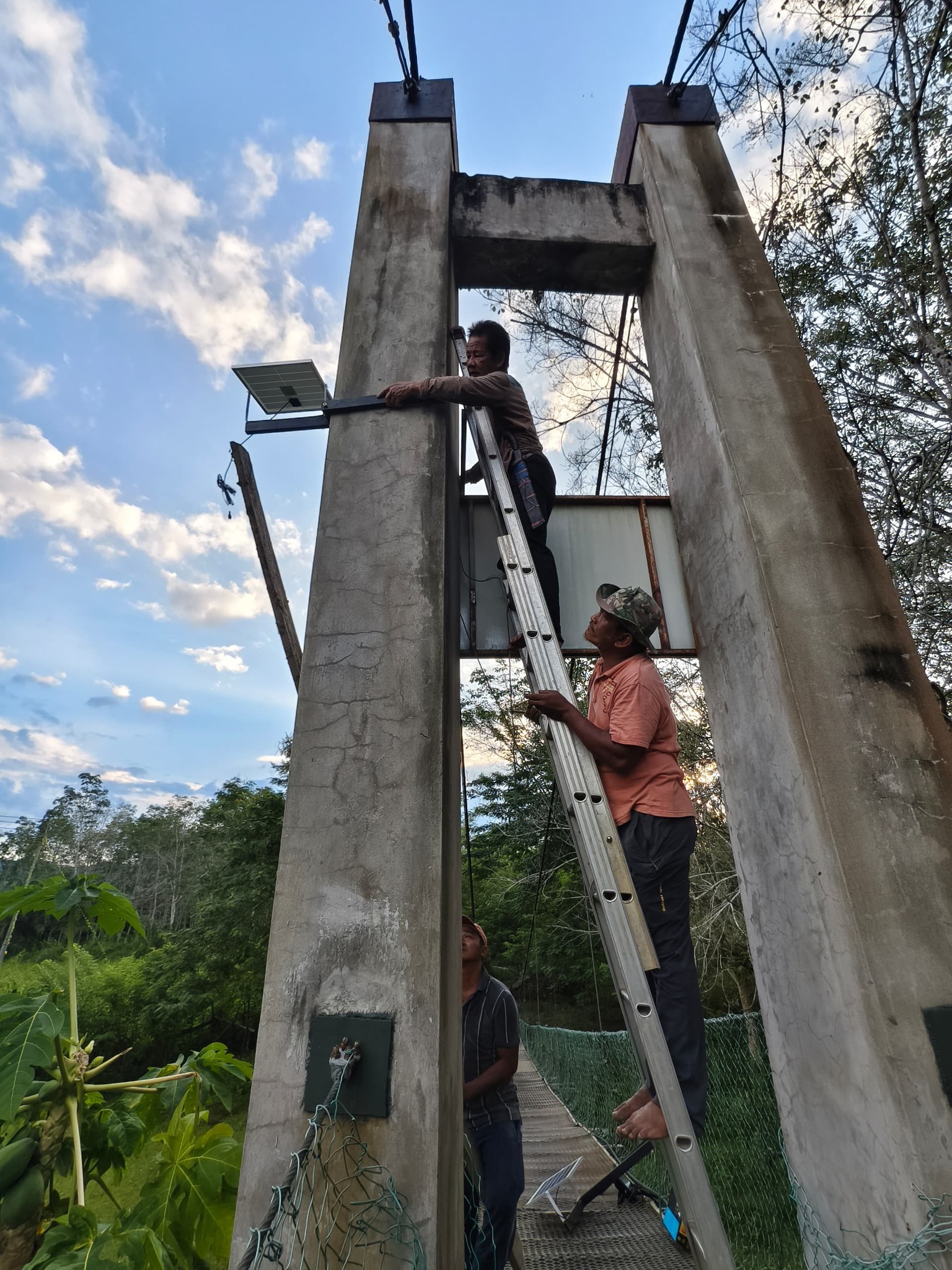


UMS Health Promotion & Wellness Outreach
Healthcare access in remote Sabah is often restricted by vast geographical distances, poor road connectivity, and lack of transport infrastructure, leaving many communities underserved and isolated from essential medical care. Recognising this reality, Universiti Malaysia Sabah (UMS) has developed innovative outreach programmes that blend academic training, medical research, and public-health service delivery. These initiatives bridge the healthcare gap by taking medical education beyond hospital walls and into the heart of rural and coastal communities, where the need is greatest. Through immersive, hands-on engagement, UMS not only provides treatment but also builds lasting health awareness and community resilience.
Rural Medical Education Programme (PuPUK Kudat)
The PuPUK Kudat initiative represents UMS’s flagship model for community-based medical education. It immerses medical students in long-term rural placements across Kudat and neighbouring districts, where they conduct health education workshops, home visits, and sanitation improvement projects while collaborating with local clinics and district health offices. Students undergo specialised training to assess community health profiles, identify local challenges such as malnutrition and poor hygiene, and implement context-appropriate interventions that promote preventive healthcare, nutrition awareness, and environmental sanitation.
Since its establishment, more than 1,600 medical students have participated in the programme, serving 32 villages and benefiting over 15,000 rural residents. The impact extends beyond medical assistance—communities have achieved measurable improvements in sanitation coverage, maternal and child health, vaccination uptake, and awareness of non-communicable diseases. The initiative also nurtures local health volunteers who are trained to maintain hygiene and assist in basic first aid, ensuring continuity of care. Importantly, PuPUK transforms rural communities from passive recipients into active partners in health governance, fostering a shared sense of responsibility for collective well-being.
Read More
UMS Mobile Clinics – Bringing Healthcare to the Community
To further expand outreach, the UMS Mobile Clinic Bus and Van, operated by the Faculty of Medicine and Health Sciences (FPSK), deliver essential medical services directly to remote and island villages that are otherwise inaccessible to regular healthcare facilities. These mobile units are equipped with diagnostic tools, medication, and digital health-record systems. Each mission includes interactive health workshops that train community members in basic first aid, hygiene practices, disease prevention, and elderly care.
For medical students, the mobile clinics act as living laboratories, offering real-world exposure to rural health delivery, empathy, and patient communication—core competencies that cannot be learned in conventional classrooms. For villagers, the mobile clinic visits provide consistent, trustworthy access to medical attention, education, and health screenings. By integrating education with service, UMS ensures that every visit leaves behind not only healthier individuals but also better-informed, self-reliant communities.
Collectively, these programmes have led to a notable reduction in preventable diseases, better hygiene standards, and strengthened community health governance across northern Sabah. They reflect UMS’s philosophy that true healthcare transformation begins with education, participation, and empowerment—ensuring that even the most remote communities enjoy the dignity of equitable access to quality health services.
Read More
UMS
Rural Health, Real Impact
Through collaboration between HUMS doctors, students, and local leaders, UMS strengthens rural resilience by providing screenings, health education, and wellness outreach to reduce inequalities in public health.
Wellness for Every Village
UMS
Sustainability in Motion
More than a vehicle, the Mobile Clinic is a living symbol of sustainability — repurposed, community-driven, and powered by compassion to create lasting change in people’s lives..
Hope on Wheels
Sustainability Through Access.
True sustainability is achieved when quality healthcare reaches every life, regardless of geography or income. The UMS Mobile Clinic Bus and Van embody that vision — moving towards a healthier, more equitable Sabah..
Access. Equity. Sustainability.
UMS
Empowering Remote Communities
Every visit is more than medical aid — it is education and empowerment. UMS staff and students teach families how to manage their health, hygiene, and nutrition, fostering long-term community resilience.
Knowledge for Well-being
UMS
Universiti Malaysia Sabah
UMS Governance for Inclusive Growth and Poverty Alleviation
As a public university committed to social mobility and sustainable development, Universiti Malaysia Sabah (UMS) embeds SDG 1: No Poverty across its institutional policies, governance structures, and operational frameworks. UMS recognises that equitable access to higher education is one of the most powerful mechanisms for breaking intergenerational cycles of poverty.
Through its inclusive governance approach, UMS ensures that student recruitment, financial aid, welfare assistance, and performance monitoring are guided by clear policies that prioritise B40 (Bottom 40%) households, first-generation learners, and underserved communities—especially in Sabah’s rural and interior districts.
UMS Policy Framework and Governance Mechanisms
At Universiti Malaysia Sabah (UMS), education is more than a pathway to employment — it is a bridge out of poverty and a promise of dignity. Guided by the national agenda for inclusive higher education and the aspirations of SDG 1: No Poverty, UMS has built a governance framework that ensures every capable student, regardless of income or geography, can access, sustain, and complete a university education.
This framework integrates policy, governance, and data intelligence into a cohesive system designed to support students from B40 and rural backgrounds. It moves beyond financial assistance to embrace holistic empowerment — combining recruitment equity, structured welfare management, close academic monitoring, and digital transparency.
Through these efforts, UMS does not merely open its doors to the underprivileged; it walks with them every step of the way — from admission to graduation, and into meaningful livelihoods. The following sections highlight the four pillars of this commitment:
i.Inclusive Student Recruitment and Admission Policy
UMS implements an Equitable Access Policy that prioritises enrolment opportunities for students from B40 households, rural schools, and indigenous communities. The Admissions Unit works with the Jabatan Hal Ehwal Pelajar (JHEP) under the Deputy Vice-Chancellor (Student Affairs & Alumni) and faculties to ensure these students are identified, supported, and monitored from the point of application through graduation.
To promote equitable access to higher education, Universiti Malaysia Sabah (UMS) implements a B40 Student Recruitment Policy aligned with the Ministry of Higher Education’s (MoHE) inclusion and accessibility agenda.
- — The policy prioritises admission for students from B40, rural, and first-generation backgrounds, ensuring financial constraints do not hinder entry into tertiary education. It also integrates targeted outreach and preparatory engagement with secondary schools, particularly in Sabah’s interior and underrepresented districts.
- — A clear governance structure supports this policy through the Jabatan Hal Ehwal Pelajar (JHEP) under the Deputy Vice-Chancellor (Student Affairs & Alumni), with operational management by the Student Welfare and Financial Division (Bahagian Kebajikan dan Kewangan Pelajar). Each faculty appoints Student Welfare Coordinators responsible for data collection, reporting, and early interventions.
-
Policy Principles
The Inclusive Admission Policy at UMS is founded on three main principles:
- Equity in Opportunity: Every qualified applicant, especially from disadvantaged backgrounds, is given equal opportunity to pursue higher education.
- Financial Accessibility: No deserving student should be denied admission due to financial constraints.
- Holistic Support and Empowerment: Beyond admission, UMS provides continuous financial, social, and academic support to ensure student success and retention.
UMS extends its focus beyond the Bottom 20% (B20) to include the Bottom 40% (B40) income group, recognising the challenges of families who live just above the poverty line yet still face financial hardships. This extension reflects UMS’s proactive role in aligning with national inclusivity strategies such as the Malaysia MADANI framework and Kementerian Pendidikan Tinggi’s (KPT) vision for equitable access to higher education.
Key Programmes and Initiatives
-
Program Siswa Sulung (PSS) – First-Generation Student Support
Program Siswa Sulung provides full tuition sponsorship, mentoring, and psychosocial support for first-generation university students from B40 families. Many of these students are pioneers in their families to enter higher education, and the programme’s mentoring structure pairs them with academic advisors and alumni mentors to guide them through academic, emotional, and financial challenges. The programme also includes career development workshops and peer networking circles, ensuring that students are well prepared for future employment or entrepreneurship.
-
Program MENITI – Second-Chance Admission Pathway
The Program MENITI (Meniti Kasih) provides a second-chance pathway for academically eligible but financially or socially disadvantaged students who narrowly missed conventional university entry criteria. By integrating academic bridging, financial assistance, and mentoring, the programme enables these students to pursue their studies with renewed hope. MENITI reflects UMS’s strong belief in the potential of every individual and its commitment to human capital development in rural Sabah and Malaysia’s interior regions.
-
Inkubator Aquapreneur Siswa UMS 2024 – Building Income Resilience
The Inkubator Aquapreneur Siswa UMS 2024 focuses on fostering entrepreneurial and income-resilience skills among B40 students through aquaculture, agritech, and sustainable business ventures. Students gain hands-on experience managing small-scale aquaponic systems, fish farming, and seaweed-based enterprises under the supervision of the Borneo Marine Research Institute (BMRI). This initiative nurtures job creators rather than job seekers, ensuring long-term financial stability and community empowerment.
-
 Universiti Malaysia Sabah (UMS) maintains a comprehensive B40 Student Monitoring System designed to ensure that every student from low-income and rural backgrounds receives the academic, financial, and emotional support needed to succeed. The system continuously tracks demographic profiles, academic performance, welfare assistance, and financial status from admission until graduation, allowing the university to maintain a clear picture of each student’s progress and well-being.
This structured monitoring approach enables real-time intervention—students facing academic decline, financial distress, or personal hardship are swiftly identified and referred for targeted assistance such as tutoring, counselling, or emergency financial aid. Data from this system is also used to analyse trends, evaluate programme effectiveness, and inform decision-making at the university and faculty levels.
Universiti Malaysia Sabah (UMS) maintains a comprehensive B40 Student Monitoring System designed to ensure that every student from low-income and rural backgrounds receives the academic, financial, and emotional support needed to succeed. The system continuously tracks demographic profiles, academic performance, welfare assistance, and financial status from admission until graduation, allowing the university to maintain a clear picture of each student’s progress and well-being.
This structured monitoring approach enables real-time intervention—students facing academic decline, financial distress, or personal hardship are swiftly identified and referred for targeted assistance such as tutoring, counselling, or emergency financial aid. Data from this system is also used to analyse trends, evaluate programme effectiveness, and inform decision-making at the university and faculty levels.
Student Enrollment (2020–2025)
Enrolment Year
Female Student
Overall
% (Female/Overall)
Female B40
B40 Total
% (Female B40/B40 Total)
2020 11641 17499 66.52 2072 2842 72.91 2021 11890 17921 66.35 3008 4123 72.96 2022 12050 18200 66.21 4190 5764 72.69 2023 12411 18799 66.02 4944 6920 71.45 2024 12505 19146 65.31 5485 7766 70.63 2025 13501 21056 64.12 6100 8765 69.59
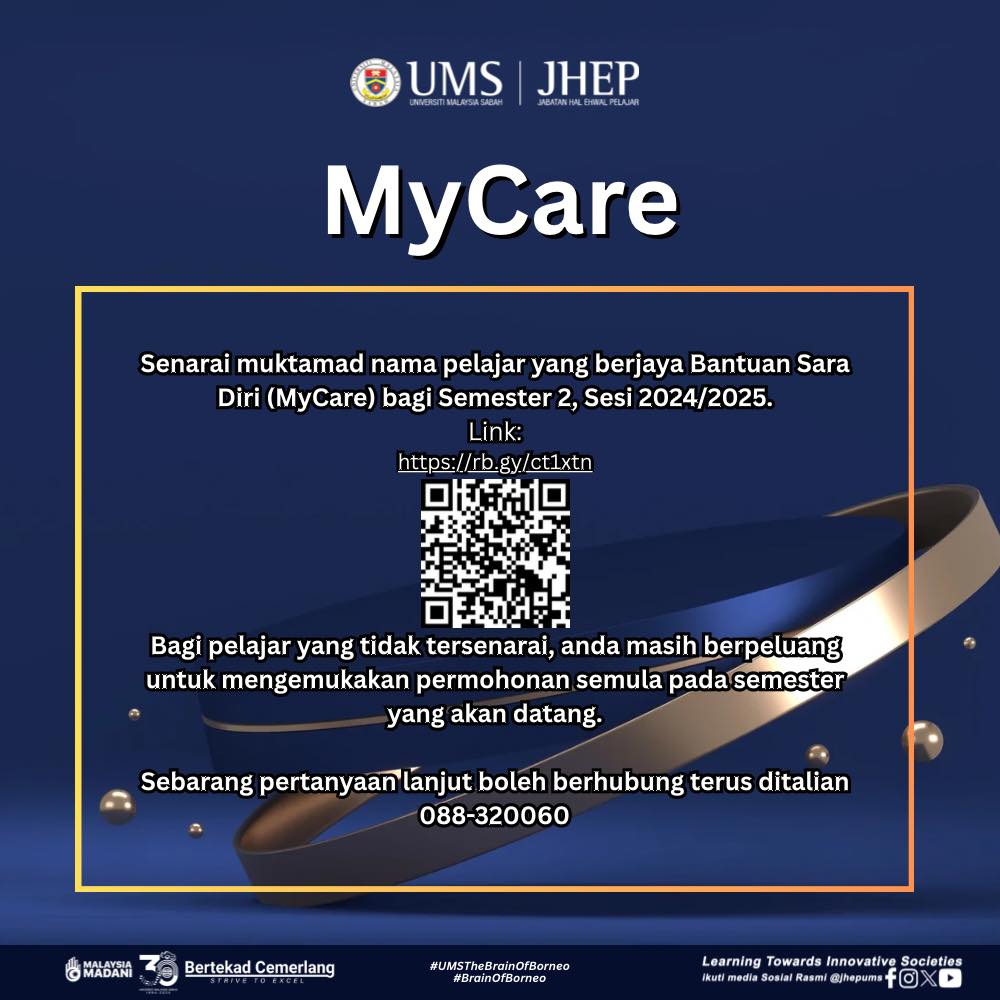
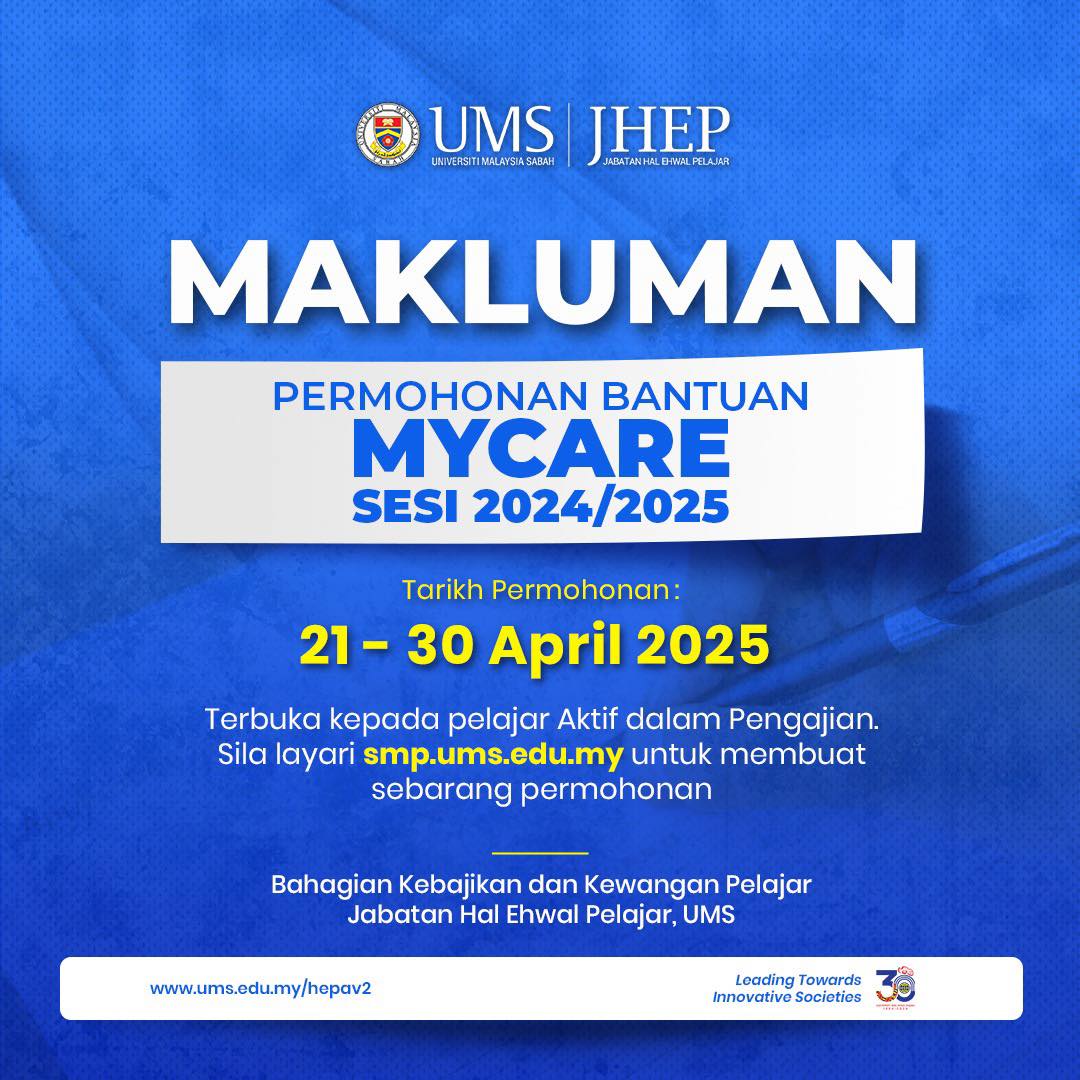
The MyCare System, managed by HEPA, is UMS’s digital backbone for student welfare and financial support. It was developed to make the delivery of aid to B40 and vulnerable students structured, transparent, and traceable.
MyCare records all welfare-related transactions and interventions: food assistance, living allowances, emergency funds, health support, and other forms of aid. It links these records to individual student profiles, allowing JHEP and the Student Welfare and Financial Division to see who is being supported, how often, and through which schemes. The system also generates reports and dashboards for management review.
By digitising welfare delivery, MyCare reduces leakages, duplication, and blind spots. It ensures that resources reach the right students at the right time, strengthens confidence in UMS’s governance, and provides hard evidence that B40-related support is systematic—not symbolic. This underpins UMS’s claim that its SDG 1 work is data-driven, auditable, and scalable.
 This integrated policy and monitoring ecosystem ensures that B40 students receive holistic, data-driven support throughout their academic journey—from recruitment to graduation. It strengthens access, retention, and completion rates while reducing dropout risks linked to financial hardship. Through this approach, UMS not only commit to reduce barriers but also establishes a replicable model of inclusive education governance that transforms poverty reduction into sustainable empowerment.
ii.Financial Inclusion and Governance Framework
The establishment of the Jabatan Hal Ehwal Pelajar (JHEP) under the office of the Deputy Vice-Chancellor (Student Affairs & Alumni) reflects UMS’s strong governance commitment to student welfare and financial inclusivity. Within JHEP, the Student Welfare and Financial Division (Bahagian Kebajikan dan Kewangan Pelajar) oversees a centralised support framework that coordinates scholarships, sponsorships, financial aid, and welfare assistance to ensure equitable access to education.
The JHEP coordinates policy integration across divisions such as Academic Services, Student Affairs, Bursary, Strategic Management Centre, and the Centre for Quality Assurance (CQA).
Poverty alleviation, inclusion, and equity indicators are reported annually through the UMS Sustainability Report and Strategic Performance Dashboard (STRIVE), aligned with national higher-education targets and the Sabah Maju Jaya Blueprint 2030.
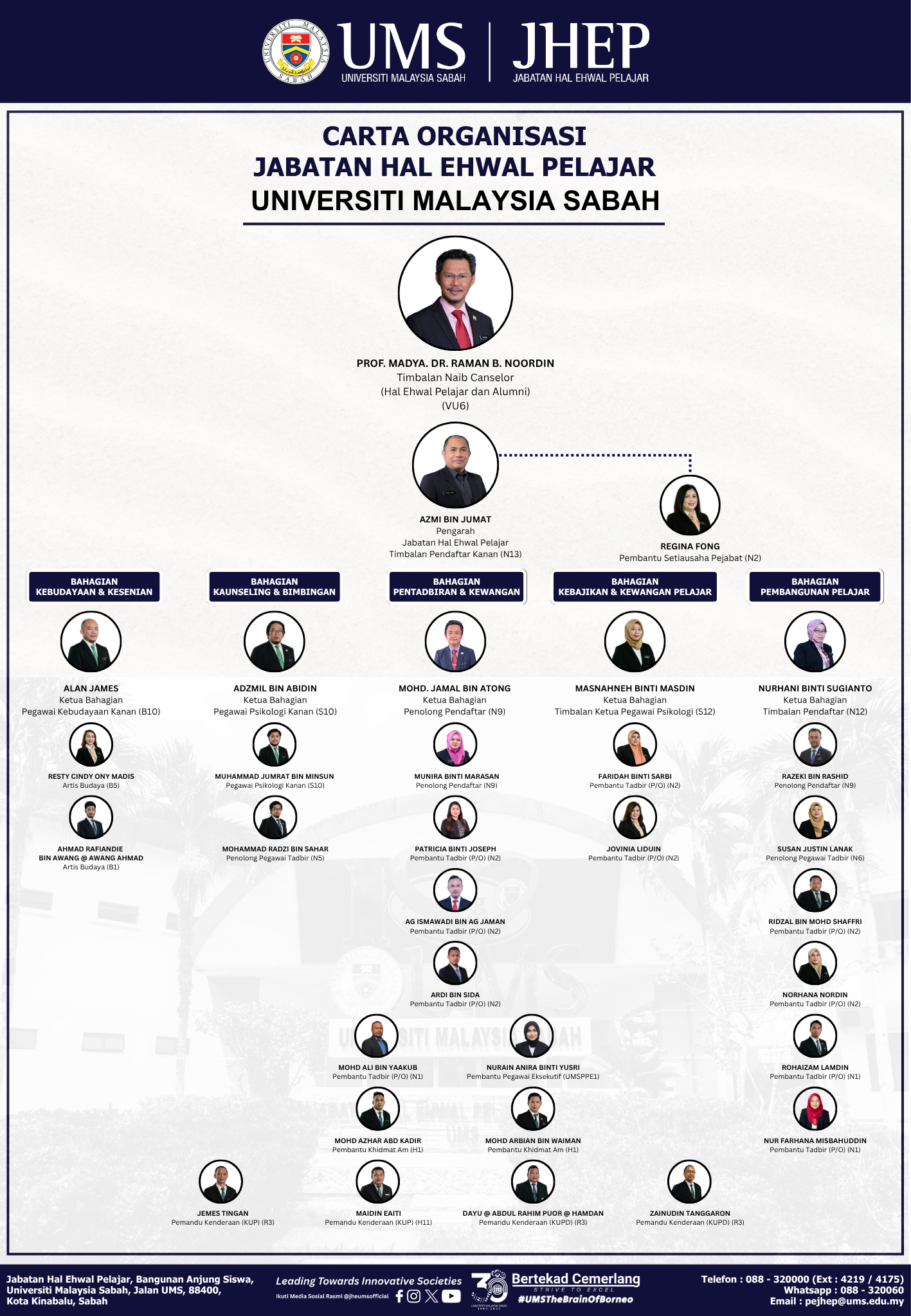 The university’s Student Welfare and Financial Division (Bahagian Kebajikan dan Kewangan Pelajar) under HEPA manages a centralised support framework that coordinates scholarships, sponsorships, welfare aid, and food assistance.
Key programmes under this framework include:
The university’s Student Welfare and Financial Division (Bahagian Kebajikan dan Kewangan Pelajar) under HEPA manages a centralised support framework that coordinates scholarships, sponsorships, welfare aid, and food assistance.
Key programmes under this framework include:
- — UMS Financial Aid Scheme (Scholarship Without Nominee)
-
— Food Assistance Programme, Food Vouchers, and Dapur Siswa
-
— Bantuan Pendidikan Awal (BPA) and Emergency Welfare Funds
-
— These mechanisms are governed by transparent eligibility criteria aligned with national poverty and income classification standards (e.g., B40 and M40 categories).
UMS works collaboratively with Yayasan Sabah, PTPTN, local NGOs, and industry partners to expand sponsorship opportunities and employability pathways for B40 students.
These partnerships align institutional governance with broader policy goals under the Malaysia MADANI framework and the UN Sustainable Development Goals (SDGs), ensuring that inclusivity and poverty reduction remain embedded in UMS’s operational DNA.
Complementing the B40 Framework, UMS offers comprehensive scholarship and financial aid schemes that provide full or partial tuition coverage, stipends, and research support for students in need. These scholarships extend beyond Malaysia’s borders — opening access for students from developing countries, particularly within ASEAN, South Asia, and Africa. Through international collaborations and exchange programmes, UMS strengthens regional education equity by giving opportunities to talented youth from economically challenged nations. By doing so, UMS contributes to global poverty reduction through knowledge empowerment, cultivating graduates who become agents of change in their home countries.
Read More
iii. Academic B40 Performance and Monitoring Framework
At Universiti Malaysia Sabah (UMS), academic equity extends beyond access — it is about ensuring that every student, regardless of background, completes their educational journey successfully. The Academic B40 Performance Framework was established to guarantee that students from B40 and low-income households are not only admitted but supported to achieve academic excellence and graduation. This framework aligns with UMS’s institutional target of maintaining a minimum 90% graduation and completion rate for all B40 students, reflecting the university’s steadfast commitment to educational inclusivity and success.
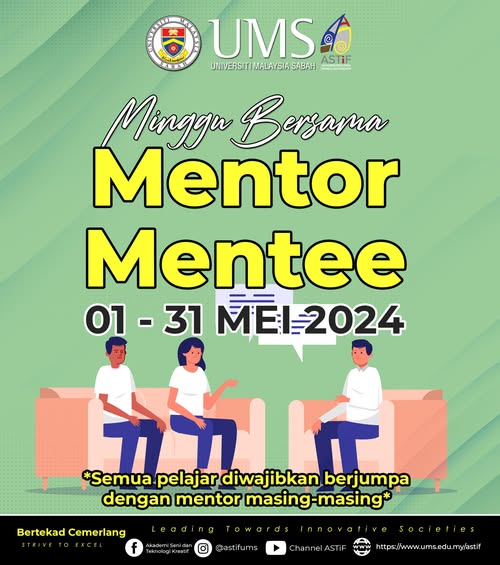
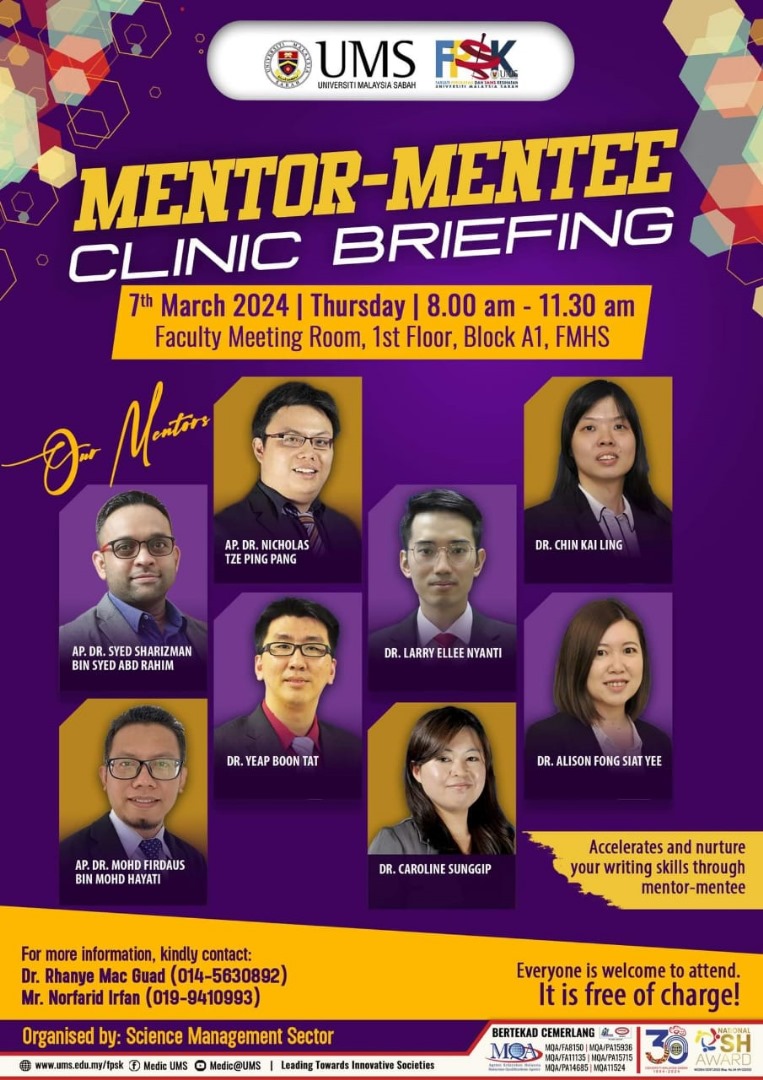
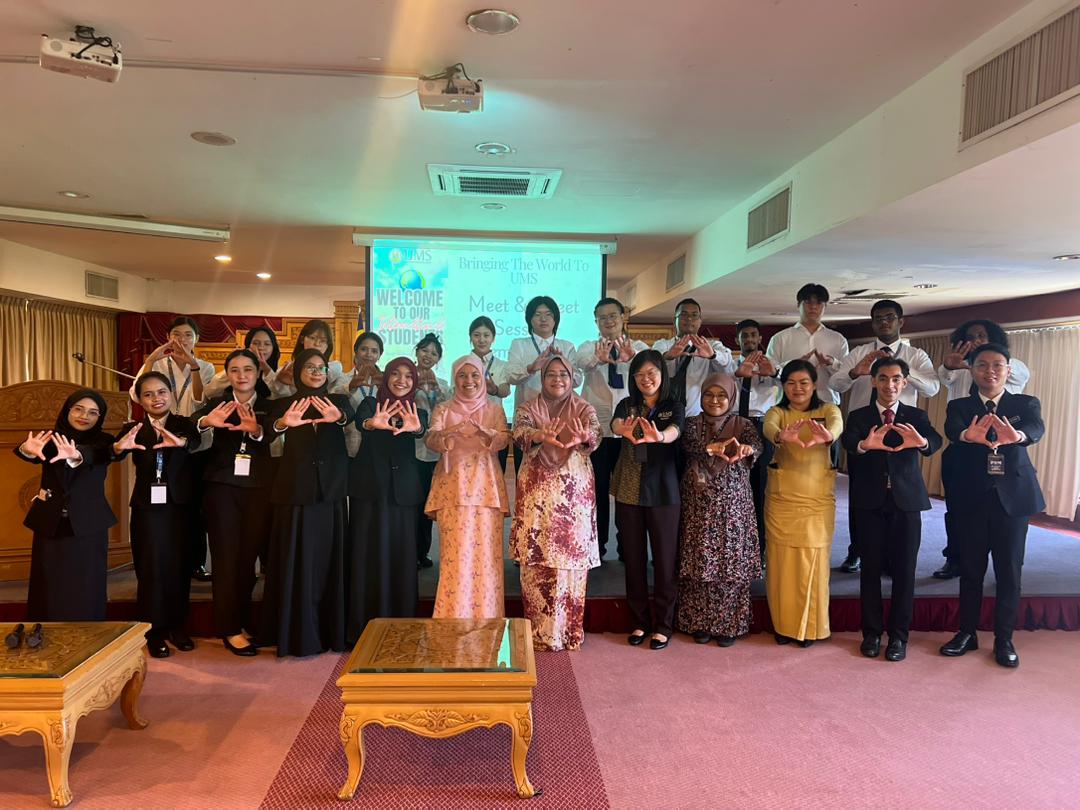 The framework integrates continuous academic tracking, mentorship, and welfare interventions under the B40 Student Monitoring System, enabling early detection and response to academic or financial challenges. Each faculty’s Welfare Coordinator reports periodically on student progress, ensuring coordinated support across units. Based on the latest performance data, UMS achieved a 99.05% graduation rate among B40 students, exceeding its minimum target and matching the overall institutional average of 98.92%. Out of 1,478 expected B40 graduates, 1,464 successfully completed their studies, underscoring the effectiveness of data-driven monitoring, mentoring, and financial assistance programmes such as food aid and scholarship support.
Category
Total Number of Graduates in 2024
B40 Graduates in 2024
Actual Graduates
4,474
1,464
Targeted Graduates
4,523
1,478
Completion Rate
98.92%
99.05%
This outstanding completion performance demonstrates that with structured policy, compassionate governance, and continuous monitoring, socioeconomic disadvantage does not define academic destiny. The Academic B40 Performance Framework exemplifies how inclusive education—supported by data and empathy—can translate opportunity into achievement. UMS’s success model provides measurable evidence that equity-based interventions yield long-term impact, cultivating graduates who carry forward not only degrees but also the transformative power of education within their families and communities.
iv.UMS Scholarship Scheme and Global Inclusivity
Beyond its national mandate, Universiti Malaysia Sabah (UMS) champions educational justice on a global scale through its Scholarship and Financial Aid Scheme, designed to remove financial barriers for both local and international students. The initiative reflects UMS’s belief that education should be accessible to all—regardless of nationality, background, or economic standing—and that empowering students from developing countries contributes to shared prosperity and global stability.
In 2024, UMS provided international student funding support to 48 sponsored students representing diverse economic classifications and continents. This included:
- — 6 students from low-income countries (Afghanistan, Chad, Yemen)
- — 18 students from lower-middle-income countries such as Bangladesh, Indonesia, Myanmar, Pakistan, Philippines, Timor-Leste, Vietnam, Ghana, and Palestine, and
- — 24 students from upper-middle and high-income countries including China, Brunei, Japan, Iran, Libya, Saudi Arabia, and others.
The scholarships cover tuition fees, living allowances, research grants, and welfare support—empowering scholars from underprivileged and conflict-affected nations to pursue quality higher education in Malaysia. Through this programme, UMS not only supports its B40 students domestically but extends its social responsibility to global learners from developing economies, aligning educational equity with humanitarian values.
International Student Funding Support (2024)
Country Classification
Total Sponsors
Low Income Country (Afganistan, Chad, Yemen) 6 Lower Middle Income Country (Bangladesh, India, Indonesia, Myanmar, Pakistan, Philippines, Timor-Leste, Vietnam, Ghana, Palestine) 18 Upper Middle or High Income Country (Brazil, Brunei Darussalam, Chine, Hong Kong, Iran, Italy, Japan, Kosovo, Kuwait, Libya, Maldives, Saudi Arabia, South Korea, Taiwan, Thailand, United Arab Emirates) 24
Total
48
This international scholarship framework reinforces UMS’s identity as a regional leader in inclusive and compassionate higher education. By enabling access for students from 24 countries, including those from the world’s least developed regions, UMS transforms its campus into a living model of South-South cooperation and academic solidarity. These scholarships cultivate future changemakers who return to their home nations equipped to contribute to social resilience, innovation, and nation-building—proving that when higher education is inclusive, its impact transcends borders and generations.
Universiti Malaysia Sabah
Policy Contributions Toward Poverty Reduction and Inclusive Economic Growth
Beyond classroom and community engagement, Universiti Malaysia Sabah (UMS) plays an influential policy role in shaping evidence-based strategies for inclusive and sustainable development in Sabah and the broader Borneo region. Through its specialised centres and research networks, UMS contributes to the formulation of economic, social, and community policies that address structural poverty, promote equitable growth, and strengthen societal resilience.
- i. Centre for Economic Development and Policy (CEDP)
Established in 2022, CEDP serves as UMS’s think-tank on economic development and public policy for Sabah and the wider Borneo region. It contributed to the proposed new Sabah Economic Model, presented to the State Government as a framework for inclusive and sustainable growth. CEDP collaborates closely with Institute for Development Studies (IDS) Sabah and Sabah Economic Development and Investment Authority (SEDIA) to align research with state priorities.
CEDP also organised the 5th International Conference on Economics (ICE 2025), focusing on digital transformation, circular economy, and social wellbeing — uniting academics, policymakers, and industry experts to discuss pathways toward a resilient, equitable economy. These efforts directly influence policymaking processes and enhance state capacity to address economic disparities and poverty in rural Sabah.
Read More
- ii. Economic Insights for Sabah Development
The Vice-Chancellor of UMS, Prof. Dr. Kasim Mansor, as a member of the Sabah Economic Council, contributes expert economic insights and policy recommendations on inclusive growth, zakat optimisation, and workforce empowerment. These insights influence macro-level strategies under the Sabah Maju Jaya Blueprint 2030.
Read More
- iii. Research-Led Poverty Policy Advocacy
The 5th International Conference on Economics 2025 (ICE 2025), hosted by the Centre for Economic Development and Policy (CEDP), Faculty of Business, Economics, and Accountancy (FPEP), Universiti Malaysia Sabah (UMS), serves as a major platform for regional policy dialogue and research collaboration. Co-organised with the Institute for Development Studies (IDS), the Sabah Economic Development and Investment Authority (SEDIA), and the Centre for Future Labour Market Studies (EU-ERA), the conference centres on the theme “Building Resilient Societies: The Intersection of Digital Transformation, Circular Economy, and Social Wellbeing.”
ICE 2025 advances UMS’s role as a policy catalyst for inclusive and sustainable development. It convenes academics, industry leaders, and policymakers to address structural poverty, digital inclusion, and socio-economic inequality—exploring how innovation, sustainable business models, and responsible economic policies can strengthen community resilience. By fostering multi-stakeholder dialogue, UMS contributes to SDG 1 (No Poverty) through policy integration that promotes equitable access to economic resources, decent work, and long-term social wellbeing across Sabah and the wider Borneo region.
Read More
- iv. Comprehensive Rural & Indigenous Poverty Studies
UMS research on the Rungus ethnic community revealed a poverty incidence of 58.2%, offering empirical insights for the design of targeted rural and indigenous poverty-eradication strategies.
Read More
Read More
- v. Poverty Eradication Programme Review
Through its policy think-tanks, strategic research, and leadership participation, UMS contributes directly to shaping Sabah’s long-term poverty-reduction and economic-development agenda. The establishment of CEDP marks a milestone in institutionalising UMS’s role as a regional policy driver — integrating academic knowledge with public decision-making. These collective efforts ensure that the voices of marginalised communities are reflected in policy frameworks
Read More
SDG 1 Progress Report : Building Inclusive Futures Through Education and Empowerment
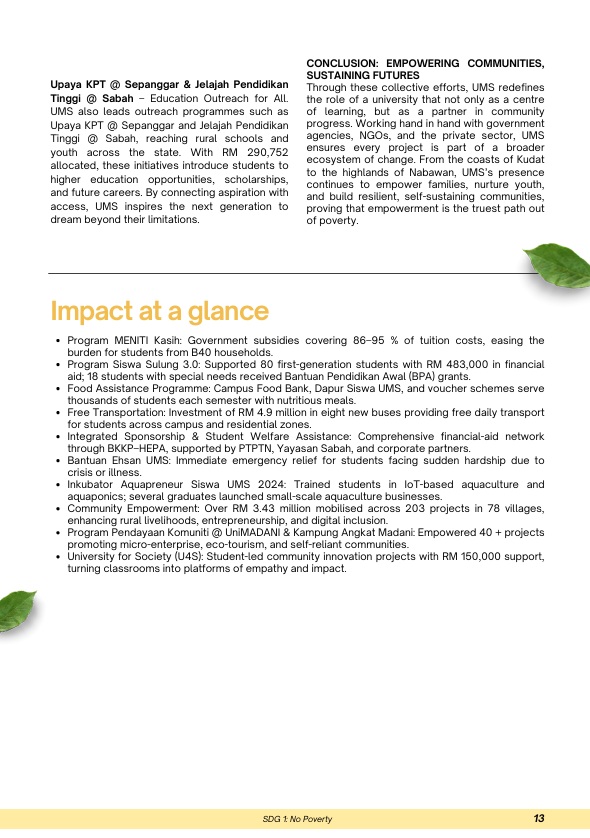
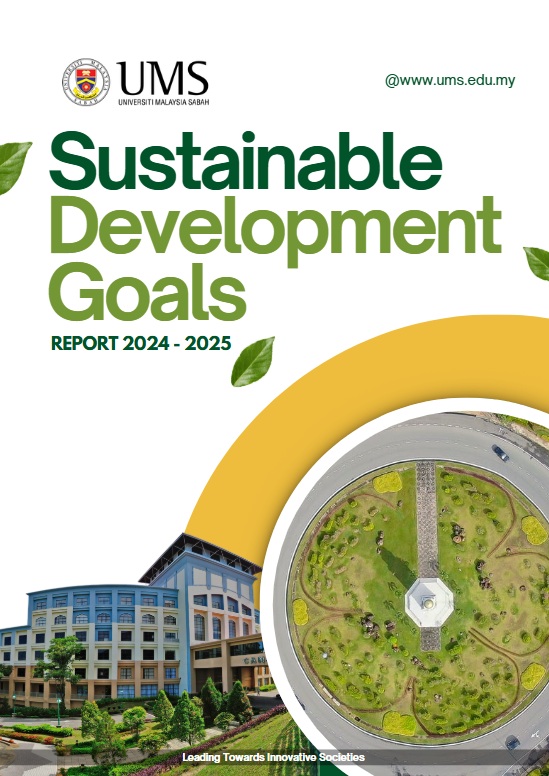
Universiti Malaysia Sabah (UMS) remains steadfast in its commitment to Sustainable Development Goal 1 (No Poverty) through a comprehensive framework that integrates education, innovation, and community empowerment to tackle the structural causes of poverty. Each year, UMS records measurable progress in reducing poverty and improving living standards, as documented in its Annual SDG Progress Report, which tracks the impact of inclusive education, community engagement, and livelihood enhancement programmes across Sabah.
Key initiatives such as the Program Siswa Sulung (first-generation student support), Program MENITI (second-chance education pathway), and the Aquapreneur Student Incubator equip students from low-income (B40 and B20) families with the skills, resources, and opportunities needed to achieve upward mobility. At the community level, RUWAS Living Labs, Micro Water Supply Projects, and Community Solar Initiatives have enhanced access to basic services including clean water, electricity, and sanitation—directly improving the well-being of rural populations.
 Access Full SDG Annual Report Here !
UMS
Rural Health, Real Impact
Through collaboration between HUMS doctors, students, and local leaders, UMS strengthens rural resilience by providing screenings, health education, and wellness outreach to reduce inequalities in public health.
Wellness for Every VillageUMS
Sustainability in Motion
More than a vehicle, the Mobile Clinic is a living symbol of sustainability — repurposed, community-driven, and powered by compassion to create lasting change in people’s lives..
Hope on WheelsSustainability Through Access.
True sustainability is achieved when quality healthcare reaches every life, regardless of geography or income. The UMS Mobile Clinic Bus and Van embody that vision — moving towards a healthier, more equitable Sabah..
Access. Equity. Sustainability.UMS
Empowering Remote Communities
Every visit is more than medical aid — it is education and empowerment. UMS staff and students teach families how to manage their health, hygiene, and nutrition, fostering long-term community resilience.
Knowledge for Well-beingUMS
Universiti Malaysia Sabah
UMS Governance for Inclusive Growth and Poverty Alleviation
As a public university committed to social mobility and sustainable development, Universiti Malaysia Sabah (UMS) embeds SDG 1: No Poverty across its institutional policies, governance structures, and operational frameworks. UMS recognises that equitable access to higher education is one of the most powerful mechanisms for breaking intergenerational cycles of poverty.
Through its inclusive governance approach, UMS ensures that student recruitment, financial aid, welfare assistance, and performance monitoring are guided by clear policies that prioritise B40 (Bottom 40%) households, first-generation learners, and underserved communities—especially in Sabah’s rural and interior districts.
UMS Policy Framework and Governance Mechanisms
At Universiti Malaysia Sabah (UMS), education is more than a pathway to employment — it is a bridge out of poverty and a promise of dignity. Guided by the national agenda for inclusive higher education and the aspirations of SDG 1: No Poverty, UMS has built a governance framework that ensures every capable student, regardless of income or geography, can access, sustain, and complete a university education.
This framework integrates policy, governance, and data intelligence into a cohesive system designed to support students from B40 and rural backgrounds. It moves beyond financial assistance to embrace holistic empowerment — combining recruitment equity, structured welfare management, close academic monitoring, and digital transparency.
Through these efforts, UMS does not merely open its doors to the underprivileged; it walks with them every step of the way — from admission to graduation, and into meaningful livelihoods. The following sections highlight the four pillars of this commitment:
- — The policy prioritises admission for students from B40, rural, and first-generation backgrounds, ensuring financial constraints do not hinder entry into tertiary education. It also integrates targeted outreach and preparatory engagement with secondary schools, particularly in Sabah’s interior and underrepresented districts.
- — A clear governance structure supports this policy through the Jabatan Hal Ehwal Pelajar (JHEP) under the Deputy Vice-Chancellor (Student Affairs & Alumni), with operational management by the Student Welfare and Financial Division (Bahagian Kebajikan dan Kewangan Pelajar). Each faculty appoints Student Welfare Coordinators responsible for data collection, reporting, and early interventions.
- Program Siswa Sulung (PSS) – First-Generation Student Support Program Siswa Sulung provides full tuition sponsorship, mentoring, and psychosocial support for first-generation university students from B40 families. Many of these students are pioneers in their families to enter higher education, and the programme’s mentoring structure pairs them with academic advisors and alumni mentors to guide them through academic, emotional, and financial challenges. The programme also includes career development workshops and peer networking circles, ensuring that students are well prepared for future employment or entrepreneurship.
- Program MENITI – Second-Chance Admission Pathway The Program MENITI (Meniti Kasih) provides a second-chance pathway for academically eligible but financially or socially disadvantaged students who narrowly missed conventional university entry criteria. By integrating academic bridging, financial assistance, and mentoring, the programme enables these students to pursue their studies with renewed hope. MENITI reflects UMS’s strong belief in the potential of every individual and its commitment to human capital development in rural Sabah and Malaysia’s interior regions.
- Inkubator Aquapreneur Siswa UMS 2024 – Building Income Resilience The Inkubator Aquapreneur Siswa UMS 2024 focuses on fostering entrepreneurial and income-resilience skills among B40 students through aquaculture, agritech, and sustainable business ventures. Students gain hands-on experience managing small-scale aquaponic systems, fish farming, and seaweed-based enterprises under the supervision of the Borneo Marine Research Institute (BMRI). This initiative nurtures job creators rather than job seekers, ensuring long-term financial stability and community empowerment.
-
Universiti Malaysia Sabah (UMS) maintains a comprehensive B40 Student Monitoring System designed to ensure that every student from low-income and rural backgrounds receives the academic, financial, and emotional support needed to succeed. The system continuously tracks demographic profiles, academic performance, welfare assistance, and financial status from admission until graduation, allowing the university to maintain a clear picture of each student’s progress and well-being. This structured monitoring approach enables real-time intervention—students facing academic decline, financial distress, or personal hardship are swiftly identified and referred for targeted assistance such as tutoring, counselling, or emergency financial aid. Data from this system is also used to analyse trends, evaluate programme effectiveness, and inform decision-making at the university and faculty levels.
The MyCare System, managed by HEPA, is UMS’s digital backbone for student welfare and financial support. It was developed to make the delivery of aid to B40 and vulnerable students structured, transparent, and traceable. MyCare records all welfare-related transactions and interventions: food assistance, living allowances, emergency funds, health support, and other forms of aid. It links these records to individual student profiles, allowing JHEP and the Student Welfare and Financial Division to see who is being supported, how often, and through which schemes. The system also generates reports and dashboards for management review. By digitising welfare delivery, MyCare reduces leakages, duplication, and blind spots. It ensures that resources reach the right students at the right time, strengthens confidence in UMS’s governance, and provides hard evidence that B40-related support is systematic—not symbolic. This underpins UMS’s claim that its SDG 1 work is data-driven, auditable, and scalable.
Student Enrollment (2020–2025)
Enrolment Year Female Student Overall % (Female/Overall) Female B40 B40 Total % (Female B40/B40 Total) 2020 11641 17499 66.52 2072 2842 72.91 2021 11890 17921 66.35 3008 4123 72.96 2022 12050 18200 66.21 4190 5764 72.69 2023 12411 18799 66.02 4944 6920 71.45 2024 12505 19146 65.31 5485 7766 70.63 2025 13501 21056 64.12 6100 8765 69.59 This integrated policy and monitoring ecosystem ensures that B40 students receive holistic, data-driven support throughout their academic journey—from recruitment to graduation. It strengthens access, retention, and completion rates while reducing dropout risks linked to financial hardship. Through this approach, UMS not only commit to reduce barriers but also establishes a replicable model of inclusive education governance that transforms poverty reduction into sustainable empowerment.
The establishment of the Jabatan Hal Ehwal Pelajar (JHEP) under the office of the Deputy Vice-Chancellor (Student Affairs & Alumni) reflects UMS’s strong governance commitment to student welfare and financial inclusivity. Within JHEP, the Student Welfare and Financial Division (Bahagian Kebajikan dan Kewangan Pelajar) oversees a centralised support framework that coordinates scholarships, sponsorships, financial aid, and welfare assistance to ensure equitable access to education. ii.Financial Inclusion and Governance Framework The JHEP coordinates policy integration across divisions such as Academic Services, Student Affairs, Bursary, Strategic Management Centre, and the Centre for Quality Assurance (CQA). Poverty alleviation, inclusion, and equity indicators are reported annually through the UMS Sustainability Report and Strategic Performance Dashboard (STRIVE), aligned with national higher-education targets and the Sabah Maju Jaya Blueprint 2030.
The university’s Student Welfare and Financial Division (Bahagian Kebajikan dan Kewangan Pelajar) under HEPA manages a centralised support framework that coordinates scholarships, sponsorships, welfare aid, and food assistance. Key programmes under this framework include:
- — UMS Financial Aid Scheme (Scholarship Without Nominee)
- — Food Assistance Programme, Food Vouchers, and Dapur Siswa
- — Bantuan Pendidikan Awal (BPA) and Emergency Welfare Funds
- — These mechanisms are governed by transparent eligibility criteria aligned with national poverty and income classification standards (e.g., B40 and M40 categories).
Complementing the B40 Framework, UMS offers comprehensive scholarship and financial aid schemes that provide full or partial tuition coverage, stipends, and research support for students in need. These scholarships extend beyond Malaysia’s borders — opening access for students from developing countries, particularly within ASEAN, South Asia, and Africa. Through international collaborations and exchange programmes, UMS strengthens regional education equity by giving opportunities to talented youth from economically challenged nations. By doing so, UMS contributes to global poverty reduction through knowledge empowerment, cultivating graduates who become agents of change in their home countries.
Read More
At Universiti Malaysia Sabah (UMS), academic equity extends beyond access — it is about ensuring that every student, regardless of background, completes their educational journey successfully. The Academic B40 Performance Framework was established to guarantee that students from B40 and low-income households are not only admitted but supported to achieve academic excellence and graduation. This framework aligns with UMS’s institutional target of maintaining a minimum 90% graduation and completion rate for all B40 students, reflecting the university’s steadfast commitment to educational inclusivity and success. iii. Academic B40 Performance and Monitoring Framework The framework integrates continuous academic tracking, mentorship, and welfare interventions under the B40 Student Monitoring System, enabling early detection and response to academic or financial challenges. Each faculty’s Welfare Coordinator reports periodically on student progress, ensuring coordinated support across units. Based on the latest performance data, UMS achieved a 99.05% graduation rate among B40 students, exceeding its minimum target and matching the overall institutional average of 98.92%. Out of 1,478 expected B40 graduates, 1,464 successfully completed their studies, underscoring the effectiveness of data-driven monitoring, mentoring, and financial assistance programmes such as food aid and scholarship support.
Category Total Number of Graduates in 2024 B40 Graduates in 2024 Actual Graduates 4,474 1,464 Targeted Graduates 4,523 1,478 Completion Rate 98.92% 99.05%
i.Inclusive Student Recruitment and Admission Policy
UMS implements an Equitable Access Policy that prioritises enrolment opportunities for students from B40 households, rural schools, and indigenous communities. The Admissions Unit works with the Jabatan Hal Ehwal Pelajar (JHEP) under the Deputy Vice-Chancellor (Student Affairs & Alumni) and faculties to ensure these students are identified, supported, and monitored from the point of application through graduation.
To promote equitable access to higher education, Universiti Malaysia Sabah (UMS) implements a B40 Student Recruitment Policy aligned with the Ministry of Higher Education’s (MoHE) inclusion and accessibility agenda.
Policy Principles
The Inclusive Admission Policy at UMS is founded on three main principles: - Equity in Opportunity: Every qualified applicant, especially from disadvantaged backgrounds, is given equal opportunity to pursue higher education. - Financial Accessibility: No deserving student should be denied admission due to financial constraints. - Holistic Support and Empowerment: Beyond admission, UMS provides continuous financial, social, and academic support to ensure student success and retention. UMS extends its focus beyond the Bottom 20% (B20) to include the Bottom 40% (B40) income group, recognising the challenges of families who live just above the poverty line yet still face financial hardships. This extension reflects UMS’s proactive role in aligning with national inclusivity strategies such as the Malaysia MADANI framework and Kementerian Pendidikan Tinggi’s (KPT) vision for equitable access to higher education.Key Programmes and Initiatives
iv.UMS Scholarship Scheme and Global Inclusivity
Beyond its national mandate, Universiti Malaysia Sabah (UMS) champions educational justice on a global scale through its Scholarship and Financial Aid Scheme, designed to remove financial barriers for both local and international students. The initiative reflects UMS’s belief that education should be accessible to all—regardless of nationality, background, or economic standing—and that empowering students from developing countries contributes to shared prosperity and global stability.
In 2024, UMS provided international student funding support to 48 sponsored students representing diverse economic classifications and continents. This included:
- — 6 students from low-income countries (Afghanistan, Chad, Yemen)
- — 18 students from lower-middle-income countries such as Bangladesh, Indonesia, Myanmar, Pakistan, Philippines, Timor-Leste, Vietnam, Ghana, and Palestine, and
- — 24 students from upper-middle and high-income countries including China, Brunei, Japan, Iran, Libya, Saudi Arabia, and others.
International Student Funding Support (2024)
| Country Classification | Total Sponsors |
|---|---|
| Low Income Country (Afganistan, Chad, Yemen) | 6 |
| Lower Middle Income Country (Bangladesh, India, Indonesia, Myanmar, Pakistan, Philippines, Timor-Leste, Vietnam, Ghana, Palestine) | 18 |
| Upper Middle or High Income Country (Brazil, Brunei Darussalam, Chine, Hong Kong, Iran, Italy, Japan, Kosovo, Kuwait, Libya, Maldives, Saudi Arabia, South Korea, Taiwan, Thailand, United Arab Emirates) | 24 |
| Total | 48 |
Beyond classroom and community engagement, Universiti Malaysia Sabah (UMS) plays an influential policy role in shaping evidence-based strategies for inclusive and sustainable development in Sabah and the broader Borneo region. Through its specialised centres and research networks, UMS contributes to the formulation of economic, social, and community policies that address structural poverty, promote equitable growth, and strengthen societal resilience.
Universiti Malaysia SabahPolicy Contributions Toward Poverty Reduction and Inclusive Economic Growth
SDG 1 Progress Report : Building Inclusive Futures Through Education and Empowerment
Universiti Malaysia Sabah (UMS) remains steadfast in its commitment to Sustainable Development Goal 1 (No Poverty) through a comprehensive framework that integrates education, innovation, and community empowerment to tackle the structural causes of poverty. Each year, UMS records measurable progress in reducing poverty and improving living standards, as documented in its Annual SDG Progress Report, which tracks the impact of inclusive education, community engagement, and livelihood enhancement programmes across Sabah.
Key initiatives such as the Program Siswa Sulung (first-generation student support), Program MENITI (second-chance education pathway), and the Aquapreneur Student Incubator equip students from low-income (B40 and B20) families with the skills, resources, and opportunities needed to achieve upward mobility. At the community level, RUWAS Living Labs, Micro Water Supply Projects, and Community Solar Initiatives have enhanced access to basic services including clean water, electricity, and sanitation—directly improving the well-being of rural populations.