

 Universiti Malaysia Sabah
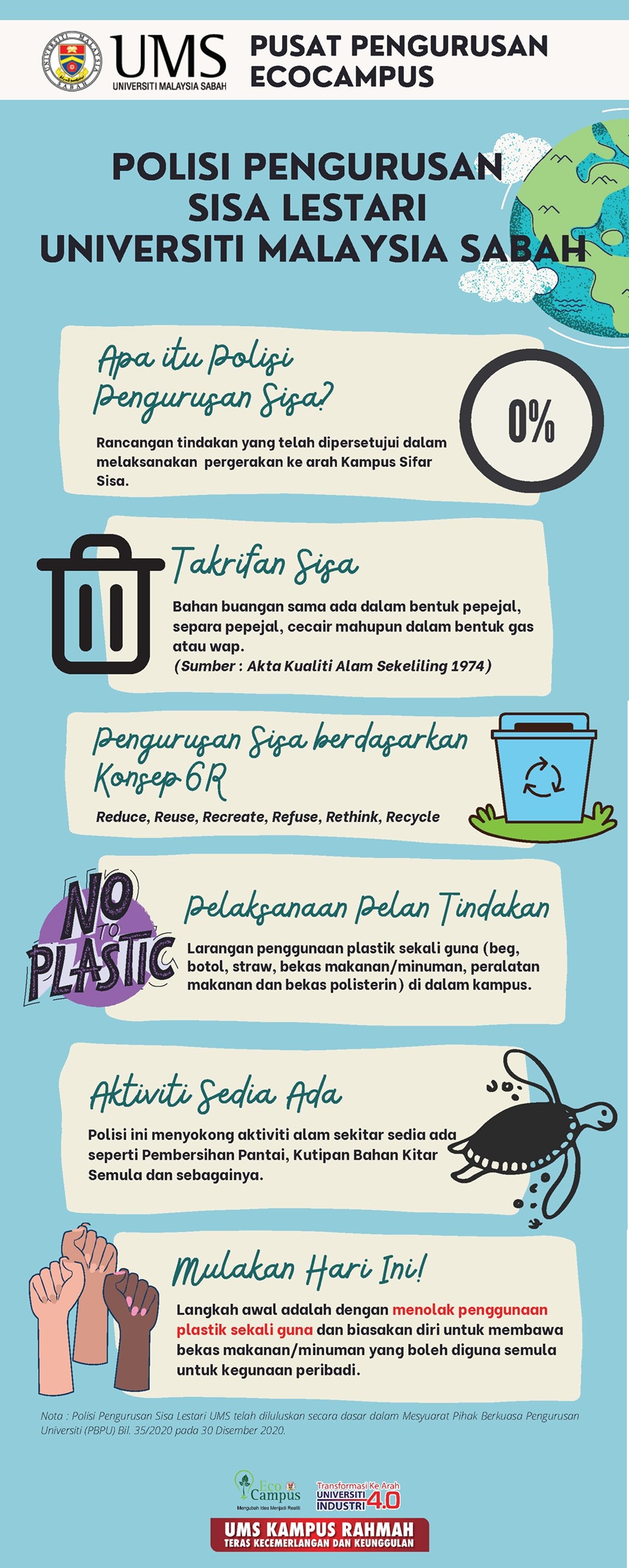
UMS' Sustainable Waste Management Policy
1. Background
The UMS' Sustainable Energy Management Policy is a policy that was established in 2018. It
is a policy to re-enforce UMS' commitment towards the creation of a sustainable environment
and the reduction of greenhouse gases.
-
State of Policy :
1. Enforcement of the Ban on Single-Use Plastics
- a) UMS shall enforce a ban on the use of all single-use plastics such as plastic bags, food containers, drinking straws, food packaging, cups, cutlery, and polystyrene containers across all campus premises.
- b) Reusable or sustainable alternative materials must be used in place of single-use plastics.
- c) Failure to comply with the ban by campus residents, contractors, food suppliers, and cafeteria operators shall result in penalties as determined by UMS.
- d) Visitors who bring single-use plastics into campus areas must carry the items back out when leaving the campus. The responsible party managing entry into campus areas must inform visitors of this policy.
- e) Public awareness and education efforts shall be strengthened regarding the negative impacts of excessive consumption of natural resources and plastic pollution on environmental sustainability.
- f) Reference is made to the Zero Single-Use Plastics Policy and the Public Sector Conducive Ecosystem (EKSA) Guidelines issued by the Ministry of Energy, Science, Technology, Environment and Climate Change (MESTECC).
2. Inorganic Waste (Non-Plastic)
- a) Inorganic waste (excluding plastics) refers to non-biodegradable materials such as metals and synthetic materials.
- b) Clear disposal instructions must be provided according to material type and labelling guidelines.
- c) Inorganic waste (excluding plastics) must be reused and/or recycled where possible.
3. Reduction of Paper Usage
- a) Priority shall be given to digital-based teaching and learning processes over printed materials.
- b) Submission of assignments, projects, and academic documents by students shall be encouraged in softcopy format.
- c) Public awareness and education activities shall be enhanced regarding the negative impacts of excessive use of natural resources.
- d) Reference is made to the Public Sector Conducive Ecosystem (EKSA) Guidelines.
4. Organic Waste
- a) Organic waste refers to biodegradable materials such as food waste, landscape waste, and animal manure.
- b) Food waste bins must be provided by all food suppliers and cafeteria operators within the campus.
- c) Food suppliers and cafeteria operators are responsible for managing and transporting collected food waste to the UMS Composting Facility, where available, or for individual composting. Failure to do so may result in penalties or termination of contracts or agreements with UMS.
- d) Cafeteria operators within UMS are encouraged to adopt the “Green Cafeteria” concept, which aims to reduce food waste generation and utilise food waste for composting or other beneficial uses within their operations.
- e) Cleaning contractors are responsible for transporting landscape organic waste to the UMS Composting Facility, where available, or for individual composting. Failure to comply may result in penalties or termination of contracts or agreements with UMS.
- f) Relevant management departments are also responsible for implementing landscape management practices that reduce the generation of landscape organic waste.
5. Recycling Programme
- a) Ensure the availability of dedicated recycling bins at strategic locations such as UMS Beach, mosques, and cafeterias.
- b) Implement campus-wide recycling programmes that involve staff, students, contractors, food suppliers, and cafeteria operators, including: i) separation of recyclable and non-recyclable waste; ii) separation of recyclable waste that must not be mixed; iii) measures to control and store recyclable materials properly.
- c) JFPIBU, food suppliers, and cafeteria operators must ensure that organic waste (food and landscape waste) and recycling facilities are adequately provided to enable recycling, composting, or individual management where applicable.
- d) JFPIBU, cleaning contractors, food suppliers, and cafeteria operators must ensure that all inorganic waste (excluding electronic waste, scheduled waste, and clinical waste) is properly segregated and recycled. The UMS Monthly Recycling Programme, coordinated by the Centre for Conducive Ecosystem Development (EKSA), is conducted on the last Saturday of every month to provide a platform for the collection of recyclable inorganic waste.
- e) Reference is made to the Public Sector Conducive Ecosystem (EKSA) Guidelines.
6. Chemical / Toxic Waste
- a) Uncontrolled disposal of chemical or toxic waste into the environment is strictly prohibited. Continuous monitoring of laboratory waste disposal practices must be carried out.
- b) Disposal containers for chemical/toxic waste must be provided at all relevant laboratories.
- c) Public awareness and education shall be enhanced to ensure efficient chemical/toxic waste management.
- d) Disposal and management of chemical/toxic waste must follow the procedures established by the relevant laboratories.
- e) Reference is made to the Guidelines for the Management of Chemical Waste by the Instrumentation and Science Services Centre (PIPS), UMS.
7. Sewage / Human Waste
- a) Regular monitoring must be conducted at sewage treatment facilities.
- b) Disposal of wastewater or any construction materials, other than human waste, into toilets is prohibited to prevent damage to the campus sewerage system.
- c) Sewage must be treated to meet acceptable standards in accordance with the Environmental Quality Act 1974 before being discharged or reused.
8. Clinical Waste
- a) Scheduled disposal of clinical waste must be carried out at least once a week.
- b) Clinical waste must be segregated into the following five categories: - Category A: Human body waste such as blood, pus, plaster, gauze, wound dressings, biopsies, and human organs. - Category B: Sharp objects such as needles, syringes, glass, scalpels, and other items that can cause injury. - Category C: Clinical waste generated from laboratories such as pathology, haematology, blood transfusion, microbiology, histology, and forensic practices. - Category D: Pharmaceutical waste such as expired medicines and vaccines. - Category E: Disposable medical equipment such as drip sets and incontinence pads.
- c) Clinical waste must be placed in clinical waste bags and then into biohazard containers, except for Category B and Category C waste.
- d) All sharp objects must be segregated and placed in sharps containers. When containers are nearly full, they must be securely sealed and stored safely before being collected by contractors.
- e) Clinical biological waste must be segregated and placed in biohazard bags. Bags must be securely sealed when nearly full and disposed of in biohazard containers. Biohazard bags must be yellow and used only for high-risk biological waste such as infectious biological materials.
- f) Reference is made to the Guidelines on the Handling and Management of Clinical Wastes in Malaysia, Ministry of Energy, Science, Technology, Environment and Climate Change (MESTECC).
9.Open Burning
- a) Open burning of any waste is strictly prohibited in accordance with the Environmental Quality Act 1974.
More About UMS
Contact UMS
+6088 320000